


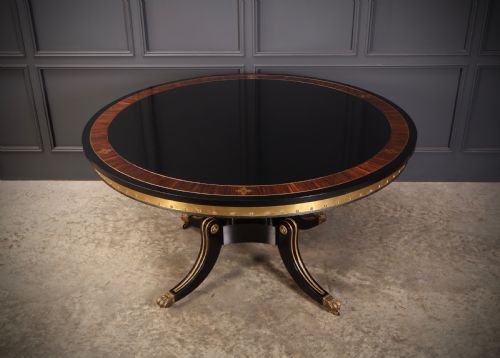


Vintage Circular Foyer Table
A vintage circular foyer table brings architectural presence to an entrance hall, offering a classic round surface that anchors the space.
Vintage Circular Foyer Table
A vintage circular foyer table serves as an impactful focal point in an entrance hall, providing a round surface designed to sit proudly in the centre of a room. These pieces function primarily as centre tables or occasional tables, welcoming guests and holding decorative objects.
The selections available span periods from the nineteenth century through to the 1930s, incorporating Regency, Victorian, and Art Deco movements. Buyers encounter diverse regional influences, including French, Italian, German, and Anglo-Indian designs.
Most examples take the form of round centre tables or smaller occasional tables, often featuring distinct pedestals or four-legged supports beneath circular tops. These tables suit hallways and large vestibules where a round silhouette softens straight architectural lines.
How they were made
Cabinet makers utilised dense hardwoods such as mahogany, walnut, rosewood, and flame birch, frequently applying them as fine veneers over stable secondary woods. Ebonised wood also appears, providing a dark, dramatic contrast against inlaid details.
Surface decoration relies heavily on contrasting timber inlays and brass inlay work to create intricate geometric or floral patterns. Several pieces incorporate heavy marble tops, particularly purple marble, requiring robust internal framing to support the stone weight.
Listings feature woods such as walnut, mahogany, rosewood, and flame birch, alongside marble and brass.
What varies in quality
Quality rests in the choice of timber figure, such as burr walnut or flame birch, and the precision of the inlay work executed by the maker. Superior examples display seamless veneer matching and tightly fitted brass or wood embellishments.
The integrity of the structural joinery beneath the top and the quality of the supporting pedestal dictate the stability of the table. Marble tops require precise stone cutting and secure seating within the wooden rim, separating finely engineered pieces from simpler regional production.
The Vintage Circular Foyer Table Glossary
- Centre table
- A freestanding table designed to be viewed from all sides and placed in the middle of a room rather than against a wall.
- Gueridon
- A small French round table, typically supported by a single central pillar or three legs, often featuring a marble top.
- Tilt-top
- A table mechanism allowing the circular wooden top to pivot vertically for storage or display when not in use.
- Ebonised wood
- Timber treated with a finish to imitate expensive ebony, creating a dense black surface popular in nineteenth-century cabinet making.
- Veneer
- A thin slice of figured wood applied over a structural base timber to provide decorative visual patterns.
Vintage Circular Foyer Table: Frequently Asked Questions
Where should I place a circular foyer table?
These tables belong in the middle of a spacious entrance hall or vestibule where people can walk around the entire circumference. They create an immediate visual anchor when entering a home.
Positioning the table centrally allows it to hold a central floral arrangement or sculptural object while keeping traffic flow balanced in all directions.
Can these tables hold heavy items?
Many period examples feature solid marble tops that naturally support substantial decorative objects, heavy vases, or large lamps without strain.
Wooden versions utilise sturdy internal framing and thick pedestals designed to bear daily weight, though consideration should be given to the delicate nature of antique veneers.
How do I identify a Regency table?
Regency pieces often display classical architectural proportions, drawing inspiration from ancient Greek and Roman design motifs popular during the early nineteenth century.
Look for dark timbers like mahogany or rosewood, sometimes accented with contrasting brass inlay or bold central pedestals resting on platform bases.
What is an Art Deco foyer table?
Art Deco pieces from the 1920s and 1930s embrace sleek geometric lines, streamlined silhouettes, and striking wood grains such as birch or walnut.
These tables move away from heavy nineteenth-century ornamentation in favour of minimalist curves and smooth, polished surfaces that highlight the natural timber.