




Upholstered Low Salon Chair
An upholstered low salon chair offers low-slung seating designed for comfort and parlor use, spanning Victorian and Edwardian periods.
Upholstered Low Salon Chair
An upholstered low salon chair brings compact, low-slung seating to a room, drawing primarily from Victorian and Edwardian periods. These pieces appear in forms such as nursing chairs, music chairs, and fireside chairs, designed originally for domestic parlors and bedrooms.
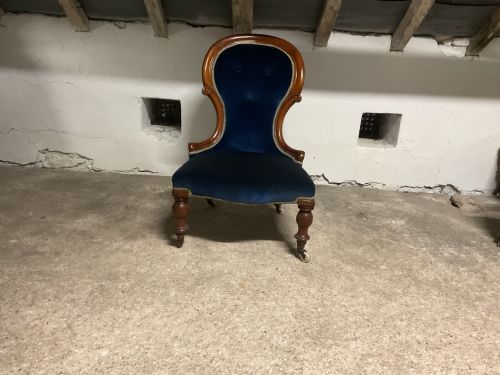
The version most commonly met on this page is the Victorian or Edwardian walnut or mahogany nursing chair, often featuring a low seat and a button back. Examples span from mid-nineteenth century pieces to early twentieth century designs, incorporating styles from Rococo Revival to Art Nouveau.
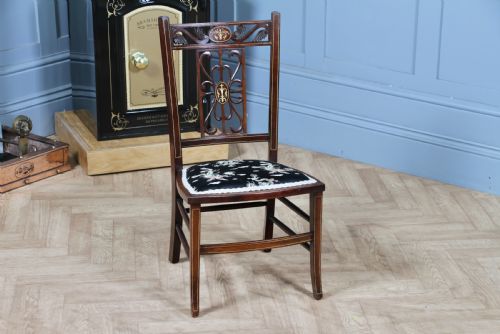
Makers and designers of the period created these low chairs to sit comfortably by a hearth or in a salon setting, using woods like rosewood and mahogany alongside painted finishes. The selection ranges from carved walnut frames to inlaid mahogany structures.
How they were made
Makers built the frames of these chairs using timbers such as mahogany, walnut, and rosewood, frequently shaping the wood through carving or turning. Structural support often relied on cabriole legs or slender uprights, sometimes enhanced with brass components or ceramic castors.
Upholstery techniques involved padding the seat and back over a sprung or webbed foundation, finished with fabrics including velvet, silk, and general textiles. Button-backed upholstery required deep securing tufts to shape the stuffing firmly within the frame.
Listings feature woods spanning mahogany, walnut, and rosewood alongside painted and silver-gilt finishes.
What varies in quality
The calibre of timber carving and the crispness of detail on the exposed wood frame set finer examples apart from standard workshop output. Deeply moulded walnut or intricately inlaid mahogany indicates a higher standard of cabinet-making.
The execution of the upholstery work, from the symmetry of buttoning to the selection of covering fabric, influences the overall character of the piece. Substantial frame construction and retained rigidity in the joints denote superior craftsmanship.
Howard and Sons
The Upholstered Low Salon Chair Glossary
- Button back
- An upholstery style where depressions are formed in the padding by pulling buttons or tufts tight through to the frame. This technique creates a cushioned, diamond-patterned surface common on Victorian seating.
- Balloon back
- A chair back shaped like a continuous, closed oval or curve resembling a balloon. It is a defining characteristic of many Victorian mahogany and walnut parlor chairs.
- Inlay
- A decorative technique where contrasting pieces of wood, metal, or shell are fitted into depressions within a solid wood surface. Edwardian makers often applied this to mahogany salon furniture.
- Fireside chair
- A low-seated armchair designed to sit near a hearth for warmth and comfort. These pieces usually feature upholstered backs and low frames to capture heat close to the floor.
Upholstered Low Salon Chair: Frequently Asked Questions
What is an upholstered low salon chair used for?
These low chairs served historically in parlors, bedrooms, and drawing rooms as comfortable seating for nursing, music-making, or fireside relaxation.
Their compact proportions allowed them to sit easily in intimate spaces without obstructing views or taking up excessive room.
How do I tell a Victorian chair from an Edwardian one?
Victorian examples frequently employ heavier timbers like walnut and mahogany, often featuring deep carving, balloon backs, or button upholstery.
Edwardian pieces tend to show lighter construction, sometimes incorporating satinwood or mahogany with delicate inlaid details and painted finishes.
Are these chairs suitable for daily use?
Many of these chairs remain structurally sound for everyday seating, provided the underlying frame and joints are stable.
Depending on the age of the piece, updating the internal webbing and upholstery fabric may be necessary to support regular modern use.
What woods were used for these frames?
Makers constructed these chair frames primarily using hardwoods such as mahogany, walnut, and rosewood. Some regional or later pieces also utilised painted wood or softer timbers finished with silver gilt.