

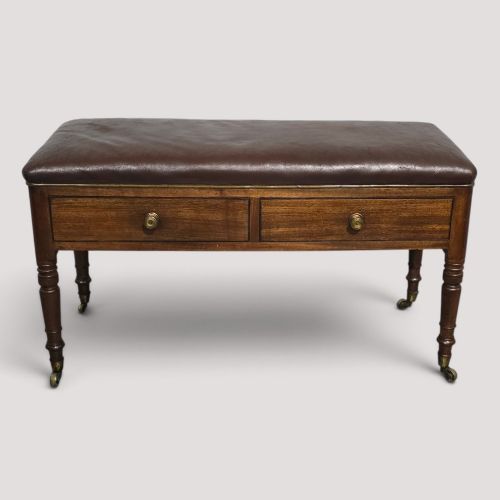
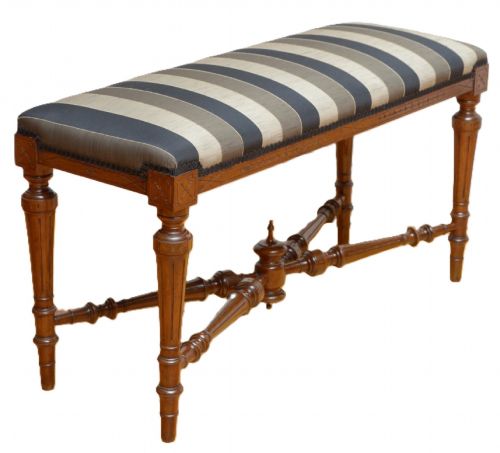


Upholstered Duet Bench
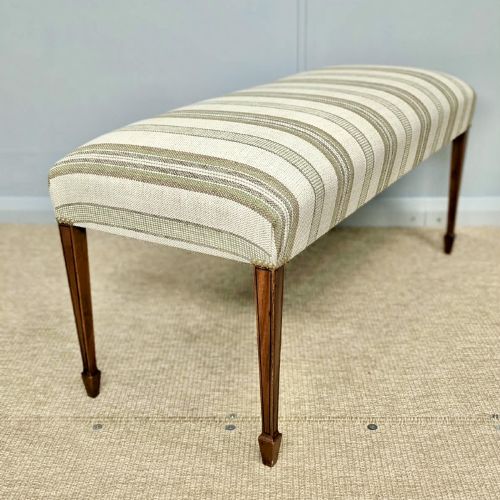
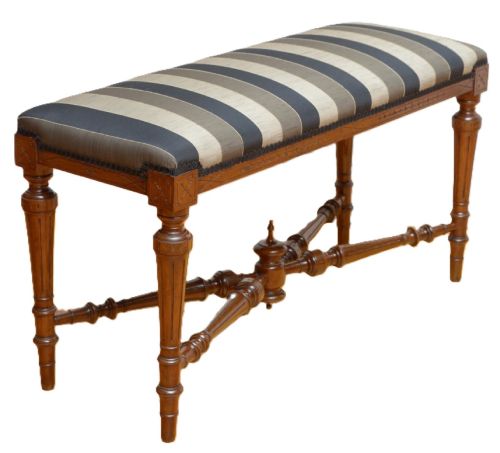
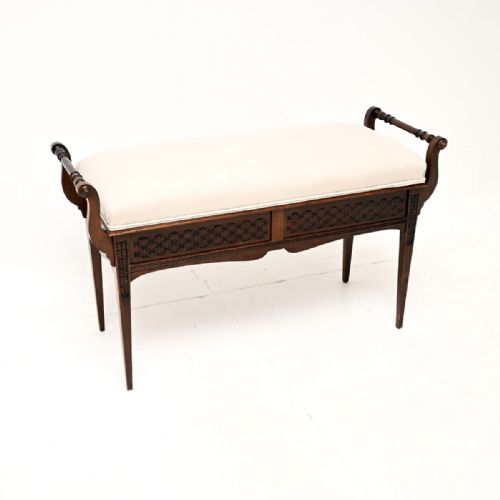
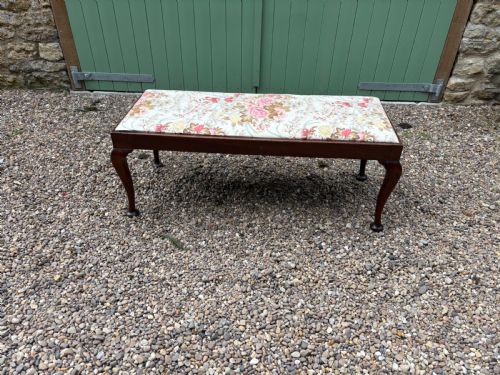
An upholstered duet bench provides double seating for the piano or window, combining functional proportions with period timber frames and textile covers.
Upholstered Duet Bench
When you search for an upholstered duet bench, you encounter long seats designed to accommodate two players at a keyboard or to sit beneath a wide window. The listings here present forms stretching from the Georgian and Regency eras through the Victorian and Edwardian periods up to Art Deco pieces.
Mahogany and walnut form the primary wooden frames across these centuries, frequently carrying inlay or carving associated with George III, Queen Anne Revival, and Louis XVI styles. You will find piano stools with hinged seats revealing music storage alongside standalone window seats and benches.
Edwardian and late nineteenth-century examples dominate the selection, often rendered in mahogany with modest inlay. Alongside these sit French gilt pieces and earlier nineteenth-century forms that prioritise heavy timber and turned supports.
Materials and Construction
Makers constructed these frames predominantly from solid mahogany and walnut, shaping the timber into turned legs, cabriole supports, or straight frames with brass mounts. Selected pieces incorporate delicate stringing and marquetry inlay into the wooden rails.
The seating sections utilise traditional upholstery techniques over a rigid base, finished in fabrics ranging from patterned textiles and leather to velvet and tapestry. Hinged mechanisms on music stools rely on durable metal hinges to secure the compartment beneath.
Upholstered Duet Bench Retail Price Guide 2026
Typical asking prices for upholstered duet bench among the pieces listed under this phrase on Sellingantiques today, from the lower quarter to the upper quarter. They describe what is for sale here now, not the wider market.
Listings feature mahogany and walnut frames spanning from the Georgian period to the Art Deco era, incorporating fabric, leather, and velvet upholstery.
Assessing Craftsmanship and Materials
The distinction between standard production and superior work rests on the selection of timber and the precision of the joinery. Dense, finely figured mahogany or walnut frames with crisp carving and secure structural joints represent higher execution.
Secondary quality factors involve the execution of inlay work and the integrity of the internal storage mechanisms on piano stools. Heavy, stable frames without structural movement indicate careful initial construction.
James Shoolbred
The Upholstered Duet Bench Glossary
- Duet stool
- A long seat designed to hold two people simultaneously, commonly placed before a piano or in front of a window. These pieces provide extended seating compared to standard single piano stools.
- Hinged seat
- A top lid attached with metal hardware that lifts to reveal an internal compartment. This cavity typically stores sheet music or small accessories.
- Inlay
- A decorative technique where contrasting pieces of wood or brass are inserted into recesses within the primary timber surface. This creates flat patterns along the rails or legs.
- Cabriole leg
- A furniture support that curves outward in an arc and tapers inward toward a pad or claw foot. This form draws inspiration from classical and revival furniture designs.
- Gilt
- A thin layer of gold leaf applied to the surface of a wooden frame. This finish appears frequently on pieces influenced by French decorative styles.
Upholstered Duet Bench: Frequently Asked Questions
What is a duet bench used for?
A duet bench provides extended seating for two individuals sharing a piano keyboard or sitting by a wide window. The longer proportions allow side-by-side placement.
Certain variants include internal storage compartments beneath the seat for keeping sheet music organised.
How do I identify an Edwardian duet stool?
Edwardian examples generally feature lighter mahogany frames, often accented with subtle stringing or inlaid decoration. The legs tend to be straight or gently tapered.
These pieces frequently date around nineteen hundred and reflect the domestic revival styles of the period.
Are these benches suitable for daily use?
Solid mahogany and walnut frames provide the structural stability required for regular seating in a modern living space. The upholstered tops can support daily occupation.
Placing the bench away from direct heat sources helps preserve the condition of both the wood and the fabric.
What is the difference between a window seat and a piano stool?
Piano stools often incorporate a hinged lid and an internal well specifically designed for holding bound music scores. Window seats typically feature fixed upholstered tops.
Both share the extended length characteristic of duet furniture but serve different functional roles within a room.