





Two Tier Oval Table
A two tier oval table provides useful surface space across multiple levels, combining practical display with elegant proportions.
Two Tier Oval Table
A two tier oval table offers double the surface area of a standard single-surface piece while maintaining a compact floor footprint. These items appear primarily in Edwardian and nineteenth-century forms, alongside later Art Deco iterations.
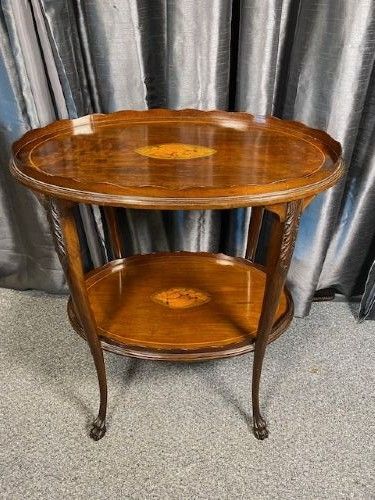
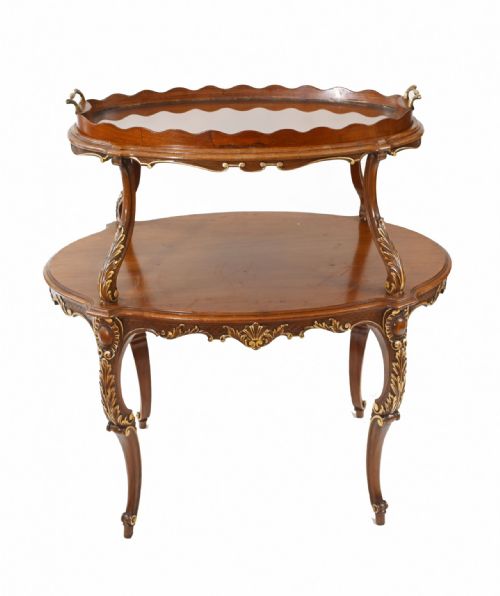
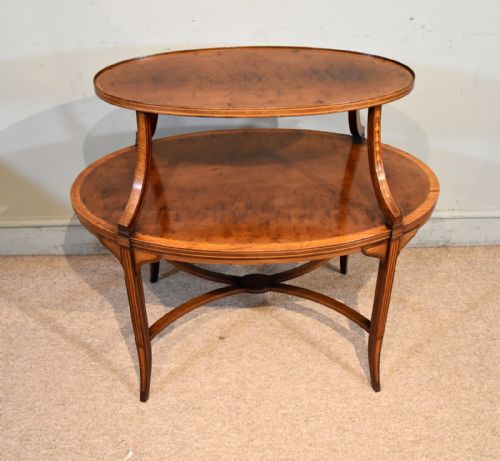
The most common version on this page is the Edwardian mahogany occasional table, frequently featuring satinwood inlay and a secondary lower shelf supported by slender legs. Other forms include etageres, serving tables, and occasional stands originating from English, French, and Italian workshops.
Materials and construction methods
Cabinetmakers utilised mahogany, walnut, and satinwood as primary timber foundations, often embellishing the surfaces with intricate marquetry and contrasting wood inlays. Structural elements frequently incorporated brass accents, glass, and occasional bone or ebony details.
Joinery techniques relied on stable framing to support the dual tiers without excess bulk. Lower shelves connect securely between the legs to maintain rigidity while preserving the graceful curved profile of the oval top.
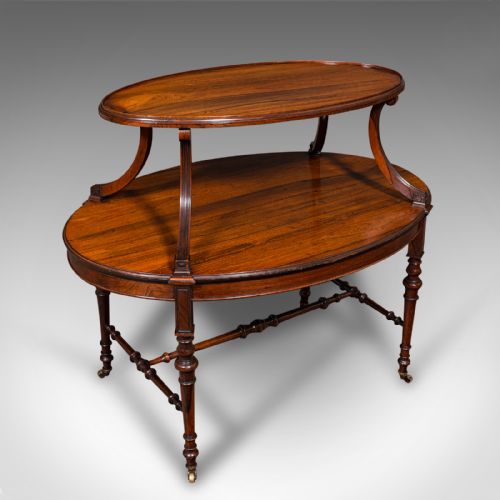
Forms on this page range from classical Edwardian occasional tables and French etageres to Art Deco lamp stands.
Distinguishing quality across examples
Quality depends heavily on the crispness of the inlay work and the selection of figured timber veneers. Finer pieces demonstrate precise marquetry and harmonious grain matching across both upper and lower tiers.
The integration of the secondary tier dictates structural success, where sturdier joints and balanced proportions elevate a piece from a simple utility stand to a refined reception room furnishing.
The Two Tier Oval Table Glossary
- Etagere
- A set of open shelves or tiers designed for displaying small objects or serving. These pieces often feature an oval top and delicate vertical supports.
- Marquetry
- Decorative veneer work arranged in pictorial or geometric patterns using various coloured woods. Craftsmen applied this technique to tabletop surfaces and borders.
- Satinwood
- A durable, hard timber with a natural golden lustre and satin-like sheen. It is frequently employed for contrasting stringing and banding on dark mahogany furniture.
- Dumbwaiter
- A multi-tiered freestanding piece historically used for holding dishes or serving items without the aid of servants. Oval variants provide tiered shelving in a compact format.
- Sheraton Revival
- A late nineteenth and early twentieth-century design movement inspired by late eighteenth-century neoclassical furniture. Pieces in this style emphasise lightness, tapering legs, and delicate inlay.
Two Tier Oval Table: Frequently Asked Questions
What is a two tier oval table used for?
These pieces serve as versatile side or occasional surfaces in living spaces and reception rooms. The lower shelf offers additional room for books, decorative items, or small collections.
Their narrow oval footprint allows them to fit beside seating or against walls where rectangular units might prove too cumbersome.
How do I date an Edwardian two tier table?
Edwardian examples typically date from around 1900 to 1910 and often feature light mahogany construction with satinwood inlay. Look for characteristic stylistic traits such as tapered spade feet and delicate stringing.
Comparing the timber finish and hardware against known period production helps narrow down the decade of manufacture.
Are these tables sturdy enough for daily use?
Most variants are built with solid framing and fixed lower tiers designed to support everyday objects like lamps and decorative bowls. The structural integrity depends on the tightness of the leg joints and the thickness of the shelves.
Placing them on level flooring prevents undue strain on the slender vertical supports characteristic of etageres.
What is the difference between an etagere and an occasional table?
An etagere specifically emphasises multiple open tiers intended primarily for display and decorative arrangement. Occasional tables focus more on a primary surface with a secondary shelf added for convenience.
Both forms utilise oval tops in this selection, though etageres lean towards lighter, more decorative framing.