
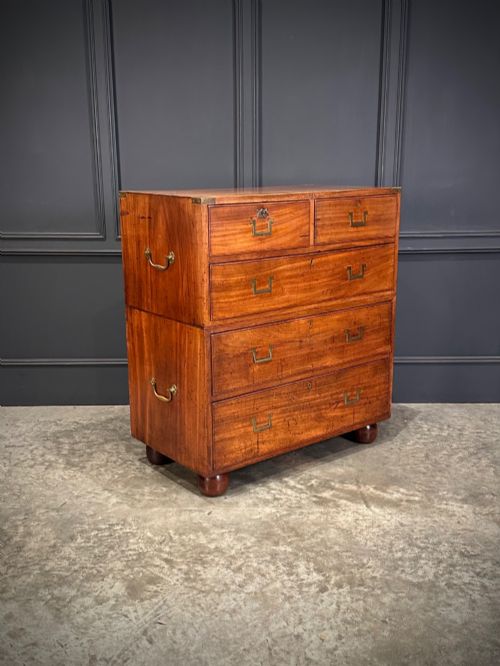
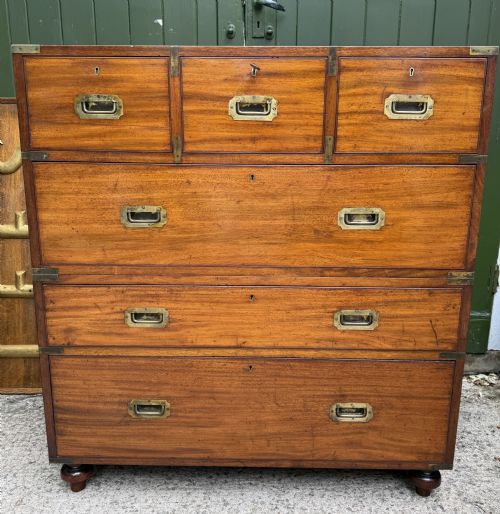

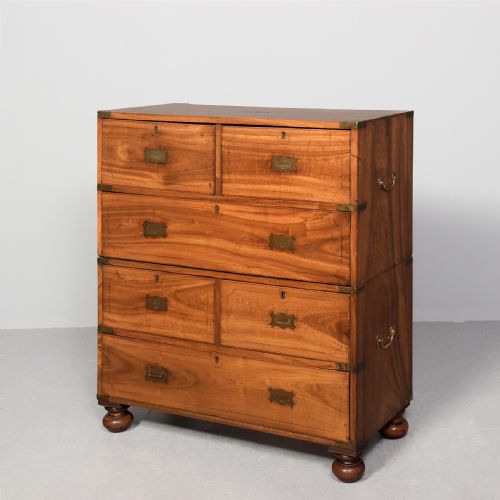
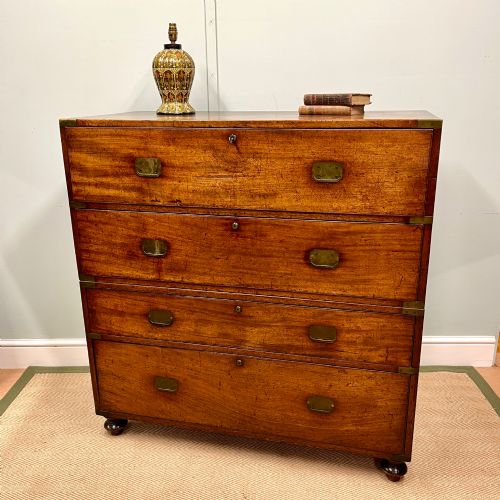




Two Part Military Chest
A two part military chest is a sectional travelling cabinet built for officers on active service, prized today for its robust modularity and clever storage.
Two Part Military Chest
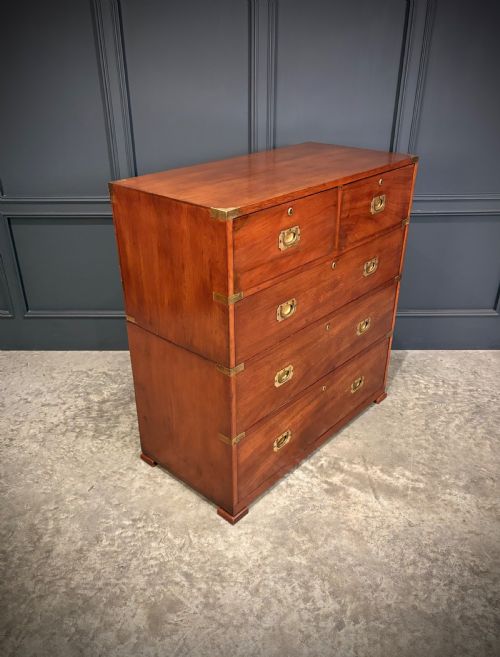
A two part military chest splits into separate modular sections designed for ease of transport during nineteenth-century campaigns. The version most common on this page is the Victorian mahogany or teak chest of drawers, often fitted with recessed brass handles and corner brackets.
Examples range from Georgian pieces through the Victorian era, taking forms such as standard drawer chests, secretaire bureaus, and cabinets. Woods span mahogany, teak, camphor wood, oak, walnut, and padouk, reflecting British military movements across the globe.
Materials and Construction
Construction relies on dense timbers like mahogany, teak, and solid camphor wood selected to withstand tropical climates and rough transit. Brass corners, binding, and flush-fitting pull handles protect vulnerable edges and prevent snagging during travel.
Each box section incorporates iron or brass carrying brackets mounted to the sides. The two halves lock together securely using internal pins, bolts, or brass strap mounts.
Two Part Military Chest Retail Price Guide 2026
Typical asking prices for two part military chest among the pieces listed under this phrase on Sellingantiques today, from the lower quarter to the upper quarter. They describe what is for sale here now, not the wider market.
Listings feature woods spanning mahogany, teak, camphor wood, oak, walnut, padouk, and rosewood across the Georgian and Victorian periods.
Standard and Execution
Quality rests on the integrity of the timber selection and the precision of the brass hardware fittings. Finely made pieces show tight dovetail joints, smooth-running drawer divisions, and well-fitted secretaire drawers with original leather writing surfaces.
Maker attribution elevates a piece significantly, with workshop names such as Ross and Co. or Army and Navy representing the upper tier of campaign furniture manufacture. The crispness of the brass recessed mounts and the thickness of the solid secondary woods further separate standard workshop output from superior commissions.
Ross & Co.·Army & Navy
The Two Part Military Chest Glossary
- Campaign chest
- A sectional piece of furniture built to dismantle into two or more parts for military transport. These items utilise flush brass hardware to avoid catching on luggage straps.
- Secretaire chest
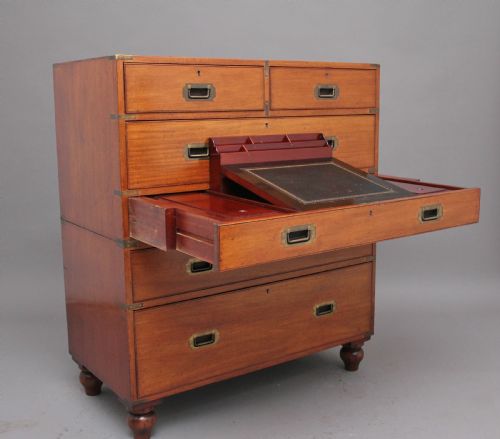
- A cabinet containing a pull-out desk drawer fitted with pigeonholes and small drawers for correspondence. This form combines a standard chest of drawers with a writing surface.
- Recessed handle
- A drawer pull set into a sunken brass dish so that the exterior remains entirely flat. This design stops handles from shearing off when chests are stacked or moved.
- Camphor wood
- An aromatic timber frequently utilised for campaign furniture produced in Anglo-Chinese workshops. The wood naturally deters insects and provides a distinctive scent.
- Brass binding
- Flat metal strips screwed around the corners and edges of chest sections to reinforce the wood against heavy impact. This feature defines the visual aesthetic of military furniture.
Two Part Military Chest: Frequently Asked Questions
How do the two sections separate?
Each chest comprises an upper and a lower box module that lift apart once securing hooks or internal screws are released.
Heavy side brackets allow handlers to hoist each half independently during transit.
What is a secretaire drawer?
The top drawer pulls open and folds down to reveal a fitted writing desk complete with small pigeonholes and compartments.
This concealed workspace allowed officers to write dispatches in the field without needing a separate table.
Why use camphor wood?
Camphor wood offers natural insect-repellent properties alongside high dimensional stability in humid climates.
Colonial workshops favored this dense timber for protecting uniforms and papers from pests.
Are all these chests British?
While many originated in Britain for domestic or overseas service, others were made by Anglo-Chinese and Anglo-Indian cabinetmakers.
Local colonial workshops utilised regional timbers like teak and rosewood while adhering to British military specifications.