
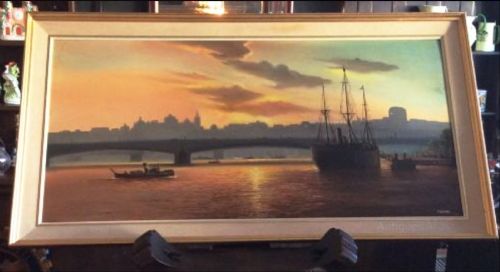


Twentieth Century Marine Artwork
Twentieth century marine artwork captures the movement of coastal tides and the grit of seafaring life through the eyes of British and European painters.
Twentieth Century Marine Artwork
Twentieth century marine artwork encompasses paintings and watercolours depicting coastal scenes, harbours, and naval subjects from across the decades. Buyers exploring this category encounter depictions of Cornish fishing ports, London Thames views, and dramatic sea battles rendered in distinct regional styles.
The selections available range from Edwardian watercolours to mid-century oil paintings on canvas and board. Works associated with the Newlyn School and British Impressionism frequently appear alongside depictions of specific vessels and coastal harbours.
Coastal villages such as St Ives, Mousehole, and Whitby provide recurring motifs across these painted scenes. Works span several decades of artistic interpretation, reflecting shifting approaches to light, water, and maritime topography.
Materials and methods
Artists working in this category applied oil paint or watercolour to canvas, paper, or wooden boards. Pigments were brushed, layered, or worked with palette knives to capture the shifting textures of sea and sky.
Many surviving examples retain their original wood frames, which complement the tonal palette of the maritime scene within. Watercolour works on paper are typically protected behind glass to preserve the delicate pigment layers.
Listings feature works executed on paper, canvas, and wood, utilising both oil paint and watercolour across multiple decades.
Qualities of execution
Quality in these maritime pieces rests upon the surety of the brushwork and the artist's command of atmospheric light. Stronger examples convey the weight of water and the openness of coastal air with economy and precision.
The structural integrity of the support, whether canvas, panel, or paper, contributes significantly to the standing of a piece. Works that demonstrate a confident handling of perspective and maritime detail command greater attention.
Clifford Hanney·Vincenzo D’Esposito·Robert Leslie Howey·Frank H. Mason·Ernest F. Hill·William Lambert Bell·Frank Wood·Owen Bowen·Edmund Gouldsmith·Paul-Louis Barruel·Maurice Sijs·Rowland Henry Hill
The Twentieth Century Marine Artwork Glossary
- Marine art
- Painting or drawing whose primary subject is the sea, ships, or coastal views. This genre includes depictions of naval engagements, working harbours, and quiet shorelines.
- Watercolour
- A painting method in which the paints are made of pigments suspended in a water-soluble vehicle. It is frequently applied to paper to achieve translucent washes of light and colour.
- Oil painting
- The process of painting with pigments that are bound with a medium of drying oil. This medium allows for rich colour depth and a textured application upon canvas or wood.
- Impressionism
- An art movement characterised by relatively small, thin, yet visible brush strokes and an emphasis on accurate depiction of light. British practitioners applied these principles to coastal and rural subjects.
- Newlyn School
- An art colony based in Cornwall during the late nineteenth and twentieth decades. Artists associated with this group painted en plein air, capturing local fishermen and coastal scenes.
Twentieth Century Marine Artwork: Frequently Asked Questions
What subjects appear in twentieth century marine art?
These works frequently depict coastal harbours, fishing boats at rest, and sweeping panoramic views of rivers such as the Thames. Naval vessels and rugged shoreline cliffs also recur across the selection.
Artists drew inspiration from specific locations including Cornish fishing villages, Yorkshire ports, and French coastal towns.
How should I care for a watercolour painting?
Watercolours on paper require protection from direct sunlight to prevent the fading of delicate pigments. Keeping them behind glass in a stable environment avoids moisture damage.
Ensure the framing allows the paper room to breathe without direct contact with the glass surface.
What is the difference between oil and watercolour marine works?
Oils offer a heavy, textured surface that captures the turbulent motion of deep water and stormy seas. Watercolours provide a lighter, luminous quality suited to quiet estuaries and coastal mists.
Both mediums were utilised extensively throughout the decades to interpret maritime subjects.
Are these paintings supplied with frames?
Many examples are mounted in period wood frames that complement the era of their creation. These surrounds often show the character of their age.
Buyers should examine specific listings to confirm whether a piece retains its original framing.