


Turned Wood Candle Holders
Turned wood candle holders are tactile domestic objects shaped on a lathe, prized for their grain and warm utility.
Turned Wood Candle Holders
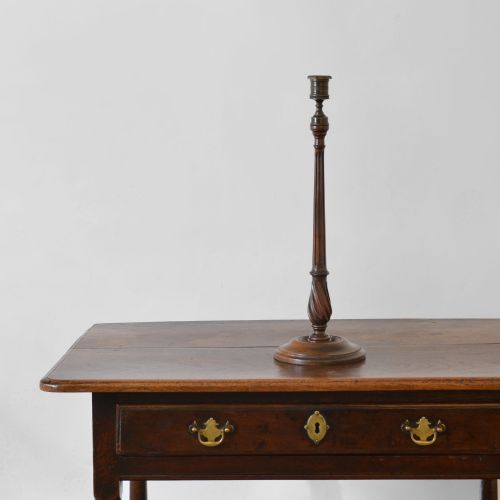
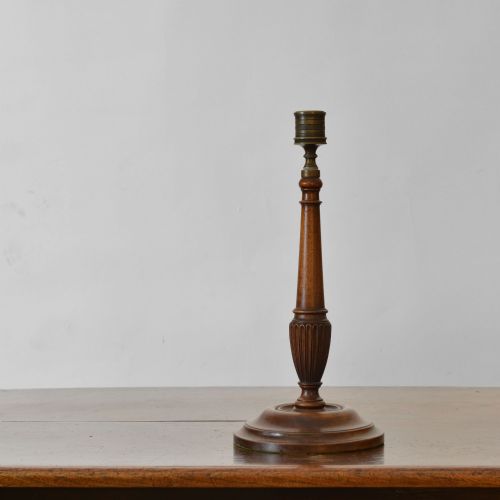
Turned wood candle holders encompass candlesticks, chamber sticks, torchere stands, and spill holders designed to secure candles safely on furniture. When you search for turned wood candle holders, you encounter items spanning the eighteenth century through the early twentieth century, including Georgian and Victorian examples.
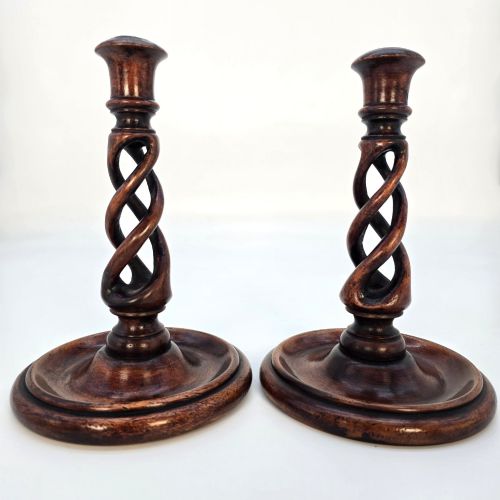
The selections on this page lean heavily toward pairs fashioned from timber such as mahogany, oak, fruitwood, walnut, and olive wood. Formats range from modest taper holders to tall barley twist designs and travelling pocket pieces.
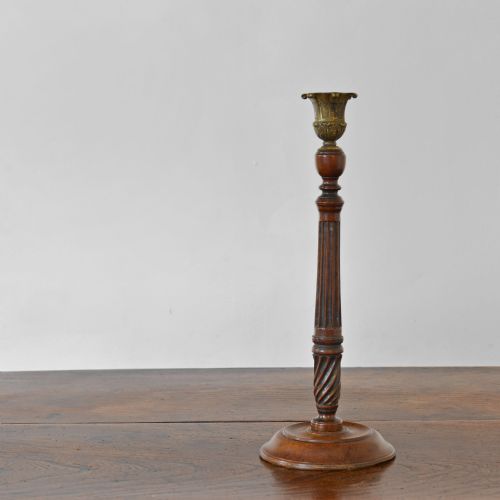
Origins stretch from English workshops to continental traditions, occasionally incorporating brass sockets or gilt leaf accents alongside the carved turned bodies.
How they were made
Maker operations utilised a lathe to shape timber blanks into cylindrical and symmetrical profiles, employing open twists, bobbin turning, or spiral carving techniques. Woods like lignum vitae, teak, and fruitwood were selected for their density and grain movement during the turning process.
Many examples integrate metal components, pairing turned wooden stems with cast brass nozzles, drip pans, or weighted bases for stability. Certain pieces utilise surface treatments such as gold leaf applied to carved pinewood or polished finishes that accentuate the natural colour of the timber.
Materials recorded across the inventory include oak, mahogany, walnut, fruitwood, pinewood, olive wood, teak, lignum vitae, brass, and gold leaf.
What varies in quality
The standard of a turned wood candle holder rests upon the crispness of the lathe work and the selection of the timber. Finely executed open twists and uniform bobbin turnings demonstrate superior craftsmanship compared to heavier, bulkier profiles.
Proportion and material integrity dictate the distinction between pieces. The integration of quality brass sconces, well-matched timber pairs, and intact original surfaces elevate certain examples above standard utilitarian production.
The Turned Wood Candle Holders Glossary
- Treen
- Small handmade wooden domestic objects. This term covers everyday items shaped on a lathe, from tableware to small candle stands.
- Torchere
- A tall decorative stand or candlestick. These elevated supports lift the light source higher in the room.
- Spill holder
- A small container for storing taper splints. They sit on mantelpieces to transfer fire from hearth to candle.
- Brighton bun
- A small pocket travelling candlestick. These compact turned wood containers unscrew to hold candles safely during journeys.
- Barley twist
- A helical carved timber column. The turning creates a rope-like spiral winding up the stem of the candlestick.
Turned Wood Candle Holders: Frequently Asked Questions
What woods were used for these candle holders?
Makers utilised a variety of native and exotic timbers depending on availability and the desired appearance. Common materials include dense hardwoods like mahogany, walnut, oak, and fruitwood.
More specialised pieces incorporate olive wood, teak, or heavy lignum vitae, occasionally contrasted with brass or gold leaf.
How do I date a turned wooden candlestick?
Dating relies upon observing the turning style, timber species, and any accompanying metal hardware. Georgian and eighteenth-century examples often display simpler proportions or hand-carved open twists.
Later Victorian and early twentieth-century pieces frequently adopt heavier barley twists, combined brass drip pans, or distinct machine-turned precision.
Were these holders made in pairs?
Many surviving turned wood candle holders were produced as symmetrical pairs to adorn mantelpieces, sideboards, or dining tables. Matching pairs are particularly common among nineteenth-century oak and mahogany examples.
Single holders also appear, often originating as chamber sticks or specific spill containers rather than decorative garnitures.