
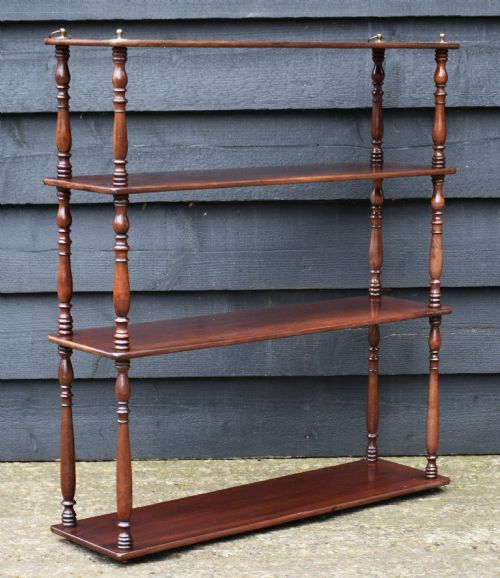
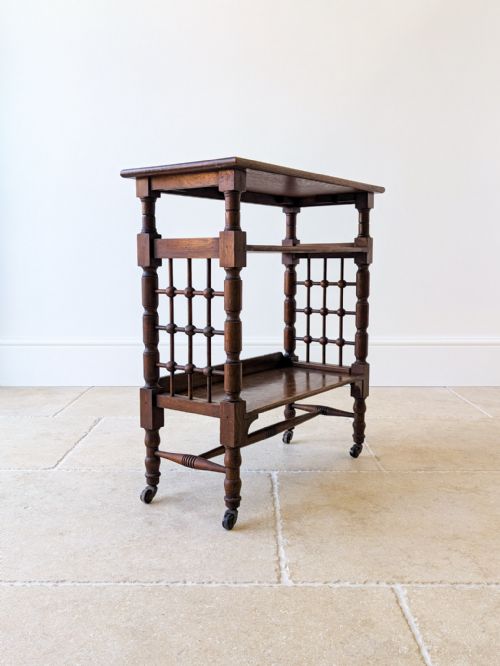
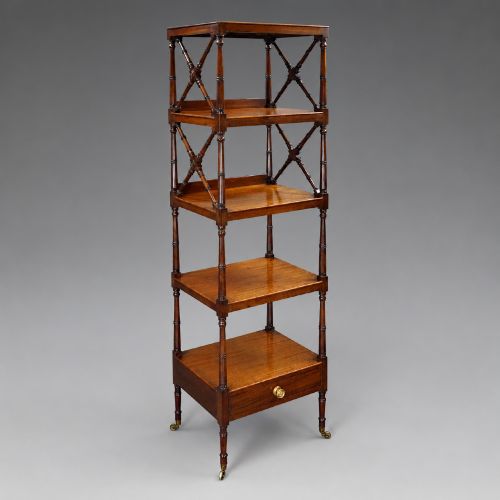
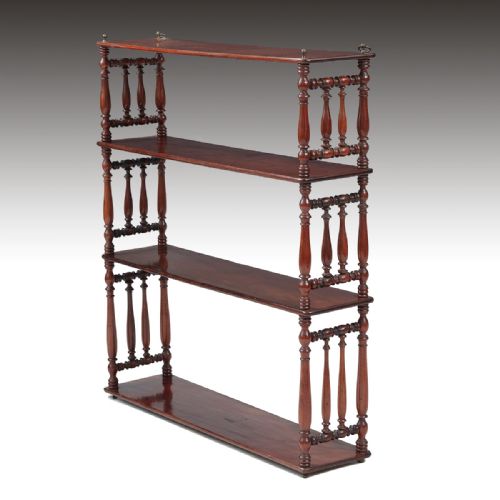
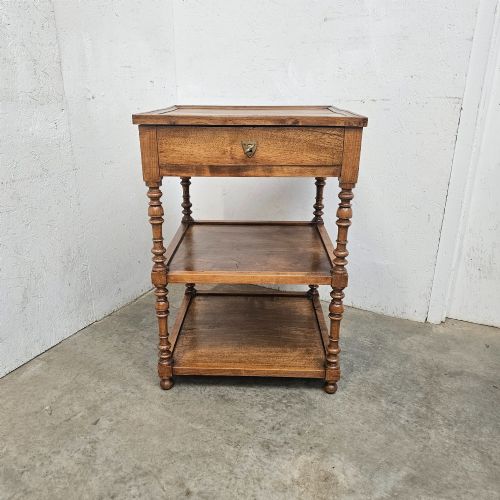


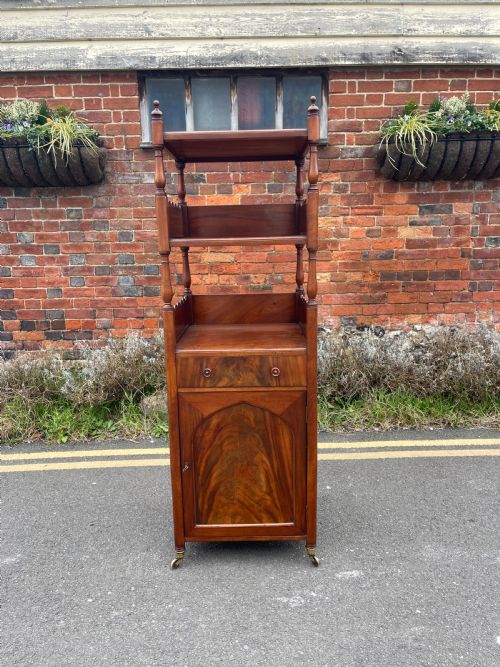


Turned Spindle Tier Shelf
A turned spindle tier shelf brings layered display space to a room, uniting functional storage with classic tiered design.
Turned Spindle Tier Shelf
When searching for a turned spindle tier shelf, a buyer is looking at multi-tiered display furniture encompassing wall shelves, whatnots, and etageres. These pieces provide open platforms supported by vertical turned components, historically utilised for books, ceramics, and ornaments.
The versions most likely to be met on this page span the Georgian, Regency, William IV, and Victorian periods, alongside later nineteenth century examples. Materials range from mahogany and walnut to cherry wood, satin birch, rosewood, and ebonised wood, sometimes incorporating brass elements.
Forms vary from hanging wall units to freestanding pieces, including designs with cupboard bases, serpentine fronts, and cellarettes. Regional influences represented include English country house and French provincial styles.
How they were made
Cabinetmakers utilised dense hardwoods such as mahogany, walnut, rosewood, and cherry wood to construct the structural uprights and shelves. Turning lathes shaped the characteristic spindle supports that divide each tier.
Finishing techniques highlighted the natural grain of timbers like satin birch and walnut, while ebonised wood provided a dark, uniform surface. Brass details were occasionally integrated for hanging hardware or decorative accents.
What varies in quality
The grade of timber selection and the precision of the turning work define the standard of a piece. Finer examples display crisply turned spindles and carefully matched wood veneers on the shelf surfaces.
Structural complexity also distinguishes the tier shelves, moving from simple hanging boards to elaborate freestanding whatnots featuring serpentine fronts, integrated cupboards, or cellarettes.
The Turned Spindle Tier Shelf Glossary
- Whatnot
- A piece of furniture consisting of multiple open shelves for displaying small objects. They appeared in various heights and were used in drawing rooms and parlours.
- Etagere
- A set of open shelves for displaying ornaments, originating in France. These pieces often feature delicate supports and multiple tiers.
- Spindle
- A round, slender turned piece of wood forming the vertical supports between shelves. Turning creates decorative profiles along the length.
- Cellarette
- A compartment or drawer incorporated into the lower section of a cabinet or whatnot for storing bottles. This addition appeared in larger nineteenth century examples.
- Serpentine front
- A shelf edge curved in a convex-concave-convex shape. This profile requires skilled woodworking to execute cleanly across multiple tiers.
Turned Spindle Tier Shelf: Frequently Asked Questions
What is a turned spindle tier shelf?
A turned spindle tier shelf is a multi-level display unit featuring vertical turned wooden supports between each platform. These pieces function as wall-hanging units or freestanding whatnots designed to hold books and decorative items.
They appear in various period styles using timbers like mahogany, walnut, and rosewood.
Where were these shelves used?
These shelves were traditionally placed in drawing rooms, parlours, and studies of country houses and town residences. They provided accessible display space for ceramics, ornaments, and reading material.
Freestanding versions stood against walls, while hanging variants utilised wall space above tables or seating.
How do I date a tier shelf?
Dating relies on timber selection, construction methods, and stylistic details associated with periods like the Georgian, Regency, and Victorian eras. Mahogany and rosewood dominate earlier pieces, whilst walnut and satin birch appear frequently across the nineteenth century.
Form also guides attribution, such as the serpentine fronts of Victorian examples or simpler George III designs.
Are these shelves sturdy?
Construction quality depends on the joinery connecting the shelves to the turned spindle supports. Freestanding whatnots offer robust platforms, while hanging shelves require secure wall fixings to bear the weight of displayed objects.
Timbers like mahogany and walnut provide inherent strength for multi-tiered structures.