



Turned Spindle Magazine Holder
These turned spindle magazine holder pieces are refined nineteenth-century and Regency furnishings that bring classical woodcraft and practical storage into a room.
Turned Spindle Magazine Holder
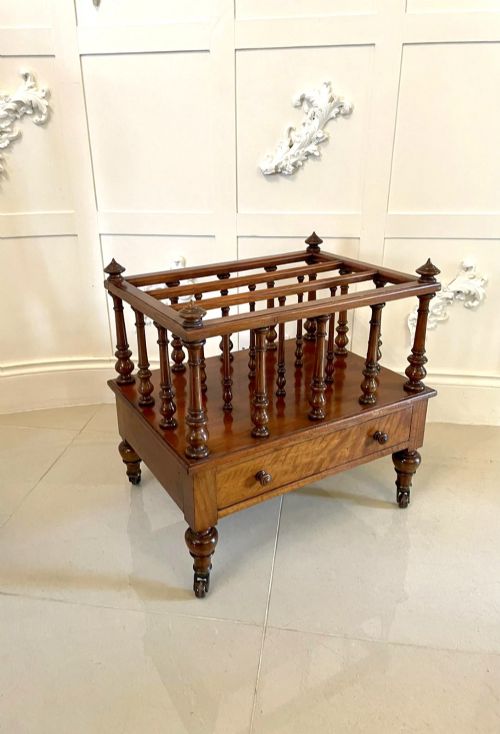
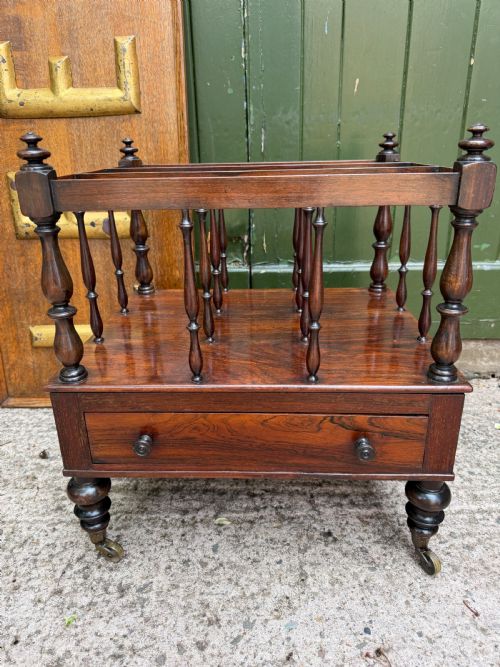
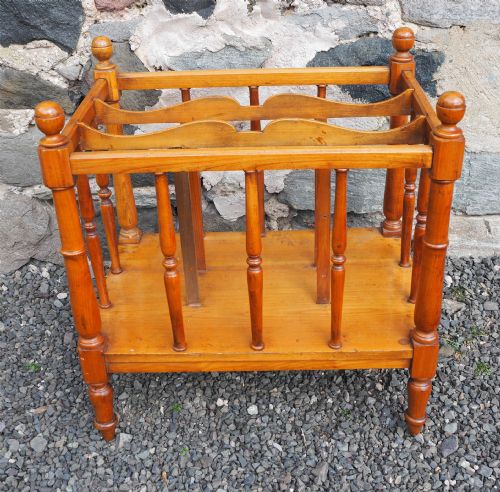
When you search for a turned spindle magazine holder, you are looking at nineteenth-century and Regency furnishings that typically take the form of canuterburys, magazine racks, and music stands. These pieces are designed with upright turned wooden spindles that form the divisions for holding periodicals, sheets of music, and folios.
The versions you are most likely to meet on this page span the Georgian, Regency, and Victorian periods, often constructed from rich timbers like mahogany, rosewood, and walnut. Many examples include a low drawer at the base and stand upon turned legs fitted with castors.
Makers such as Gillows, Shoolbred, and Edwards & Roberts contributed to this tradition, producing refined iterations that double as display surfaces or small side tables. The overarching form remains rooted in domestic utility, combining slender vertical turnings with sturdy timber bases.
How they were made
Cabinetmakers utilised dense cabinet timbers such as mahogany, rosewood, walnut, and fruitwood to construct the main frames and partitions of these pieces. Burr walnut and ebonised finishes also appear, providing deep grain patterns and contrasting dark surfaces.
The characteristic vertical divisions rely on turned wooden spindles, shaped on a lathe to create symmetrical profiles. Drawer construction frequently incorporates hand-cut dovetails, while brass castors are fitted to the feet for mobility.
What varies in quality
The distinction between standard domestic items and top-tier pieces rests on the choice of timber and the precision of the turnery. Figured walnut and richly grained rosewood elevate a piece, while crisp, evenly spaced spindle turnings demonstrate superior workshop practice.
Edwards & Roberts·Gillows·Shoolbred
The Turned Spindle Magazine Holder Glossary
- Canterbury
- A low stand with divisions, traditionally used for holding sheet music or periodicals. It frequently incorporates a small drawer beneath the rack section.
- Spindle
- A slender, turned wooden rod used as a vertical divider or structural support. They provide open framework walls while keeping papers upright.
- Figured walnut
- Walnut timber possessing an attractive, rippled grain pattern. Cabinetmakers selected these boards for highly visible surfaces.
- Castor
- A small wheel mounted in a swivel housing at the base of a leg. They allow heavy timber furniture to be moved across floors easily.
- What-not
- An open set of tiered shelves used for displaying or storing small objects. These are sometimes combined with canterbury bases.
Turned Spindle Magazine Holder: Frequently Asked Questions
What is a turned spindle magazine holder used for?
These pieces were originally designed to hold sheet music, folios, and periodicals within sitting rooms and parlours. Today, they serve a similar domestic function for organising magazines, books, and modern papers.
The vertical spindle divisions keep soft-bound items upright and separated, preventing them from slumping while keeping titles visible at a glance.
How do I tell a Regency piece from a Victorian one?
Regency and early nineteenth-century examples often favour straight-grained mahogany or rosewood with restrained classical lines. The proportions tend to reflect earlier furniture traditions before mid-century Victorian preferences took hold.
Victorian pieces frequently utilise figured walnut, black walnut, or ebonised finishes. They can exhibit more exuberant turnery and decorative detailing across the frame and drawer fronts.
Did these pieces always have drawers?
Not all examples feature storage beneath the rack section. Many consist purely of open spindle divisions mounted on legs or a platform base.
When a drawer is present, it is typically positioned at the very bottom of the piece, built with a small wooden knob and dovetailed joints for storing small accessories.
What timbers were used for these holders?
Cabinetmakers relied on durable hardwoods that could support structural weight while taking a fine polish. Mahogany and rosewood dominate the earlier pieces in the timeline.
Walnut, burr walnut, fruitwood, and ebonised mahogany become more common as the nineteenth century progresses, offering varied colour tones and grain textures.