
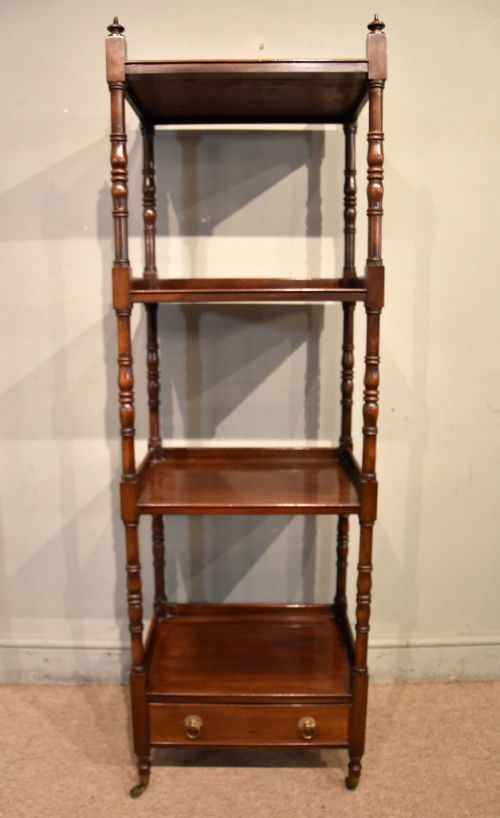

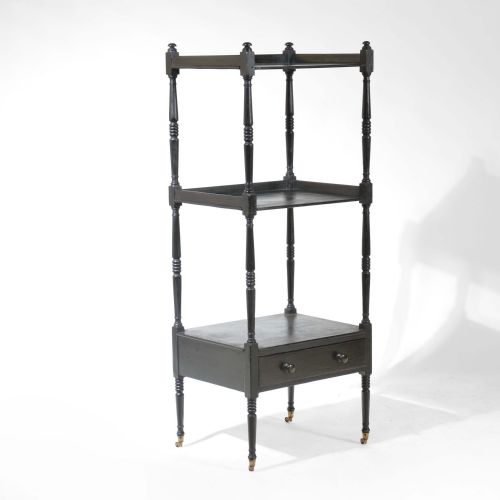


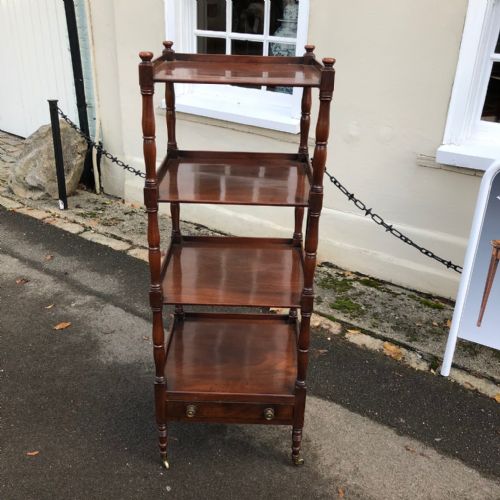
Turned Column Corner Shelf
These turned column corner shelf pieces offer tiered display space, bringing compact architectural character and practical storage to tight corners.
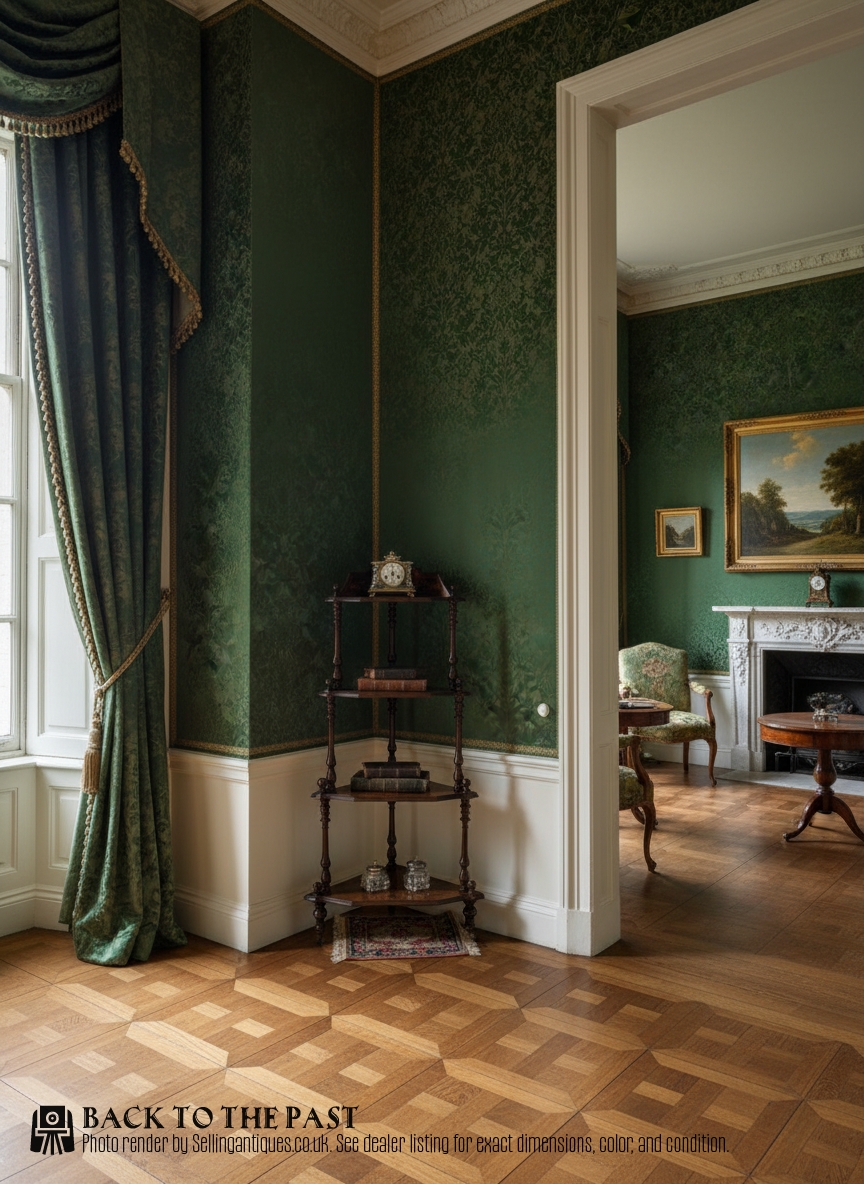
Turned Column Corner Shelf
A turned column corner shelf fits snugly into room angles, utilising vertical space efficiently with multiple tiers. Buyers searching for a turned column corner shelf encounter freestanding and tier formats primarily associated with whatnots and etageres.
The selections span distinct historical periods including the Georgian era, Regency, and Victorian times, alongside late nineteenth century examples. Walnut, mahogany, oak, and rosewood form the structural core of these tiered display units.
Makers designed these stands with differing tier counts, ranging from four tier configurations to simpler shelved formats. Octagonal shapes and tapering forms appear alongside dedicated corner whatnot designs.
Materials and construction
Cabinet makers utilised dense hardwoods such as mahogany and walnut, frequently incorporating ebonised wood or birdseye maple for decorative contrast. Boxwood inlay adds fine linear detail to selected walnut and Victorian pieces.
Structural uprights feature distinctive turned columns that support stacked tiers. Additional materials like brass fittings and cane appear in specific configurations across the inventory.
Even the birds needed somewhere to look when maple trees grew spots for these shelves.
Judging quality
Distinctions in quality rest on the selection of timber veneers and the crispness of the column turning. Finer examples display carefully matched grain patterns in mahogany, birdseye maple, or walnut across each tier.
The integration of delicate boxwood inlay and sturdy brass elements separates standard production from superior pieces. Architectural proportion in the tapering forms and multi-tiered structures governs overall visual balance.
The Turned Column Corner Shelf Glossary
- Whatnot
- A movable set of open shelves for displaying small objects, popular from the late eighteenth century onward. These tiered pieces often feature turned uprights.
- Etagere
- A piece of furniture consisting of a set of open shelves for displaying ornaments. It shares many characteristics with the whatnot.
- Ebonised
- Wood stained or treated to resemble ebony, providing a deep black finish. This technique appears on certain Georgian examples.
- Birdseye maple
- Timber featuring small, circular figures resembling birds' eyes, prized for decorative veneer work. Early nineteenth century makers utilised this distinctive wood.
- Boxwood inlay
- Contrasting pale wood inserted into recesses in a darker surface to create linear patterns. Victorian walnut pieces frequently display this detail.
Turned Column Corner Shelf: Frequently Asked Questions
What is a turned column corner shelf used for?
These tiered stands serve as display surfaces for books, ornaments, and small collections. Their angular footprint allows them to occupy unused room corners effectively.
Historically developed as whatnots and etageres, they provide multiple levels of open storage without dominating floor space.
How do I identify the period of a shelf?
Dating relies on timber selection, decorative techniques, and overall architectural form. Georgian and Regency pieces often feature mahogany with tapering columns.
Later Victorian and Edwardian examples introduce walnut, boxwood inlay, and ebonised finishes alongside explicit four tier formats.
Are these shelves freestanding?
Most pieces in this category are designed as freestanding tier units rather than wall-mounted brackets. Their weighted bases and turned column supports maintain stability.
They sit directly in room angles, supported by multiple vertical posts across each level.
What woods are typical for these shelves?
Mahogany and walnut predominate across the inventory, supplemented by oak, rosewood, and birdseye maple. Cabinet makers selected these durable hardwoods for structural integrity.
Surface enrichment often includes boxwood inlay and ebonised treatments to highlight the grain and form.