


Marquetry Corner Whatnot
A marquetry corner whatnot gathers tiers into dead space, saving floor while holding books, porcelain or small bronzes.
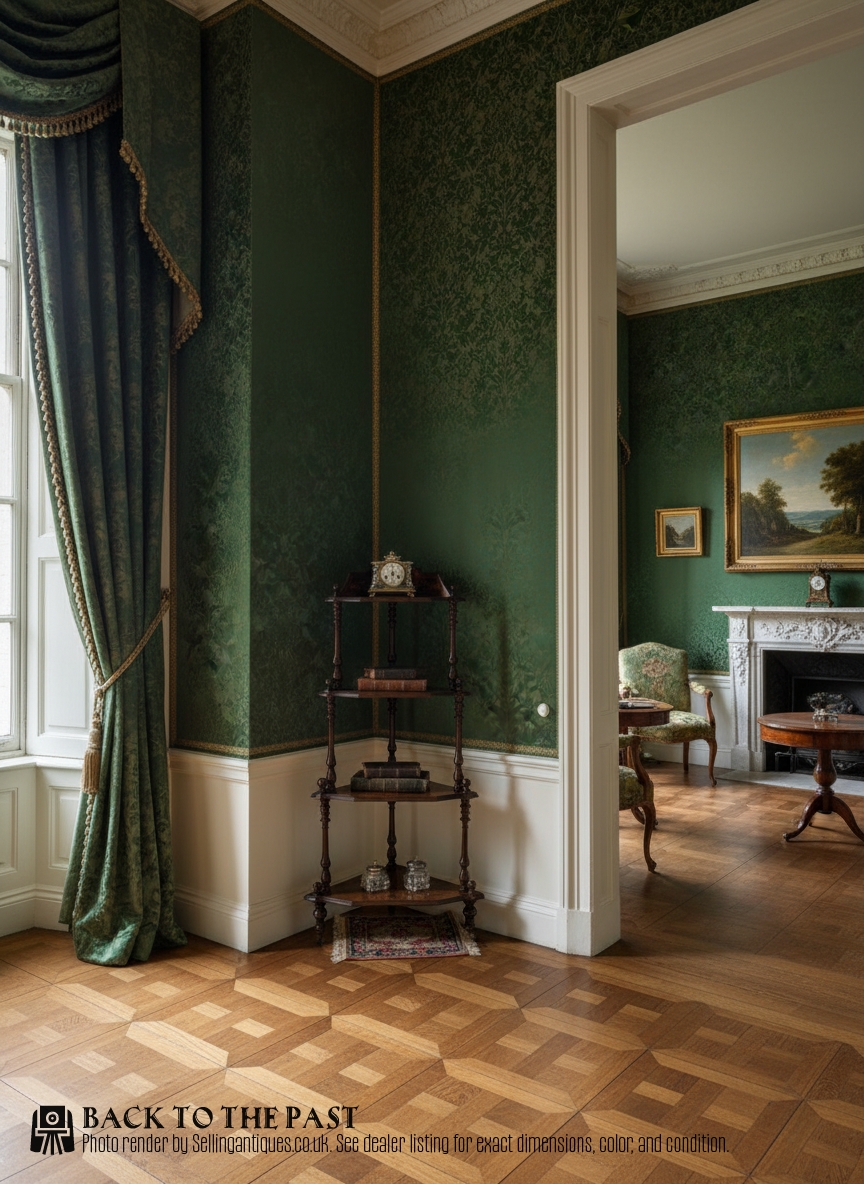
Marquetry Corner Whatnot
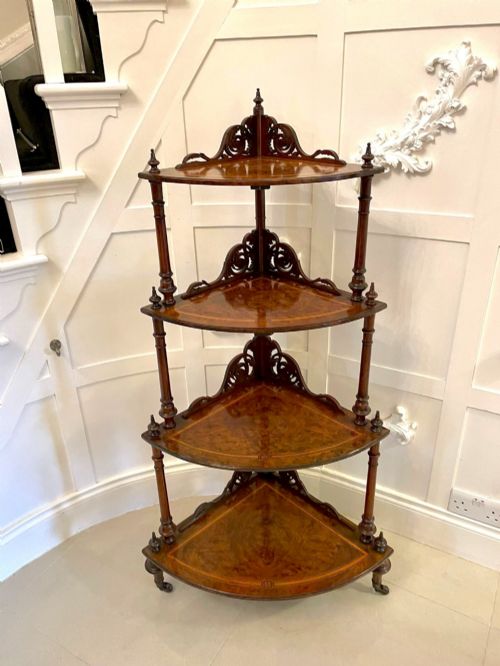
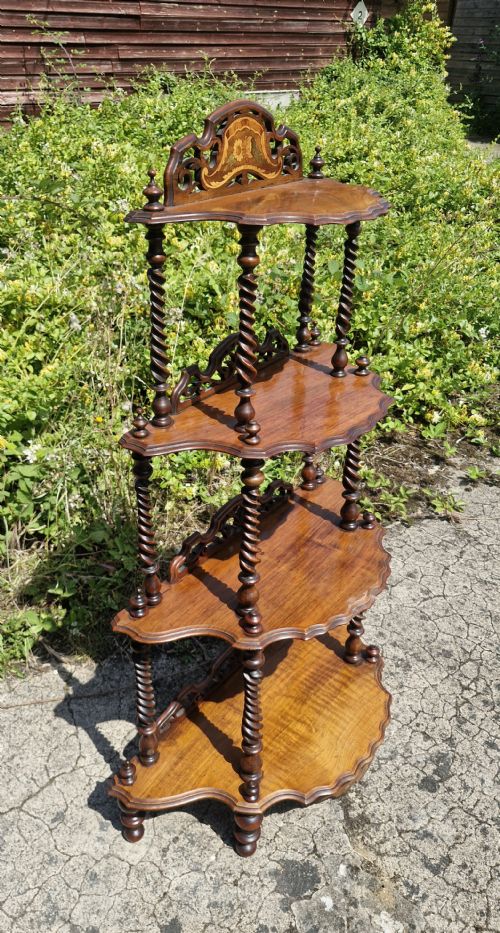
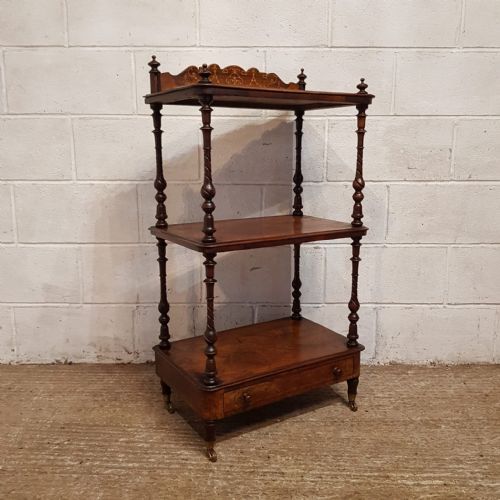
When you search for a marquetry corner whatnot, you find tiered display furniture designed to slot neatly into the angle of a room. The pieces appearing here belong principally to the Victorian period, running from the mid nineteenth century into the Edwardian era around nineteen hundred.
Most examples take the form of four tier corner stands or open display shelves built to occupy rooms economically. Walnut dominates the construction, accompanied by burr walnut, mahogany and ebonised wood.
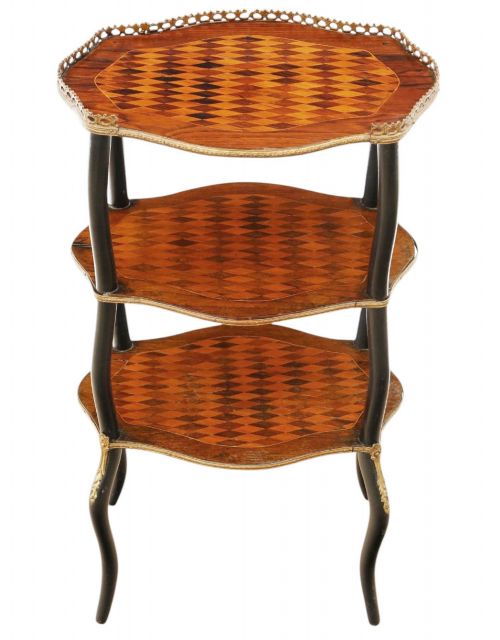
The defining characteristic across these items is the presence of inlaid decoration, utilising boxwood, marquetry and parquetry to ornament the surfaces. These stands combine practical open shelving with decorative timber work tailored for corner placement.
How they were made
Cabinet makers built these pieces using walnut as a primary timber, frequently selecting figured burr walnut for enhanced grain pattern and visual depth. Mixed timber parquetry and boxwood inlay were then applied to the surfaces to create geometric or floral patterns.
Structural elements often incorporated ebonised wood to provide contrast against the warm brown tones of the walnut. Brass components occasionally appeared in the assembly and support of the tiers, adding metallic punctuation to the woodwork.
Every listed whatnot utilises walnut timber, paired with boxwood inlay, marquetry, parquetry or ebonised wood across Victorian and Edwardian periods.
What varies in quality
The standard of a corner whatnot rests upon the crispness of the timber inlay and the richness of the walnut veneer selection. Finer pieces display meticulous parquetry and boxwood work that remains flush with the surrounding surface.
Proportion and timber choice dictate the distinction between ordinary utility items and superior examples. Well chosen burr walnut and balanced four tier elevations indicate more ambitious cabinet making.
The Marquetry Corner Whatnot Glossary
- Marquetry inlay
- Decorative wood veneers cut and fitted together to form pictorial or ornamental designs on a surface. This technique requires precise hand cutting to achieve seamless junctions between contrasting timbers.
- Parquetry
- Geometric mosaic woodwork arranged in repeating patterns such as cubes or chequers. It differs from marquetry by relying on regular geometric shapes rather than sweeping pictorial motifs.
- Burr walnut
- Timber taken from a tree growth or burl, yielding swirling, highly figured grain patterns. Cabinet makers prized this wood for prominent display surfaces on Victorian furniture.
- Ebonised wood
- Timber treated with a dark stain or finish to imitate ebony. This process created stark contrasts against lighter inlaid elements.
- Etagere
- A piece of furniture consisting of a set of open shelves for displaying small objects. These tiered stands offered both storage and decorative display space in nineteenth century interiors.
Marquetry Corner Whatnot: Frequently Asked Questions
What is a corner whatnot used for?
These tiered stands served to display decorative ceramics, small sculptures and books in nineteenth century sitting rooms.
Their angular footprint allowed them to utilise neglected wall junctions without obstructing floor traffic.
How do I date a walnut whatnot?
Dating relies on stylistic markers and timber choices spanning the Victorian era and early twentieth century. Pieces from the mid nineteenth century often show simpler walnut construction, while later examples incorporate elaborate boxwood inlay and ebonised framing.
Construction methods and edge treatments also shift from heavier proportions towards lighter Edwardian forms around nineteen hundred.
Where should I place a corner whatnot?
A corner whatnot belongs in an unused room angle where its stacked shelves can add height and vertical interest.
Keep the piece away from direct sunlight and strong heat sources to protect the walnut veneer and delicate boxwood stringing.
What woods were used for these stands?
Walnut serves as the primary structural and visual timber across these pieces, frequently appearing as burr walnut for richer grain figures.
Makers added boxwood, mahogany and ebonised wood to provide contrast for the inlaid decorative panels.