



Tunbridge Ware Parquetry
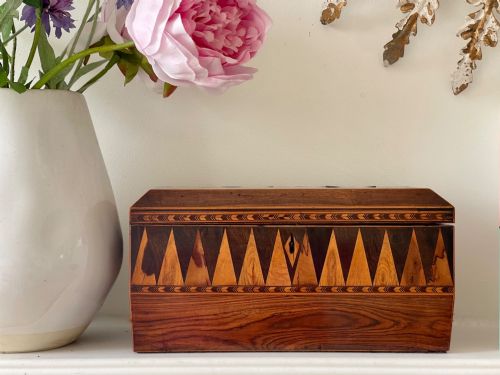
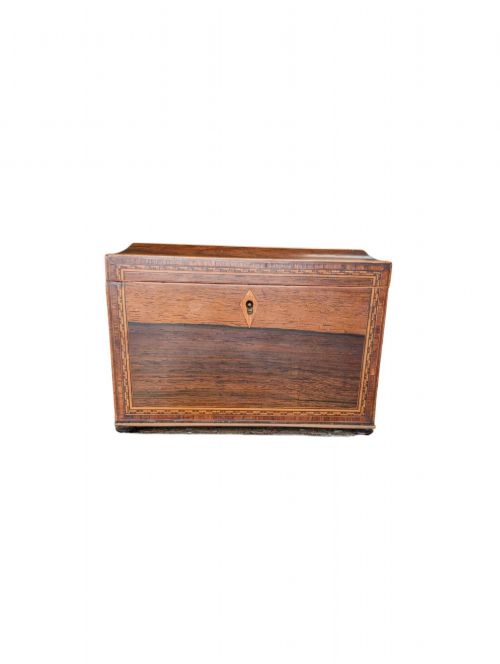
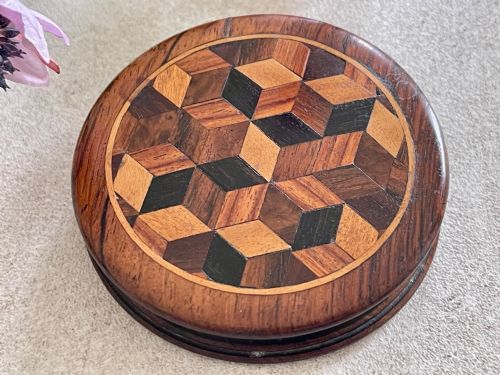
These tunbridge ware parquetry pieces are intricate wooden boxes and domestic objects built from tiny mosaic tiles, offering collectors remarkable geometric precision.
Tunbridge Ware Parquetry
Tunbridge ware parquetry encompasses a specialised group of wooden boxes, writing slopes, tea caddies, and small decorative objects originating mainly from the nineteenth century. Buyers seeking this style will encounter Victorian and Regency pieces alongside Georgian and Edwardian examples constructed from various timber species.
The most common forms on this page are tea caddies, sewing boxes, and writing slopes, often rendered in rosewood or walnut and featuring detailed mosaic wood inlay. These items served as functional desktop or parlour accessories for genteel households.
Makers utilised characteristic geometric parquetry and pictorial mosaic panels to ornament surfaces, ranging from simple banding to elaborate butterfly motifs and architectural views. Each piece demonstrates the patience required to assemble thousands of minute wooden prisms.
How they were made
Craftsmen constructed tunbridge ware parquetry by gluing together numerous strips of coloured woods in geometric or pictorial arrangements, then slicing the resulting block across the grain into thin mosaic veneers. Walnut, rosewood, boxwood, and mixed wood inlay provided the natural palette of shades needed to build complex patterns.
These mosaic veneers were applied to carcases of walnut, rosewood, or other timber to form tea caddies, boxes, and writing slopes, often complemented by brass fittings or fitted silk interiors. The precision of the wood mosaic required exact sawing and careful smoothing to achieve a flush surface.
Listings feature items from the Georgian, Regency, and Victorian periods, constructed primarily in walnut, rosewood, and boxwood.
What varies in quality
Quality in tunbridge ware parquetry lies in the complexity of the mosaic work and the choice of primary timber, with burr walnut and rosewood elevating the status of a piece. The fineness of the individual wood prisms dictates the intricacy of the geometric patterns or pictorial panels.
The presence of named makers such as Henry Hollamby or Edmund Nye distinguishes certain items, alongside well-preserved fitted interiors complete with original compartments, silk linings, or brass hardware.
Henry Hollamby·Edmund Nye
The Tunbridge Ware Parquetry Glossary
- Parquetry
- A mosaic woodwork technique forming geometric patterns using thin pieces of timber. This method creates the signature tiled surfaces seen across nineteenth-century boxes and caddies.
- Tea Caddy
- A lidded container designed for storing loose tea leaves securely. These vessels often contained fitted compartments and mixing bowls inside.
- Writing Slope
- A portable desk with a slanted lid that opened to reveal a writing surface and storage for stationery and ink. Many examples include velvet inserts and secret drawers.
- Burr Walnut
- A figured wood grain harvested from walnut tree growths, valued for its swirling patterns. Cabinet makers used burr walnut veneers to decorate the primary surfaces of high-status boxes.
- Stringing
- Thin lines of contrasting wood inlaid into the surface of a piece to form borders or panels. It provides linear definition around geometric parquetry motifs.
Tunbridge Ware Parquetry: Frequently Asked Questions
What are tunbridge ware boxes used for?
These boxes served domestic purposes such as storing tea, needlework supplies, stationery, or correspondence. Owners kept them in parlours and studies for daily organisation.
Today, they function as decorative display objects or collection centerpieces, retaining their original utility for holding small keepsakes.
How do I date a piece?
Dating relies on stylistic clues, materials such as rosewood or burr walnut, and structural forms associated with the Georgian, Regency, and Victorian periods. Specific decades appear in records from the eighteen-forties onwards.
Labels, maker signatures like Henry Hollamby or Edmund Nye, and specific box designs also help narrow down the production era.
Are interiors usually original?
Many pieces retain their fitted wooden compartments, paper linings, or silk components. These internal elements support the historical integrity of the object.
Alterations to the interior do occur over time due to heavy use or restoration work during the nineteenth or twentieth centuries.
How should I care for parquetry?
Keep wooden boxes away from direct sunlight and moisture to protect the delicate wood mosaic veneers and natural timber tones. Stable room temperatures prevent the wood from warping.
Dust gently with a dry cloth and avoid harsh cleaning products that might damage the surface finish or loosen the mosaic tiles.