




Tufted Leather Office Chair
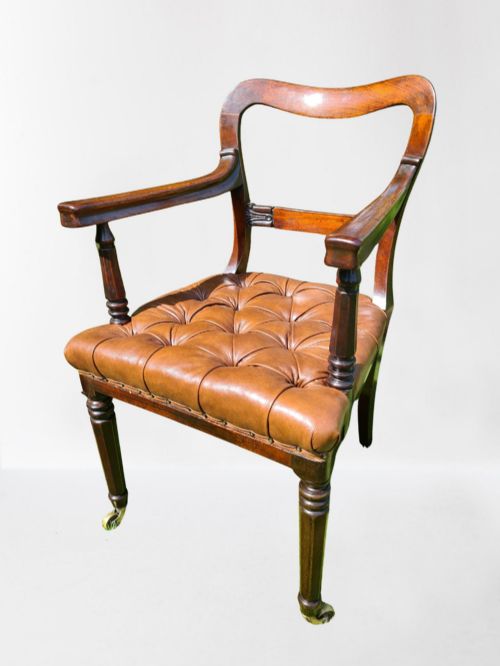
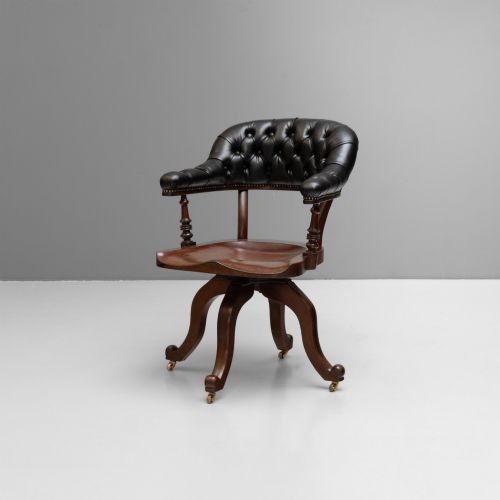
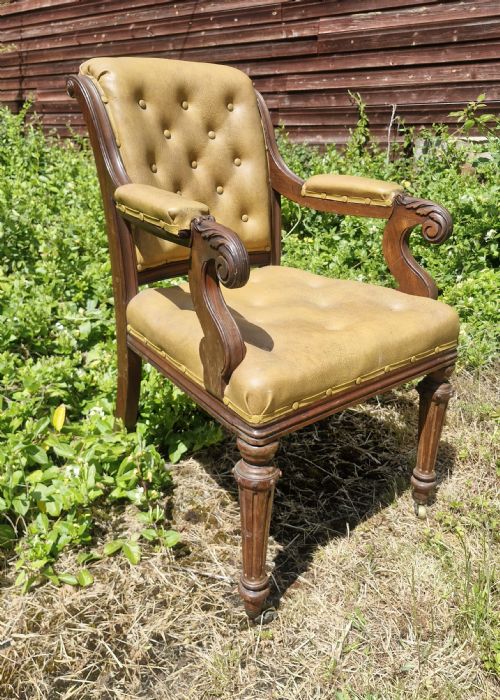
A tufted leather office chair brings substance to a study, offering deep buttoning and sturdy timber support built for long hours at a desk.
Tufted Leather Office Chair
When you search for a tufted leather office chair, you encounter sturdy desk chairs and library armchairs designed for working spaces. These pieces emerge predominantly from the nineteenth century, spanning Victorian and Georgian style periods.
The versions you meet on this page typically feature mahogany or oak frames paired with buttoned leather upholstery. They take the form of revolving desk chairs, tub chairs, and traditional armchairs intended for practical daily use.
How they were made
Cabinet makers constructed the frames using dense hardwoods like mahogany and oak, often shaping them into revolving mechanisms or fixed armchair bases. These timbers provide the structural backbone required for heavy office environments.
Upholsterers applied leather over padding, securing the surface with deep tufting and individual brass tacks. Iron and cast metal components frequently supported the swiveling and adjusting functions on nineteenth century desk models.
Nineteenth century clerks spent decades spinning in mahogany chairs, leaving behind brass tacks polished bright by generations of leaning elbows.
What varies in quality
The refinement of the timber turning and the depth of the carving separate standard workshop output from finer furniture. Superior examples display carefully selected grain patterns on the mahogany or oak framing.
The grade of the leather and the precision of the buttoning dictate the overall finish of the seating. Tighter pleating and more robust hides indicate higher standards of period craftsmanship.
The Tufted Leather Office Chair Glossary
- Tufted leather
- Upholstery pulled into deep indentations and secured with buttons to create a padded, geometric pattern. This technique keeps the internal stuffing evenly distributed.
- Captain chair
- A low-backed armchair designed for use at a desk or table, often featuring a rounded top rail. These items frequently incorporate swivel mechanisms.
- Gainsborough chair
- An eighteenth century style armchair featuring an upholstered back and seat with open padded arms. The design supports upright seating at a library table.
- Revolving mechanism
- The internal iron or wooden hardware that allows a chair to turn through a full circle. Early versions rely on central threaded spindles.
- Tub chair
- A seating form characterised by a continuous curved back and armrest shaped like a basin. This style wraps around the sitter for added enclosure.
Tufted Leather Office Chair: Frequently Asked Questions
Are these chairs comfortable for daily work?
These pieces were originally built for long hours at a desk, offering supportive wooden frames and padded seating. Their ergonomic shape accommodates extended periods of sitting in a study.
Modern users often find the firm nineteenth century padding suits upright working habits well. The supportive backrests encourage good posture throughout the day.
How do I identify a Victorian desk chair?
Victorian examples typically display dense mahogany or oak framing combined with deep buttoned leather upholstery. Turning on the wooden components often follows nineteenth century conventions.
Revolving versions from this era generally utilise heavy iron or brass underframes. The joinery employs traditional methods visible beneath the seat platform.
What is the difference between oak and mahogany models?
Oak frames generally present a prominent grain and a slightly more rustic appearance, frequently associated with club and library armchairs. Mahogany versions offer a smoother, darker surface finish favored in formal offices.
Both timbers provide exceptional durability, though mahogany often takes finer carved detail. The choice between them depends entirely on the aesthetic of your workspace.
Do all of these chairs swivel?
Not every piece in this category rotates, as the selection includes both stationary armchairs and revolving desk models. Fixed library chairs provide a stable seat without mechanical parts.
Swivel variants incorporate central wooden or iron spindles hidden beneath the seat. Checking the underframe reveals whether a particular chair turns.