






Red Leather Tub Chair
A red leather tub chair offers deep, enveloping seating that bridges formal library utility and relaxed domestic comfort.

Red Leather Tub Chair
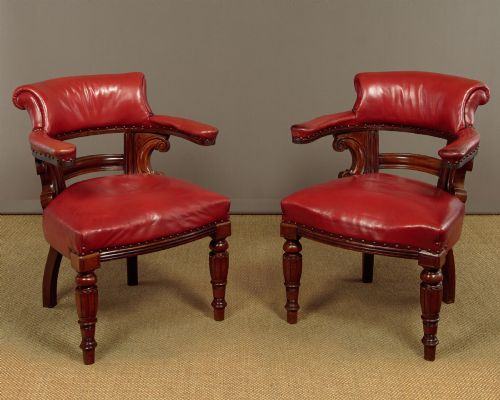
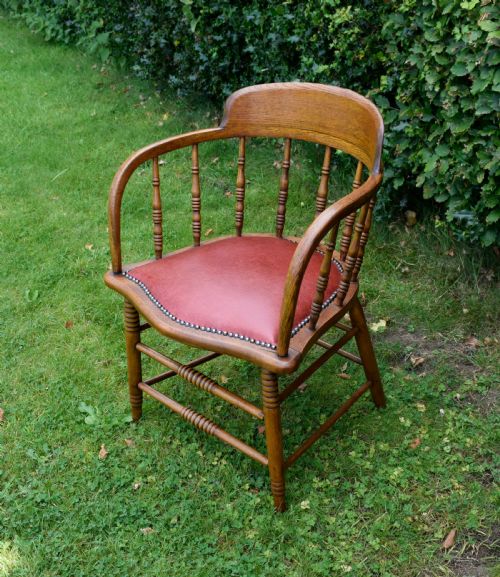
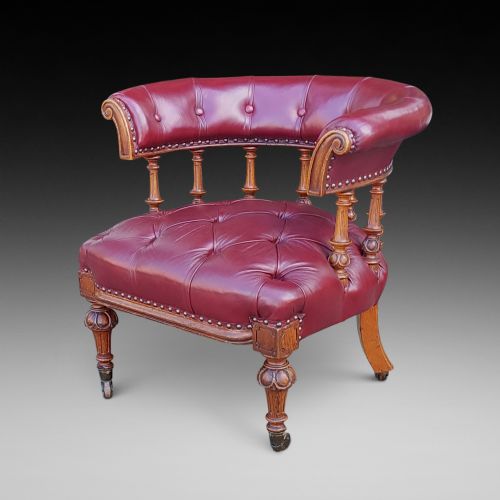
A red leather tub chair is primarily encountered in Victorian and Edwardian forms, frequently serving as a desk chair, library chair, or compact armchair. These pieces typically feature a curved, half-barrel backrest that flows seamlessly into low arms, offering a supportive, enclosed sit.
The materials and frames vary across the nineteenth and early twentieth centuries, drawing on sturdy hardwoods like mahogany, oak, walnut, and beech. Many examples incorporate swivel mechanisms, brass castors, or deep buttoning, aligning with traditional office and study requirements.
Materials and construction
Cabinet makers constructed the foundational frames of these chairs using durable timbers such as mahogany, oak, and walnut, often shaping the curved backrails from steam-bent wood or solid joined segments. These sturdy skeletons support the sprung or webbed seat platforms designed for sustained daily use.
Upholstery relied on supple leather - frequently dyed in rich red, burgundy, or oxblood tones - secured with brass or iron nail tacking. Metal components such as steel swivel spindles and brass castors were integrated into desk and library variants for mobility and adjustment.
A swivel mechanism let Victorian clerks spin rapidly between ledger books without ever leaving the comfort of their red leather embrace.
Evaluating craftsmanship and condition
Quality rests heavily on the integrity of the timber frame and the depth of joinery, where tight joints and substantial weight distinguish superior cabinet work from lighter commercial output. The suppleness and grain of the leather upholstery, alongside the neatness of hand-applied tacking, signal the maker's original investment of time.
Subtleties in the carving of the arms, the presence of original brass castors like those by Cope and Collinson, and the preservation of a rich, patinated finish elevate certain examples. Pieces that retain their original mechanical swivel actions and internal webbing without excessive modern intervention command greater appreciation.
Cope and Collinson
The Red Leather Tub Chair Glossary
- Tub chair
- An armchair featuring a continuous curved back and low arms that form a protective, rounded enclosure. This form became particularly popular in nineteenth-century libraries and studies.
- Buttoning
- An upholstery technique where indentations are pulled into the padding using twine or thread secured with buttons. This secures the internal stuffing and creates a diamond pattern.
- Castor
- A small wheel mounted on a swivel attached to the base of furniture legs. They allowed heavy library and desk chairs to be moved across carpets and floors with ease.
- Library chair
- A sturdy seat designed for reading rooms, studies, or offices, often featuring upholstered arms and supportive backrests. They prioritize ergonomic comfort for prolonged periods of work.
- Patina
- The surface sheen and softening of colour developed by wood and leather through decades of handling, light, and polishing. It serves as a visible record of age and use.
Red Leather Tub Chair: Frequently Asked Questions
Were these chairs used at desks?
Many of these chairs were specifically designed for writing desks, library tables, and office use during the nineteenth and early twentieth centuries. Their compact footprints and curved backs allowed users to sit comfortably while writing or consulting large volumes.
Revolving and adjustable height variants appeared frequently in professional settings, combining the enclosed comfort of a tub design with mobility.
How do I distinguish Victorian from Edwardian examples?
Victorian versions often feature denser timbers like mahogany or walnut, deep buttoning, and heavier frames built for formal domestic or institutional libraries. They lean towards darker red and oxblood leather tones.
Edwardian pieces tend to show lighter construction using beech or oak, sometimes incorporating brighter red upholstery or simpler lines. Art Deco variants from later decades introduce cream leather and more geometric curves.
Is the leather original on antique tub chairs?
Leather survives in varying states across historical seating, and many pieces have undergone professional re-upholstery over their lifetimes to maintain usability. Original leather typically displays a distinct patina, fine craquelure, and signs of gentle fading.
When replacement leather has been applied using traditional dying and hand-tacking methods, it respects the original aesthetic while offering practical durability for modern interiors.
Where should I place a tub chair at home?
These compact armchairs suit small reading corners, home studies, bedrooms, or beside a fireplace where space is limited but comfort remains essential. Their rounded profiles allow them to sit neatly in room corners without dominating the floor plan.
They also function effectively as occasional desk seats or paired opposite a larger sofa in a drawing room.