
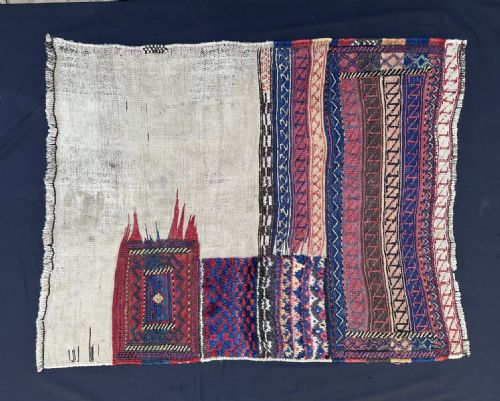
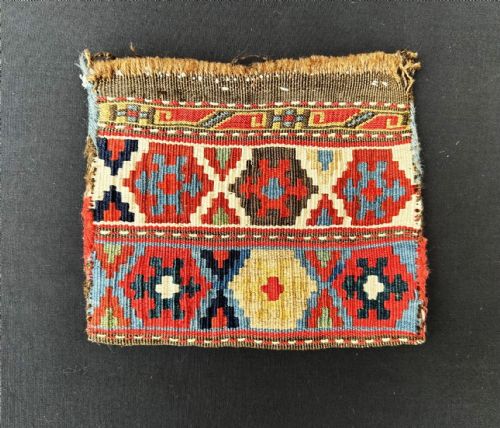

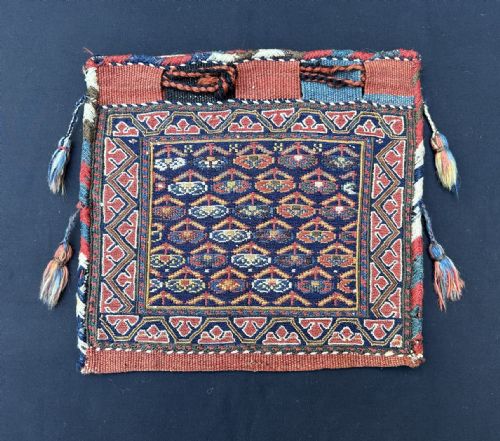
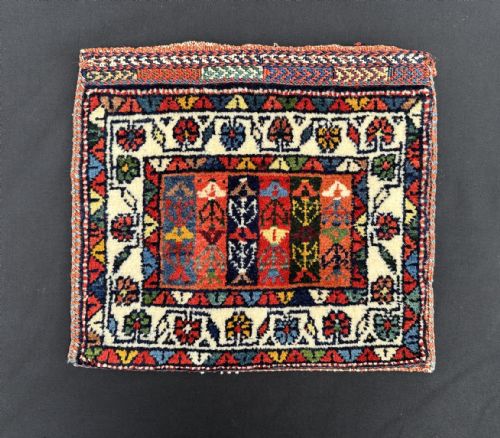
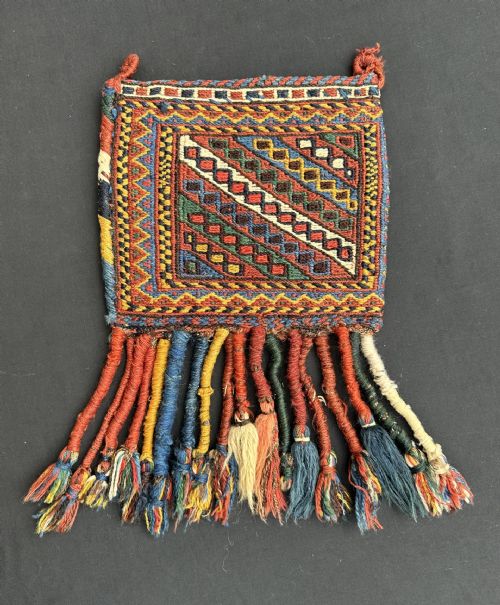


Tribal Nomad Woven Bag
A tribal nomad woven bag offers a direct link to the utilitarian artistry of Persian, Caucasian and Central Asian nomadic groups.
Tribal Nomad Woven Bag
Materials and construction
These textiles rely on hand-spun wool and cotton, occasionally incorporating goat hair and cowrie shells for structural reinforcement or ornamentation. Nomads utilised natural dyes to achieve deep red, blue, ivory and brown palettes, often applied across pile-woven surfaces and soumak work. The structural foundation demands robust spinning and knotting to endure daily migration and hard camp use.
Techniques vary from pile knotting on bag faces to flat-woven plain backs and intricate soumak wrapping on salt bags and saddlebags. Weavers executed precise geometric or medallion patterns from memory, passing tribal motifs down through generations without written drafts.
Listings feature items spanning from 1860 through the early twentieth century, made from hand-spun wool, cotton, goat hair and natural dyes.
Judging quality in nomadic bags
Quality rests upon the fineness of the spin, the density of the knotting or weave and the brilliance of the natural dyes. Superior examples display high-grade wool with a lanolin-rich handle and deeply saturated colours that show minimal fading. The clarity of the tribal design and the precision of the borders distinguish exceptional tribal weaving from standard utilitarian work.
The integrity of the remaining structure, whether a complete half-khorjin or a well-preserved bag face, also influences the piece. Expert execution in complex techniques like soumak work or crisp drawing in secondary motifs marks the upper tier of these nomadic textiles.
The Tribal Nomad Woven Bag Glossary
- Torba
- A small tent storage bag produced by Turkmen and other Central Asian tribes. These rectangular pouches typically hung inside a yurt to store personal possessions.
- Chuval
- A large Turkmen storage bag traditionally used for bedding and household goods. They often feature multiple guls arranged in strict geometric rows.
- Soumak
- A flat-weave technique where coloured weft threads wrap around the warp threads in a herringbone pattern. This method creates a durable, textured surface without a cut pile.
- Gul
- A medallion or repeated octagonal motif found in Turkmen and Baluch weaving. Each design often identifies a specific tribe or clan.
- Namakdan
- The traditional Persian term for a salt bag. These narrow-necked vessels stored rock salt for livestock or domestic use.
Tribal Nomad Woven Bag: Frequently Asked Questions
What were tribal bags used for?
Nomads utilised these woven bags to transport and store essential household goods during seasonal migrations. Different shapes accommodated specific contents, such as salt, tobacco, pipes, grain or bedding.
Inside the tent, they served as organised storage containers that kept belongings off the damp earth. Their durable construction protected contents from dust and rough handling on pack animals.
How do I care for a textile bag?
Keep your textile away from direct, strong sunlight to prevent natural dyes from fading over time. Gentle vacuuming with a low suction setting helps remove accumulated dust without damaging the wool fibres.
Avoid hanging heavy pieces by their top edge alone to prevent structural distortion. Consult a specialist textile conservator if cleaning becomes necessary.
How can I identify tribal origins?
Specific colour palettes, border patterns and structural techniques often point to particular regions and tribes. For instance, Shahsevan pieces frequently show fine soumak work from Azerbaijan, while Tekke pieces use deep reds and distinct guls.
Examining the weave structure and secondary colours provides further clues about whether a piece originated in South Persia or Western Afghanistan.
What is a half-khorjin?
A half-khorjin is one side of a paired saddlebag that has been separated over time. Complete double saddlebags were originally joined by a central web that draped across a pack animal.
When the connecting web wore out, owners often cut the two faces apart to use them individually as mats or small wall hangings.