

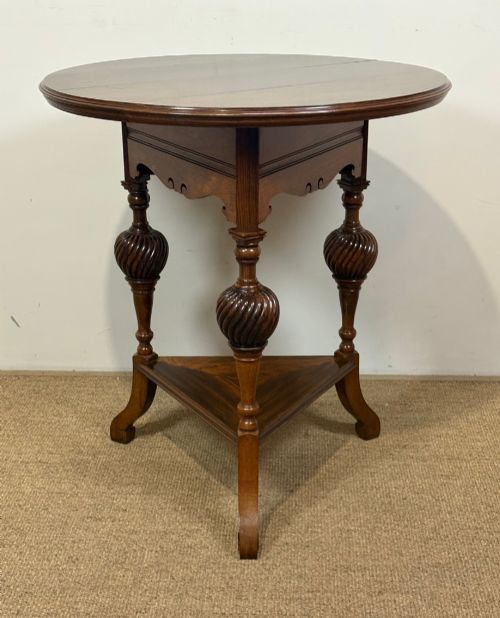
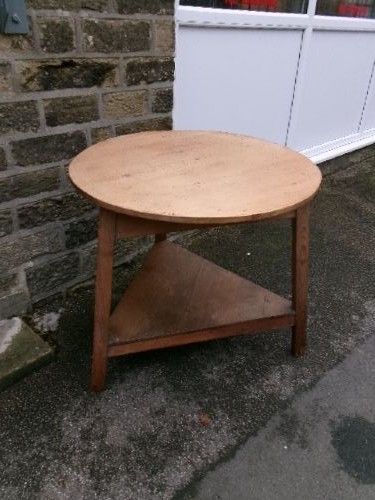
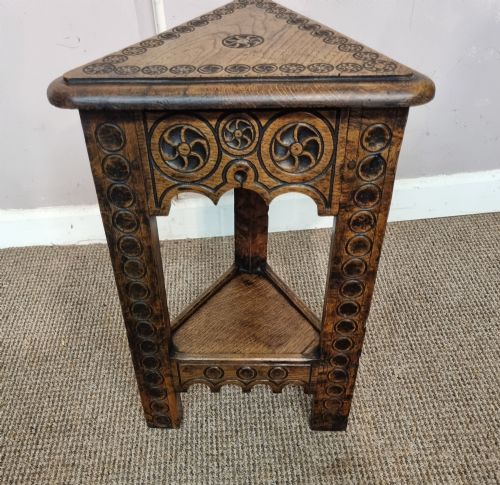
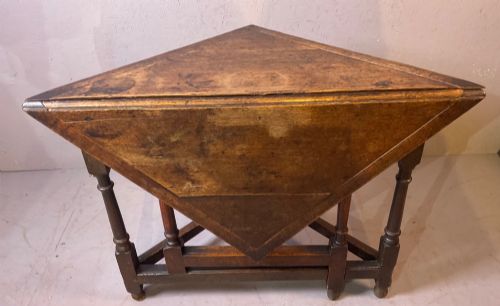


Triangular Side Table
A triangular side table offers clever geometry and compact proportions, making it a practical choice for filling awkward corners or small spaces.
Triangular Side Table
A triangular side table brings unusual three-sided geometry to interior spaces, functioning variously as a corner table, occasional table, or folding card table. The selection spans periods from the 17th century through the Georgian, Victorian, and Edwardian eras, reflecting enduring utility.
Most examples encountered here utilise drop leaves, folding tops, or lift-top mechanisms to expand their surface area when needed. These tables appear in forms such as handkerchief tables, cricket tables, and corner tea tables.
Origins range across English country oak pieces to more refined rosewood and mahogany specimens with satinwood inlay. The form adapts readily to differing domestic uses, from simple display surfaces to games and card tables.
What varies in quality
The choice of primary timber and secondary woods dictates the baseline quality, with dense mahogany and figured rosewood sitting above basic oak or elm. Craftsmanship in the hinge mechanisms and folding supports distinguishes finely executed pieces from standard utilitarian items.
The crispness of carved details and the precision of satinwood inlay separate workshop production from simpler provincial output. Well-executed marquetry and balanced proportions elevate the visual standing of individual tables.
Triangular Side Table Retail Price Guide 2026
Typical asking prices for triangular side table among the pieces listed under this phrase on Sellingantiques today, from the lower quarter to the upper quarter. They describe what is for sale here now, not the wider market.
Early oak tables share their name with the cricket pitch, though they spent their time holding tea rather than bats.
The Triangular Side Table Glossary
- Credence table
- A folding table with a swinging leg to support an opening leaf, often associated with 17th-century English oak furniture.
- Handkerchief table
- A triangular folding table with a single drop leaf that unfolds to form a square surface, popular in the 18th and 19th centuries.
- Cricket table
- A small three-legged round or triangular table constructed from oak or elm, traditionally used in country settings.
- Marquetry
- The art of applying pieces of veneer to a structure to form decorative patterns, frequently seen on Dutch console and card tables.
- Envelope table
- A card table with a four-flap folding top that rotates and opens like an envelope to reveal a baize-lined surface.
Triangular Side Table: Frequently Asked Questions
Where does a triangular side table fit best?
These tables find a natural home in corners or beside seating where standard rectangular furniture proves too bulky.
Their angular footprint allows them to tuck neatly against walls while providing a useful surface for lamps and small objects.
How do drop leaves function on these tables?
Hinged flaps extend the surface area when supported by swing legs or gate-leg mechanisms.
Dropping the leaves returns the table to its compact triangular profile for easy placement.
What is a handkerchief table?
A handkerchief table is a triangular folding table featuring a hinged leaf that opens to create a larger square top.
Victorian and Georgian makers produced these in mahogany and rosewood for flexible use in parlours.
Are these tables sturdy enough for daily use?
Solid construction in timbers like oak, mahogany, and elm provides dependable everyday stability.
Tables with folding leaves benefit from careful handling of their support mechanisms during adjustment.
How do I date an antique triangular table?
Stylistic clues such as George II cabriole legs, Edwardian satinwood inlay, or 17th-century oak framing indicate the period of origin.
Construction methods and timber selection also assist in establishing the age of the piece.