
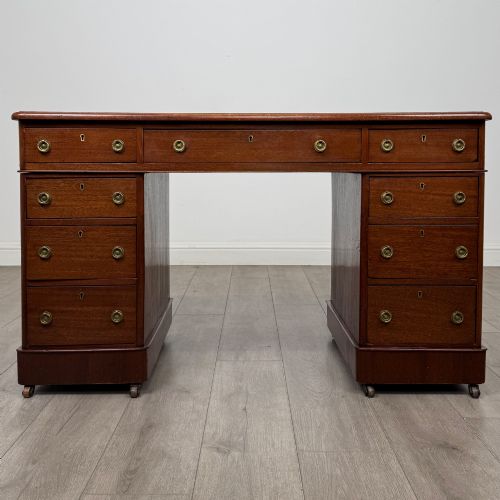
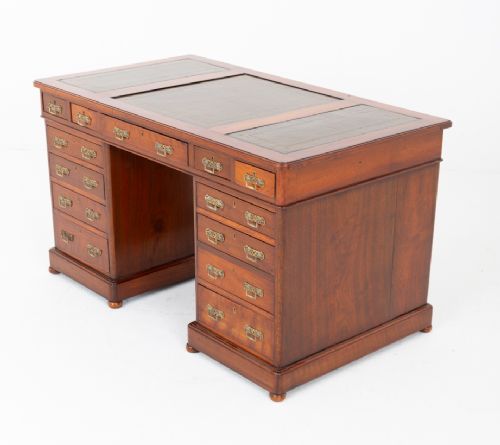
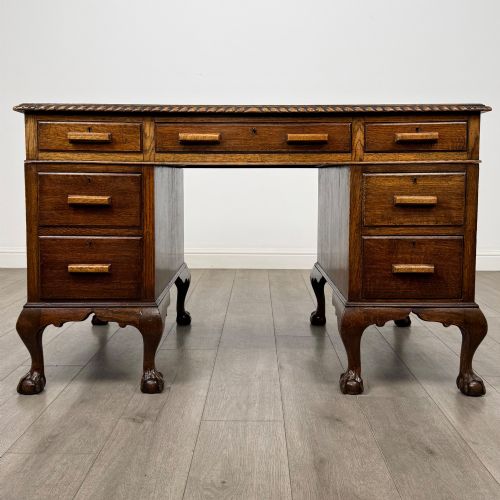
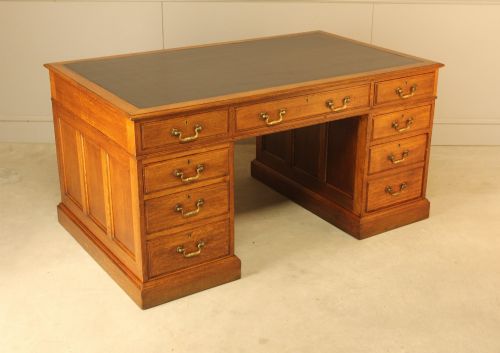



Traditional Twin Pedestal Desk
A traditional twin pedestal desk offers substantial workspace and ample storage, grounding a study with classic proportions.
Traditional Twin Pedestal Desk
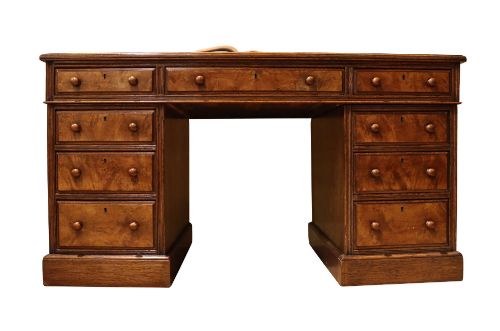
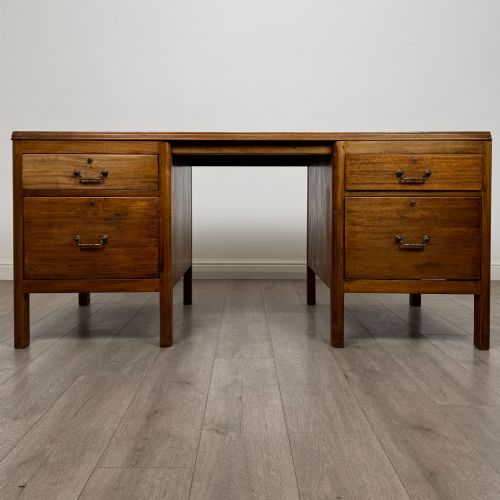
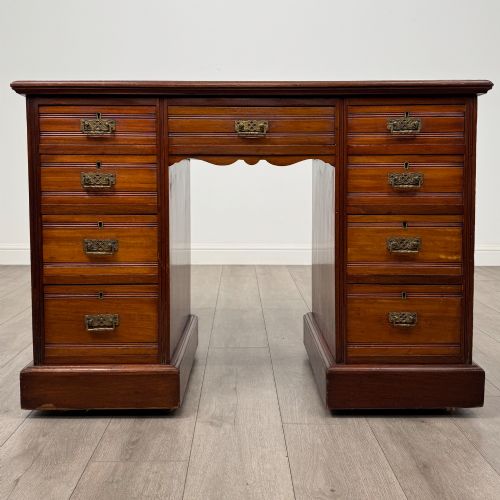
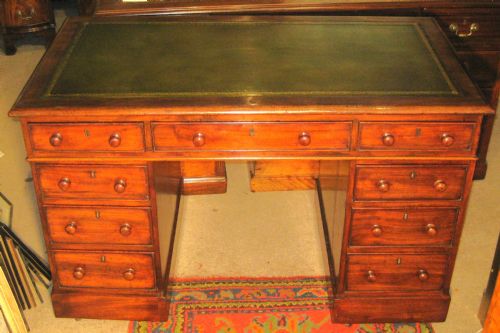
A traditional twin pedestal desk consists of two distinct drawer columns supporting a single writing surface, creating a balanced and formal workspace. These pieces emerge primarily from the Victorian and Edwardian eras, constructed to anchor substantial studies and libraries. Buyers encounter various iterations ranging from compact nine-drawer setups to large partners desks designed for simultaneous use from both sides.
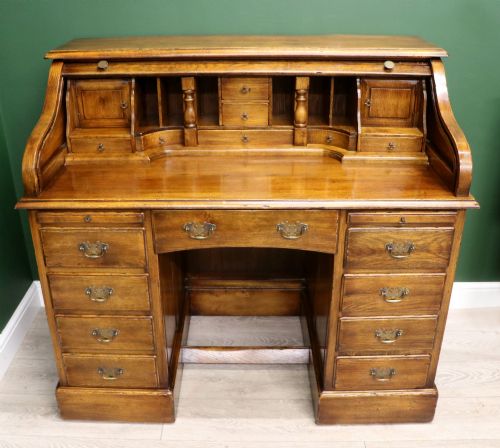
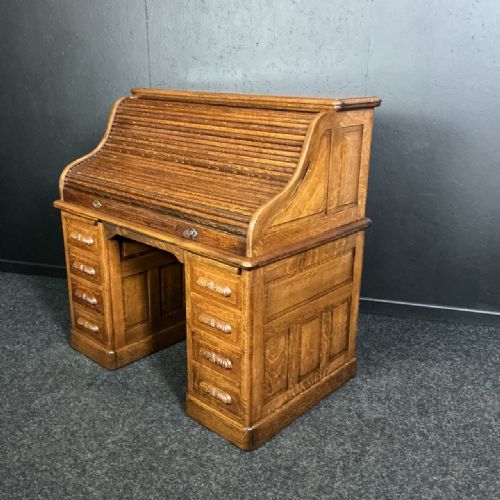
Mahogany remains the dominant wood across these listings, accompanied by oak, burr walnut, and satinwood inlay. Makers often integrated inset leather writing surfaces into the top boards, providing a durable and refined texture for daily correspondence. Forms span simple pedestal writing tables to elaborate roll top variants and Chippendale style revivals.
The layout generally places graduated drawers within each pedestal beneath a central frieze drawer, creating a deep kneehole space in the centre. Larger formats such as partners desks scale up this architecture to accommodate dual workspaces with cupboards or banks of drawers facing both directions. Surviving examples reflect the domestic and professional requirements of the nineteenth and early twentieth centuries.
Materials and Construction Methods
Cabinet makers relied heavily on solid timber and carefully matched veneers, utilising mahogany, oak, and burr walnut over secondary framing woods. Surfaces frequently incorporated tooled leather inserts bordered by gilt tooling, set flush into the primary timber top. Drawer boxes featured traditional dovetail joints, ensuring durable construction capable of withstanding heavy daily use.
Decorative detailing on these desks involved crossbanding, stringing, and satinwood inlay to accentuate drawer edges and panel borders. Brass hardware, including drop handles and key escutcheons, completed the functional joinery. Workshops applied polished finishes that enhanced the natural grain patterns of curl mahogany and golden oak.
Listings span the nineteenth and early twentieth centuries, featuring Victorian, Edwardian, and Georgian style pieces in mahogany, oak, and burr walnut.
Evaluating Quality and Craftsmanship
Quality in a traditional twin pedestal desk rests upon the selection of timber figures, such as highly figured burr walnut or curl mahogany, matched symmetrically across the drawer fronts. Superior examples exhibit refined proportions, crisp carving where stylistic revivals apply, and heavy solid brass fittings rather than stamped replacements.
The structural integrity of the pedestals and the smoothness of the drawer action indicate the level of joinery skill employed during manufacture. Higher grade pieces often feature oak-lined drawer internals and secondary timbers of equal quality, maintaining stability and alignment across the entire framework.
The Traditional Twin Pedestal Desk Glossary
- Partners desk
- A large pedestal desk designed with drawers and cupboards on both sides, allowing two people to work opposite one another. These frequently appeared in libraries and large administrative offices.
- Pedestal desk
- A freestanding desk comprising a top surface supported by two separate columns of drawers or cabinets. The central space between the pedestals forms a kneehole.
- Burr walnut
- A veneer sliced from the gnarled growths of walnut trees, prized for its swirling, decorative grain patterns. Cabinet makers used it on prominent exterior surfaces.
- Kneehole
- The recessed central space beneath the writing surface of a desk, positioned between the two supporting pedestals. It allows the user to sit comfortably close to the drawers.
- Roll top desk
- A desk featuring a flexible slatted wooden tambour that slides along tracks to cover the writing surface and pigeonholes. This mechanism secures the desk contents without needing a traditional hinged lid.
Traditional Twin Pedestal Desk: Frequently Asked Questions
What is a partners desk?
A partners desk is a large pedestal desk built with working drawers and cupboards on both sides. This symmetrical layout allows two people to sit opposite each other and use the desk simultaneously.
Such desks typically date from the nineteenth century and were intended for shared offices, libraries, or grand studies.
How do I arrange a pedestal desk in a room?
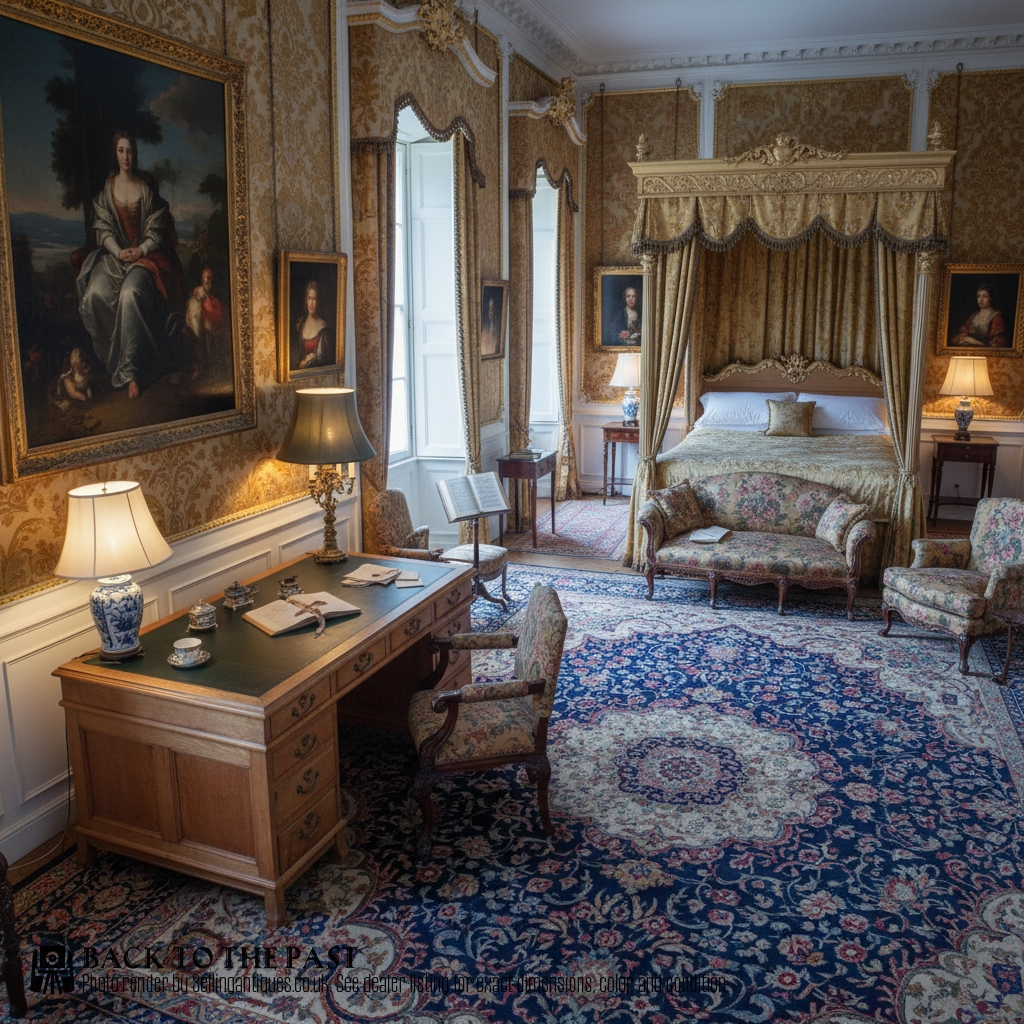
A pedestal desk is designed to be freestanding and looks best positioned in the centre of a room rather than pushed against a wall. This showcases the finished back panels and pedestal construction from all angles.
For partners desks, placing them centrally creates a striking focal point and allows access to drawers from both sides.
What woods were commonly used?
Mahogany is the most frequent primary timber found in these listings, ranging from dark red varieties to golden mahogany and curl mahogany. Oak and burr walnut also appear regularly, sometimes accented with satinwood inlay.
Secondary woods such as pine or oak were typically reserved for drawer linings and internal framing.
How do I distinguish Victorian from Edwardian desks?
Victorian desks, spanning the mid to late nineteenth century, often display denser mahogany timbers, deeper colour tones, and robust proportions. They frequently feature hand-tooled leather writing surfaces and traditional brass drop handles.
Edwardian desks, dating from the early twentieth century, tend to show lighter oak or mahogany construction, sometimes incorporating revival styles like Chippendale or simpler inlaid satinwood stringing.