
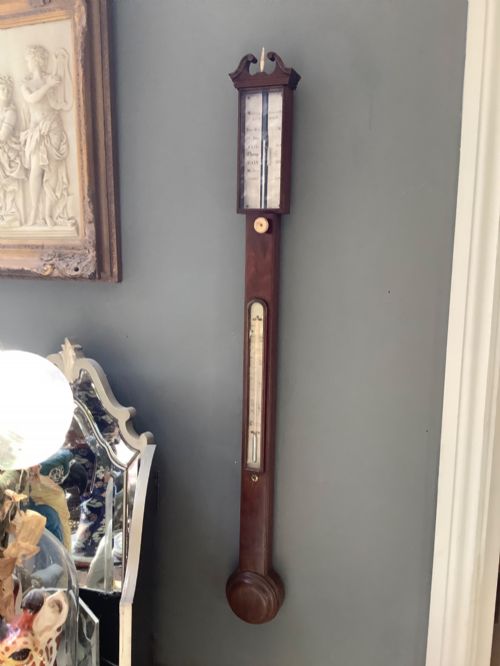


Traditional Stick Barometer
A traditional stick barometer brings precision weather-tracking into the hall, offering the classic tall proportions and mercury columns that collectors prize.
Traditional Stick Barometer
A traditional stick barometer is a vertical weather instrument designed to measure atmospheric pressure through a exposed or enclosed tube of mercury. When you search for a traditional stick barometer, you find tall, upright timber cases housing long silvered scales and vernier dials. These items originate from periods including the Georgian and Victorian eras, alongside nineteenth-century continental examples.
The pieces listed here appear in forms such as standard stick barometers, ships barometers, and even larger hall stands incorporating the instrument. Mahogany, oak, burr walnut, and ebonised timber form the predominant wooden housings for these instruments. Brass cistern covers, glass tube protections, and bone or paper vernier scales complete the primary configurations available to buyers.
How they were made
Cabinetmakers constructed the tall wooden cases using timbers like mahogany, oak, and walnut, often shaping them with carved details or sleek ebonised finishes. Glass protected the delicate mercury columns, while brass was utilised for cistern covers, gimbals on maritime versions, and small indicator pointers.
Makers inscribed the measurement scales on bone, paper, or silvered brass plates, allowing users to read atmospheric changes accurately. Skilled artisans integrated these sensitive glass tubes into sturdy wooden trunks designed to hang securely upon interior walls.
Admiral Fitzroy designed his famous storm barometers so fishermen could read the approaching gales directly from the wall before heading out to sea.
What varies in quality
Quality in these barometers rests on the choice of timber veneer, the crispness of the scale engravings, and the retention of original glass and brass components. Superior examples display figured mahogany or burr walnut with fine carving, whereas simpler versions rely on plain oak or basic ebonised wood.
The reputation of the maker influences desirability, with signed instruments by makers such as Ciresa of Milan, Bassi, or Admiral Fitzroy commanding closer inspection. Original scales made of bone or silvered metal also elevate an instrument above those with later paper replacements.
Admiral Fitzroy·Ciresa of Milan·Bassi
The Traditional Stick Barometer Glossary
- Vernier scale
- A small sliding auxiliary scale that allows the user to read barometric pressure fractions more precisely. It sits directly over the main pressure scale alongside the mercury tube.
- Cistern
- The small reservoir at the base of the barometer tube that holds the reserve mercury. It is frequently concealed behind a decorative brass or wooden cover.
- Banjo barometer
- A domestic weather glass featuring a rounded dial at the base resembling a banjo shape, distinct from the linear trunk of a stick barometer. These often incorporate humidity and temperature dials alongside the main pressure gauge.
- Ships barometer
- A marine adaptation fitted with gimbals to allow the instrument to swing upright on rolling vessel walls. These typically feature brass cylindrical cases and heavy mounting brackets.
Traditional Stick Barometer: Frequently Asked Questions
How do stick barometers work?
A stick barometer measures atmospheric pressure by balancing the weight of mercury in a glass tube against the pressure of the air on the reservoir below. As weather systems shift, the mercury column rises or falls accordingly.
Users read the height of the column against a graduated scale to forecast immediate weather changes. Traditional examples rely on precise glassblowing and sensitive mechanical calibration.
Where should I hang a stick barometer?
These instruments require stable interior locations away from direct sunlight, radiators, and heavy draughts. Sudden temperature shifts can affect the metal and wood components as well as the mercury reading.
Hang the tall wooden case securely from a sturdy wall fixing to prevent accidental knocks. The hallway or study makes a traditional placement for daily observation.
How do I date a stick barometer?
Dating relies on the style of the timber case, the materials used for the scale plates, and construction methods. Georgian examples often display simpler mahogany trunks, while Victorian versions may feature heavier carvings or maritime gimbal mounts.
Signatures or paper maker labels inside the case offer the most direct evidence of origin. Comparing the casework details against known period furniture helps narrow down the decade of manufacture.
Can these barometers still be moved?
Moving a traditional stick barometer requires extreme care to prevent the mercury column from breaking the glass tube. The instrument must be tilted gently to allow the mercury to fill the tube before transport, or the mercury must be professionally drained.
Many modern collectors prefer to have a specialist handle the relocation of antique mercury barometers. Once installed in a new room, the instrument needs time to adjust to the local air pressure.