
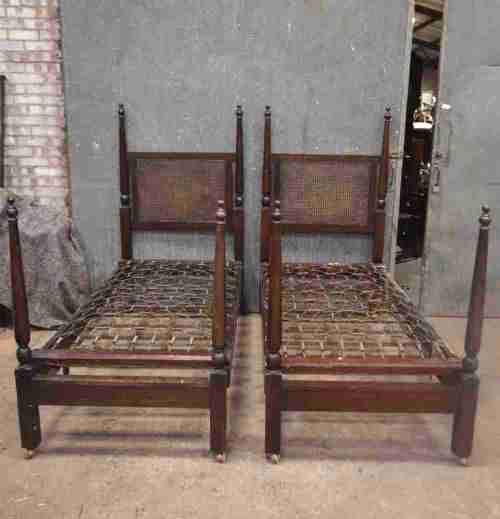
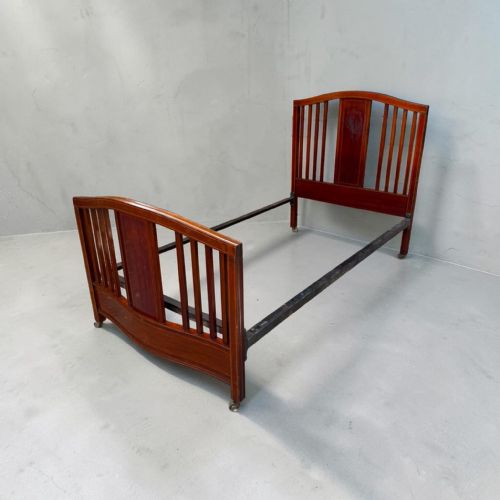


Traditional Single Wooden Bed
When you want a traditional single wooden bed, you are looking at timber frames built for one sleeper that carry the character of past centuries.
Traditional Single Wooden Bed
A traditional single wooden bed is a solitary sleeping frame constructed from timber, designed to support a single mattress. These pieces encompass sturdy bedsteads, panelled headboards, and occasional pairs intended for matching rooms.
The selections span the nineteenth and early twentieth centuries, drawing heavily upon Edwardian workshops alongside earlier nineteenth-century examples. You will frequently encounter mahogany and oak frames, often detailed with carved panels, inlay work, or cane inserts.
Makers of the period turned to distinct historical revivals, producing furniture that echoes Queen Anne, Georgian, and Arts and Crafts ideals. While complete beds dominate, individual bedheads occasionally appear for modern mattress adaptation.
How they were made
Cabinet makers built these frames using solid hardwoods like mahogany, oak, and walnut, frequently applying burr walnut veneer or contrasting inlay to enrich plain surfaces. Timber was selected for grain pattern and strength, ensuring the load-bearing rails and uprights remained stable over decades of use.
Construction techniques relied on traditional joinery supplemented by metal brackets where structural rigidity was paramount. Caning was woven by hand into wooden frames for airy headboards, whilst decorative carving and raised panels were executed entirely by hand.
Listings feature oak, mahogany, walnut, and satinwood, spanning the nineteenth century through the Edwardian era.
What varies in quality
Quality rests primarily in the selection of timber and the ambition of the design, moving from utilitarian pine and simple softwood carcasses up to figured mahogany and burr walnut veneers. Finer pieces demonstrate superior timber matching across prominent panels and careful attention to secondary woods.
The execution of decorative elements separates standard production from finer craftsmanship. Crisp hand-carving, precise inlaid banding, and integrated structural detailing elevate a bedstead from basic sleeping furniture to a notable piece of room architecture.
Heal And Son
The Traditional Single Wooden Bed Glossary
- Bedstead
- The complete framework of a bed, including headboard, footboard, and side rails. This term distinguishes the entire wooden structure from a simple mattress and base.
- Bergere
- A closed upholstered armchair, or in this context, a wooden frame featuring woven cane panels. It provides a lighter visual texture to heavy timber headboards.
- Inlay
- The technique of inserting contrasting pieces of wood or shell into a recessed wooden surface to form a decorative pattern. It was widely utilised on Edwardian mahogany frames.
- Panelled
- Constructed with flat or raised wooden panels fitted within a grooved frame. This method accommodates the natural seasonal movement of timber without splitting.
Traditional Single Wooden Bed: Frequently Asked Questions
What size mattress fits these beds?
Older single beds often vary slightly from modern standard mattress dimensions. It is essential to measure the internal rails precisely before ordering a new mattress.
Custom or slightly narrower mattresses may be required for older nineteenth-century frames to sit flush within the wooden side rails.
Are these beds easy to assemble?
Most traditional wooden beds utilise metal bolt slots or heavy iron corner brackets to lock the side rails to the headboard and footboard. They dismantle completely for transport and reassemble with simple spanners.
Care should be taken not to over-tighten iron bolts into aged timber threads during assembly.
Can I use modern bedding with them?
Standard single duvets, sheets, and pillows work seamlessly with these historic frames. The primary adjustment involves ensuring the base height accommodates modern pocket-sprung or foam mattress depths.
Slatted wooden roll-out bases are frequently added to modernise the interior support while preserving the exterior antique appearance.
How do I care for antique wood?
Maintain timber frames by dusting with a dry lint-free cloth and applying occasional quality beeswax to nourish the polish. Avoid placing wooden furniture near direct heat sources or damp environments.
Excessive sunlight will fade mahogany and walnut over time, so positioning away from bright windows preserves the original colour.