






Arts and Crafts Bedstead
An arts and crafts bedstead brings honest timber construction and careful joinery straight into the bedroom.
Arts and Crafts Bedstead
An arts and crafts bedstead represents the domestic ambitions of a movement that valued simple construction and visible grain over heavy Victorian ornament. When you search for an arts and crafts bedstead, you encounter substantial timber frameworks alongside occasional metal frames, reflecting the domestic needs of the late nineteenth and early twentieth centuries.
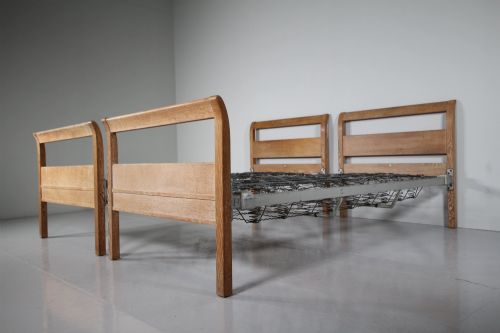
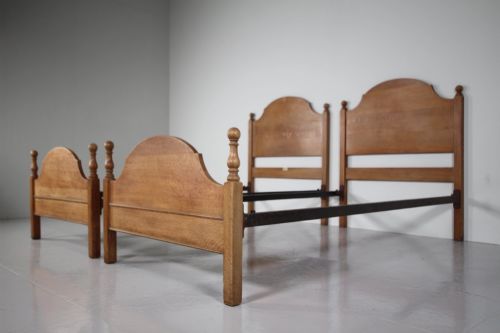
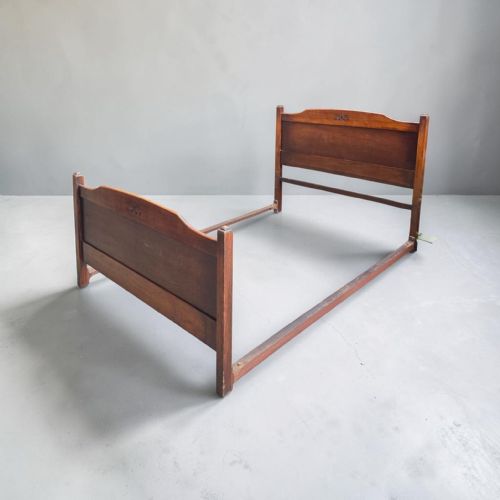
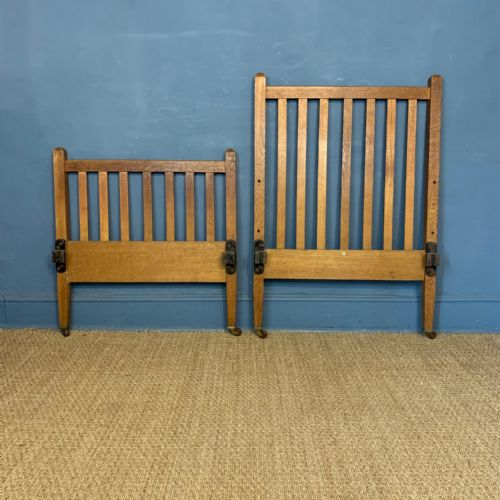
The pieces listed on this page encompass various configurations, from single beds and pairs to double beds and four-poster frames. Oak forms the backbone of these offerings, appearing frequently alongside fruitwood, sweet chestnut, and iron.
Edwardian examples and pieces from the 1920s dominate the selection, showing how makers adapted vernacular designs into twentieth-century homes. You also find larger pieces attributed to specific periods like the nineteenth century alongside later interpretations from the 1930s and 1940s.
Assessing Quality
The distinction between standard production and exceptional work lies in the choice of timber and the precision of the hand-carved or panelled details. Pieces constructed from rarer woods like sweet chestnut or fruitwood stand apart from standard oak examples.
Maker identification heavily influences a piece, with surviving maker labels or attributed workshop origins adding considerable interest to the construction. The overall proportion and integrity of the timber frame determine how successfully the design holds together.
Listings span from the 19th century through the Edwardian period, 1910, 1920, 1930, and into 1940.
Heals·Stanley Webb Davies·Oliver Morel·James Shoolbread and Co·Shapland and Petter·Heal and Son
The Arts and Crafts Bedstead Glossary
- Bedstead
- The framework of a bed consisting of headboard, footboard, and side rails, designed to support a mattress. This term covers both wooden and metal domestic sleeping frames.
- Edwardian
- Pertaining to the reign of King Edward VII, spanning from 1901 to 1910, though the style extends slightly either side. Furniture from this era often lighter in proportion than Victorian precedents.
- Panelled
- Built with flat wooden panels fitted into grooved frames, commonly seen on headboards and footboards. This technique allows wood to expand and contract naturally without warping.
- Four Poster
- A bed with four vertical columns supporting a tester or canopy frame above. These substantial pieces dominate the room with architectural presence.
Arts and Crafts Bedstead: Frequently Asked Questions
How do I assemble an antique bedstead?
Most arts and crafts bedsteads utilise standard iron bed bolts or side rail hooks that slot directly into the headboard and footboard posts. Take care to align the joints evenly and tighten the fixings gradually to ensure the frame remains square.
Because timber moves with household humidity, check that the side rails sit level before placing any mattress base across the slats. Avoid over-tightening bolted connections to protect the internal threads within the antique wood.
Are single beds available as pairs?
Yes, several listings feature matched pairs of single beds originating from the same maker and period. These twin configurations often share identical panel details and timber selection.
Sourcing matched single beds gives consistency to guest rooms or twin bed layouts while retaining individual character. Check the dimensions of each frame, as historical single beds can vary slightly in width.
What woods were used for these beds?
Oak is the predominant timber found across these pieces, ranging from solid frames to panelled headboards. Other listings showcase fruitwood, sweet chestnut, and satinwood.
Metal components also appear, including brass, cast iron, and steel frames. Each material requires appropriate maintenance to preserve the surface finish over time.
How do I date an arts and crafts bed?
Dating relies on stylistic markers, construction methods, and any surviving maker labels or stamps. Pieces from the Edwardian era and the 1920s often feature simpler, rectilinear forms compared to earlier Victorian interpretations.
Examine the back of the headboard and the interior of the side rails for workshop stamps or paper labels. Comparing the timber grain and hardware style against documented examples helps narrow down the decade.