


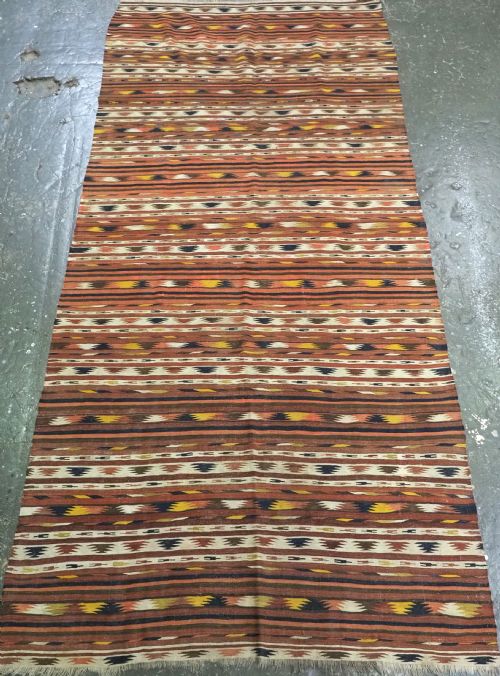


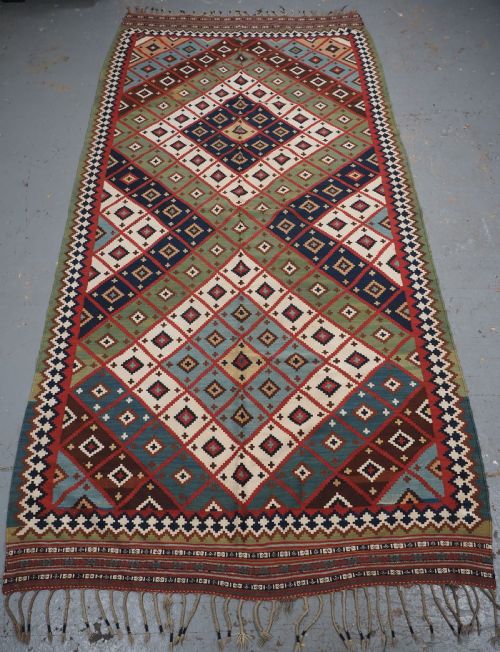


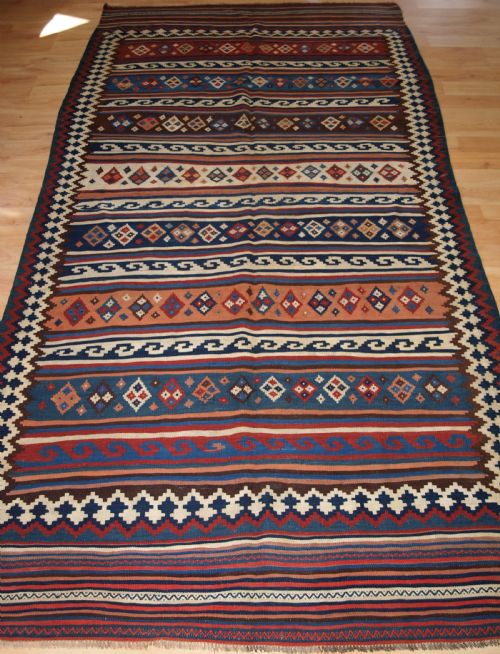


Traditional Kilim Floor Rug
A traditional kilim floor rug brings flat weave character into a room, offering geometric patterns and rich history from nomadic and regional traditions.
Traditional Kilim Floor Rug
A traditional kilim floor rug comprises flat weave textiles originating from diverse regions including Anatolia, Central Asia, and Eastern Europe. These pieces date across the late nineteenth and early twentieth centuries, spanning periods from the eighteen-eighties to the nineteen-twenties.
Buyers frequently encounter flat weave kilims displaying banded designs, repeat patterns, and all-over motifs. These textiles utilise wool and cotton foundations, often dyed with natural colourants.
What Varies in Quality
Quality rests upon the tightness of the weave and the precision of the geometric execution. Finer structures display intricate banded designs and complex repeat patterns handled with technical control.
The sophistication of the natural dye palette and the integrity of the textile structure distinguish superior examples. Condition and the preservation of long kilim ends also influence the standing of individual rugs.
Current listings include pieces utilising wool and cotton, featuring natural dyes across periods from eighteen-eighty to nineteen-twenty.
The Traditional Kilim Floor Rug Glossary
- Kilim
- A flat weave textile produced without a pile by interlocking warp and weft threads. This construction method creates lightweight rugs with distinct geometric patterns.
- Soumak
- A wrapping technique used in carpet and kilim making that creates a durable structure with visible braided threads on the face. It adds texture and substance to nomadic flat weaves.
- Warp
- The vertical threads stretched across a loom that form the foundation of the rug. Weft threads pass horizontally through these warp strands to build the pattern.
- Natural Dyes
- Colourants derived from plant, insect, and mineral sources used to dye wool and cotton yarns. These dyes produce organic tones that age with subtle fading.
- Palas
- A term applied to certain flat weave rugs and utility textiles produced by tribal groups. They often feature simple banded or striped compositions.
Traditional Kilim Floor Rug: Frequently Asked Questions
How do I clean a traditional kilim floor rug?
Gentle surface brushing and careful vacuuming without a beater bar remove loose dust and grit.
Professional specialist cleaning is necessary for deeper maintenance to protect natural dyes and wool fibres.
Can I use a kilim rug in a high traffic hallway?
Flat weave runners and rugs function well in corridors when paired with an appropriate underlay to prevent slipping.
Regular rotation distributes foot traffic evenly across the wool surface.
What is the difference between a kilim and a pile carpet?
Kilims are woven flat without knots, resulting in a lighter textile without a raised pile surface.
Pile carpets use knotted vertical tufts that create a dense, soft cushion underfoot.
How do I identify the origin of a kilim rug?
Regional motifs, weave density, and specific colour palettes provide clues to the workshop or tribal origin.
Comparison with documented examples from areas like Anatolia or Central Asia clarifies provenance.