


Traditional Floor Covering
Traditional floor covering brings together hand-knotted wool and cotton carpets from Persia, Turkey, and the Caucasus to ground a room with pattern and history.
Traditional Floor Covering
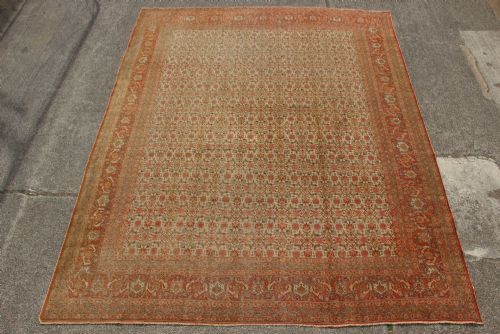
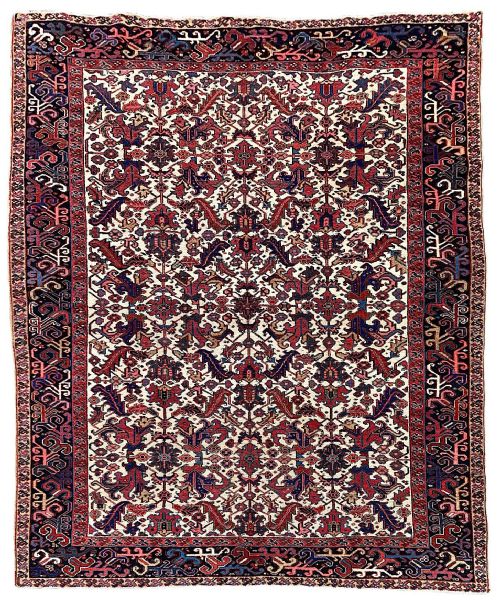
When you search for traditional floor covering, you encounter a selection of hand-knotted rugs and carpets originating primarily from Persia and Turkey. These pieces range from room-sized carpets down to smaller area rugs and cushions, spanning periods from the late nineteenth century into the early twentieth century. The version you are most likely to meet on this page is a room-sized or area carpet rooted in Persian styles such as Heriz, Isfahan, and Tabriz, alongside Turkish Oushak weaves.
The material evidence on this page shows works attributed to specific regional traditions, including Caucasian, Ottoman, and Persian tribal workshops. The forms include large palace-size carpets, smaller village rugs, and utilitarian bag face cushions adapted for domestic interior use. Each piece reflects the specific weaving centres and nomadic influences of its origin, offering distinct medallion and floral motifs.
Distinctions in quality
The upper tier of these carpets is defined by the fineness of the knot density and the precision of the drawn design. Master workshops and specific regional weavers achieved superior definition in floral and medallion layouts by using tightly spun wool on sturdy cotton foundations. This level of execution allows complex patterns to remain crisp and legible across large room-sized surfaces.
At the other end of the scale, quality varies through heavy wear, structural thinning, and the softening of the original pile. Distressed surfaces alter the visual impact, shifting the balance between intact pattern work and the patinated texture of exposed foundation threads. The most successful pieces retain their structural cohesion regardless of age or surface wear.
Wool and cotton are the sole materials recorded across every carpet, rug, and cushion listed on this page.
Benlian·Mokhtashem
The Traditional Floor Covering Glossary
- Pile
- The upright yarn loops that form the soft surface of a carpet. It is sheared evenly after knotting to reveal the pattern.
- Warp
- The vertical threads stretched tightly on the loom that form the structural backbone of the rug. Cotton is standard in these pieces.
- Weft
- The horizontal threads passed across the warps between rows of knots to lock the pile in place. This secures the overall tension of the weave.
- Medallion
- A large central ornamental design motif placed in the middle of the carpet field. It usually dictates the symmetry of the surrounding pattern.
- Bag face
- The decorative front panel of a nomadic storage bag, woven in a smaller format and later used as a small accent rug or cushion.
Traditional Floor Covering: Frequently Asked Questions
How do I clean an antique wool carpet?
Vacuum gently using a suction-only attachment without a rotating brush bar to protect the wool pile.
Professional specialist cleaning is recommended for deeper maintenance to prevent dye bleed or fibre damage.
Are these carpets suitable for heavy foot traffic?
Wool and cotton hand-knotted rugs are naturally durable and withstand regular walking when placed correctly over an underlay.
Using a quality underpad cushions the fibres and reduces friction against hard flooring surfaces.
How can I tell a Heriz rug apart from an Isfahan rug?
Heriz carpets typically feature bold, geometric medallions with large angular corners and robust, sturdy wool.
Isfahan rugs showcase delicate, refined floral curves and intricate scrollwork executed with a much finer knot count.
What is an Oushak carpet?
Oushak carpets originate from Turkey and are known for their luminous wool and softer, muted pastel or pink colour palettes.
They often feature large-scale floral and vine trellis designs that suit both traditional and contemporary interiors.