


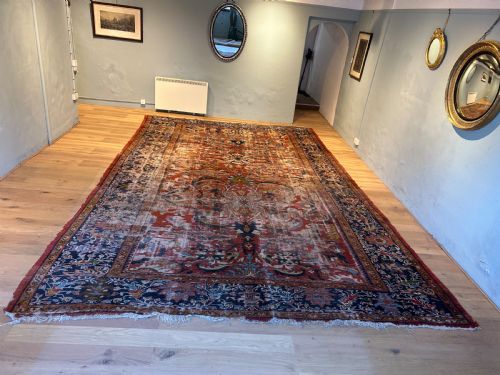


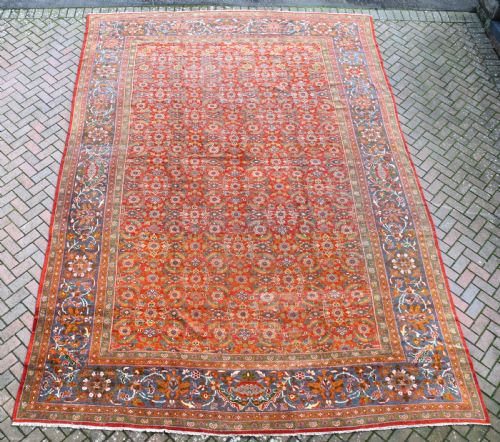
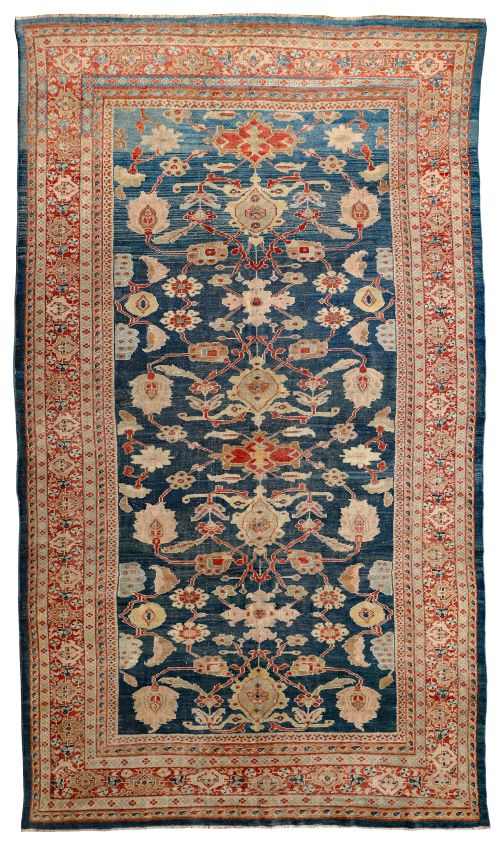


Blue Ziegler Carpet
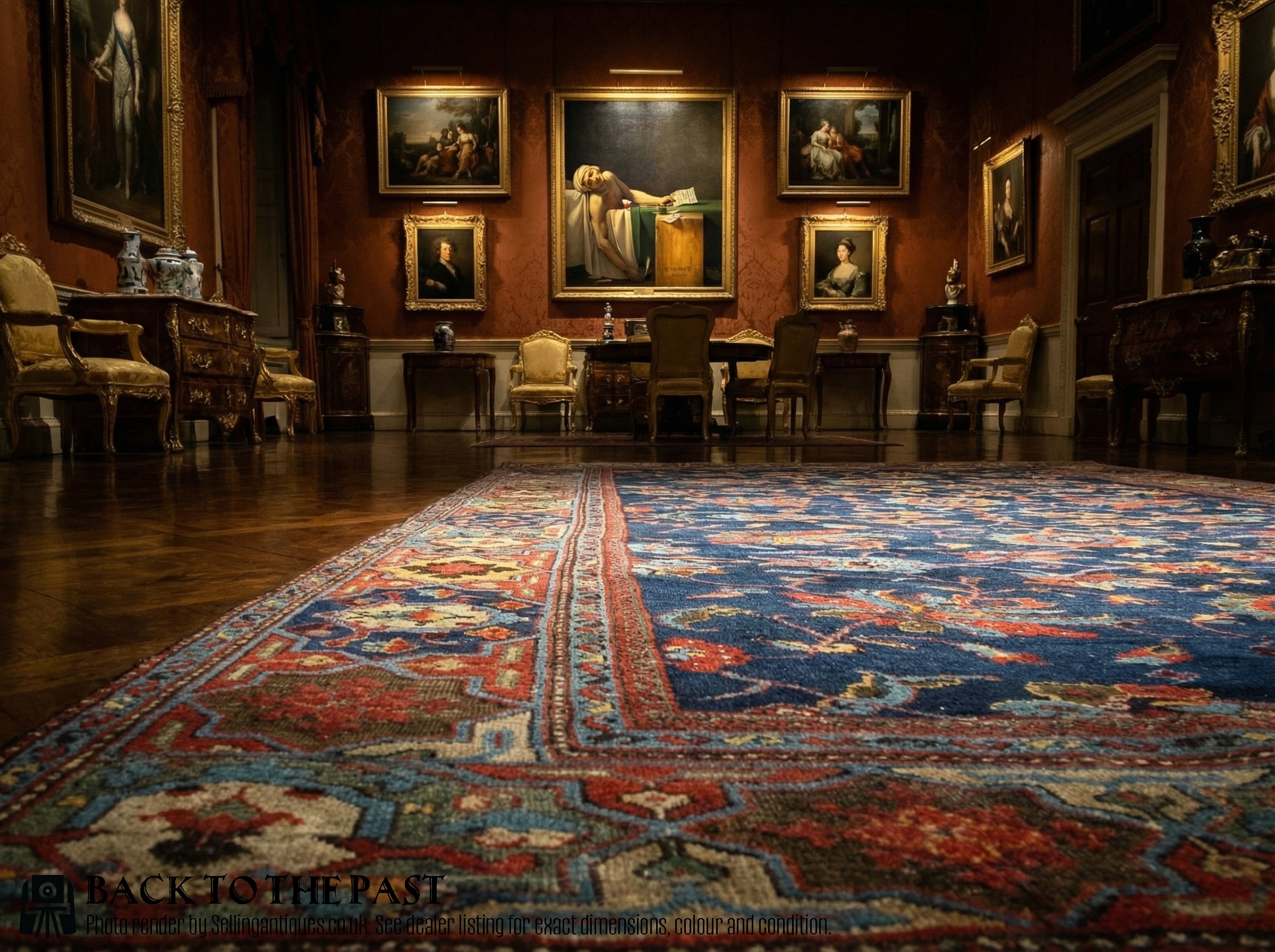
A blue ziegler carpet brings room-anchoring scale and muted, room-softening pattern into a period interior.
Blue Ziegler Carpet
When you search for a blue ziegler carpet, you look at nineteenth-century floor coverings originating from West Persia and the Sultanabad region. These pieces date from the late nineteenth century, specifically spanning the 1880s, 1890s, and around 1900.
The most common examples on this page are grand room-size and palace-size carpets, alongside smaller area rugs. They carry designations linking them to Persian Ziegler, Fereghan, and Mahal traditions.
How they were made
These carpets are constructed using wool pile on cotton foundations, providing both soft surface texture and structural stability. Weavers in the Sultanabad region knotted these materials by hand to create durable floor coverings.
The production involved large-scale workshop output tailored for Western markets, utilising characteristic soft palettes and expansive overall patterns.
Several palace-size carpets here are large enough to cover the floor space of an entire modern apartment.
What varies in quality
The grade of wool and the fineness of the knotting determine the tactile richness of the surface. Carpets with tightly packed foundations hold their structural integrity far better under heavy use.
Palace-scale pieces with balanced proportions and well-executed dye saturation sit at the upper end of the scale. The subtlety of the blue tones and the clarity of the large-scale floral motifs dictate visual success.
Ziegler & Co
The Blue Ziegler Carpet Glossary
- Ziegler
- A nineteenth-century commercial firm and carpet producer operating in Persia. They established workshops in Sultanabad to export large decorative carpets to Western markets.
- Sultanabad
- A West Persian city and carpet-producing region known for large-scale floral designs. Carpets from this area frequently feature expansive patterns suited to European drawing rooms.
- Mahal
- A designation for carpets woven in the villages surrounding Sultanabad. These pieces often share design vocabularies with larger Ziegler productions.
- Fereghan
- A Persian weaving region associated with fine nineteenth-century rugs and carpets. Pieces bearing this attribution typically display refined detail within traditional layouts.
Blue Ziegler Carpet: Frequently Asked Questions
What is a blue ziegler carpet?
A blue ziegler carpet is a nineteenth-century Persian floor covering produced largely in the Sultanabad region for Western export. These pieces are defined by soft blue fields and expansive floral designs.
They combine wool pile with cotton foundations to create durable furnishings suited to substantial rooms.
How do I style a blue ziegler carpet?
These carpets work well as the central anchor in a drawing room or dining space. Their muted blue tones and large-scale patterns complement both antique timber furniture and simpler modern interiors.
Ensure the room dimensions allow the borders to remain visible rather than hidden entirely beneath heavy furniture.
How do I date a blue ziegler carpet?
Dating relies on stylistic markers, construction materials, and historical production periods associated with nineteenth-century Persian workshops. Most examples date from the 1880s through to around 1900.
Examine the condition of the wool pile, the structure of the cotton foundation, and the specific nuances of the design attribution.
Are these carpets suitable for daily use?
These nineteenth-century rugs and carpets were built for domestic life using sturdy wool and cotton materials. Palace-size and room-size examples handle moderate foot traffic when paired with a quality underlay.
Regular gentle vacuuming without a beater bar helps maintain the integrity of the hand-knotted pile over time.