
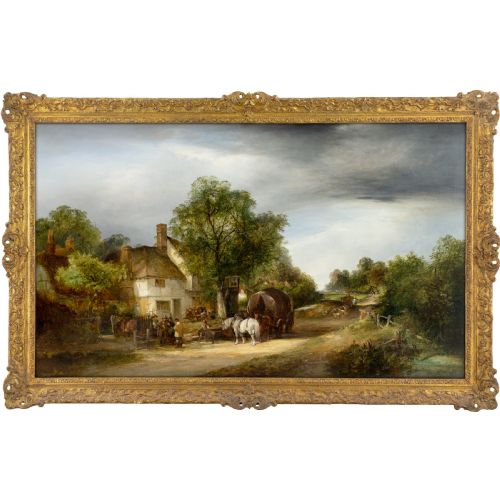
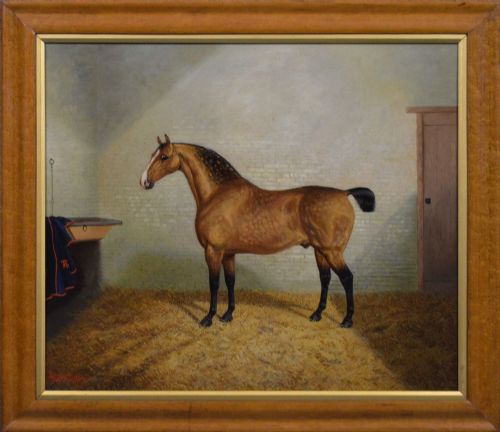
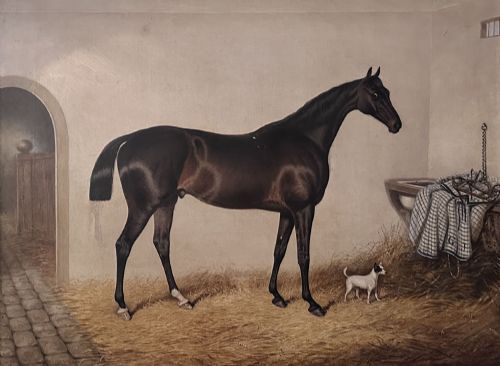


Traditional Equestrian Fine Art
Traditional equestrian fine art captures horses and riders in oil and canvas across the nineteenth and twentieth centuries.
Traditional Equestrian Fine Art
Traditional equestrian fine art encompasses oil paintings and watercolours depicting horses, hunting scenes, and rural life. Buyers browsing this page frequently encounter Victorian and nineteenth-century canvases focusing on individual animal portraits and rural farmyard settings.
The subjects range from solitary bay hunters and dappled buckskins to complex coaching scenes and horse fairs. Many works place horses alongside cattle, pigs, and hounds within detailed country landscapes.
Most examples originate from British and French schools active during the Victorian and Edwardian eras. These pieces record the central role of the horse in nineteenth-century transport, agriculture, and sport.
How they were made
Artists painted primarily with oil paint on stretched canvas or applied watercolours to paper, mounting finished works in wood frames finished with gilt or giltwood. The physical construction relies on traditional stretched linen and heavy timber stretchers.
Brushwork varies from the tight academic realism of Victorian portraiture to the looser, atmospheric strokes associated with British Impressionism and country schools. Pigments were layered to build depth in coats, manes, and pastoral backgrounds.
Ducks and pigs frequently wander into the background of these serious equestrian scenes.
What varies in quality
Quality rests upon the artist's command of equine anatomy, perspective, and the play of light across muscle and coat. Superior works demonstrate precise observation of movement and proportion, whereas lesser examples stiffly render the animal.
The integration of the horse into its surrounding landscape also dictates standard. Masterworks balance the central animal subject with a harmonious background of handlers, hounds, or farmyard architecture.
Albert Clark·John Sanderson Wells·John Frederick Herring·Edward Brice Stanley Montefiore·Alexander Maclean·John Atkinson·Sir John Gilbert·Michael Lyne·Heywood Hardy·John Frederick Herring Jnr·John Richard Worsdale·Benedict Angell Hyland·Edward Lloyd·George Cole·John Parker Davis
The Traditional Equestrian Fine Art Glossary
- Canvas
- A heavy woven fabric used as a surface for oil painting. It is typically stretched tightly over a wooden frame before application.
- Giltwood
- Timber carved and surfaced with thin sheets of gold leaf. This material frequently frames nineteenth-century paintings.
- Sporting art
- A genre of painting dedicated to horses, hounds, shooting, and field sports. It flourished across Britain during the Victorian period.
- Watercolour
- A painting method where fine pigment is suspended in a water-based solution. It produces transparent layers on paper.
Traditional Equestrian Fine Art: Frequently Asked Questions
What is traditional equestrian fine art?
Traditional equestrian fine art comprises nineteenth-century and early twentieth-century paintings depicting horses in sporting, agricultural, and portrait contexts.
These works utilise oil paint or watercolour to document the animal's central place in historical rural life and leisure.
How do I identify a Victorian horse painting?
Victorian horse paintings usually display detailed realism, heavier giltwood frames, and subjects related to coaching, hunting, or farm labour.
Signatures, clothing styles of riders, and canvas stamps offer further clues to the specific decade of creation.
Where were these paintings produced?
The majority originate from British and French artists working within established regional schools and academic traditions.
Painters captured local horse fairs, country estates, and rural farmyards across England and continental Europe.
How should I care for an oil painting?
Keep canvas paintings away from direct sunlight and sharp temperature fluctuations that cause paint and wood to expand.
Dust surfaces gently with a soft, dry brush and avoid liquid cleaners on both the canvas and the gilt frame.