




Traditional Chinese Nesting Tables
Traditional chinese nesting tables offer a set of graduated surfaces that slide neatly together, bringing both utility and fine grain work into a room.
Traditional Chinese Nesting Tables
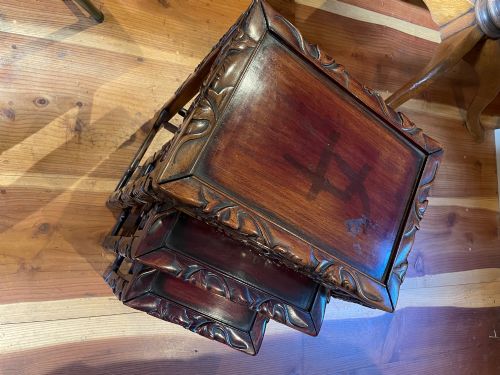
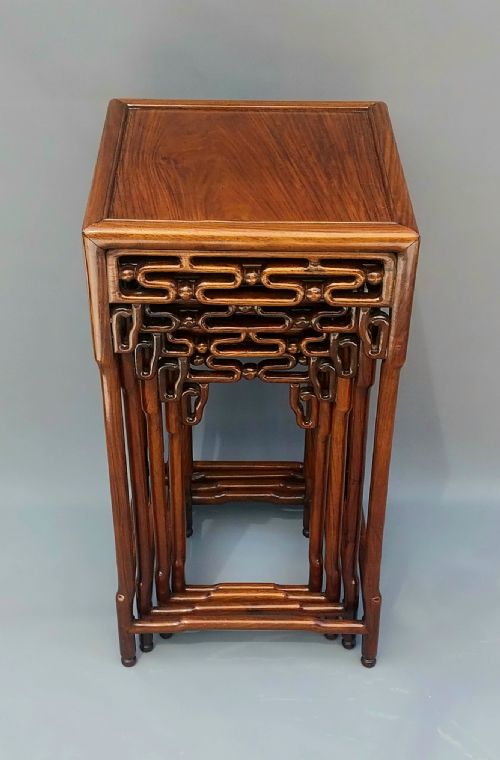
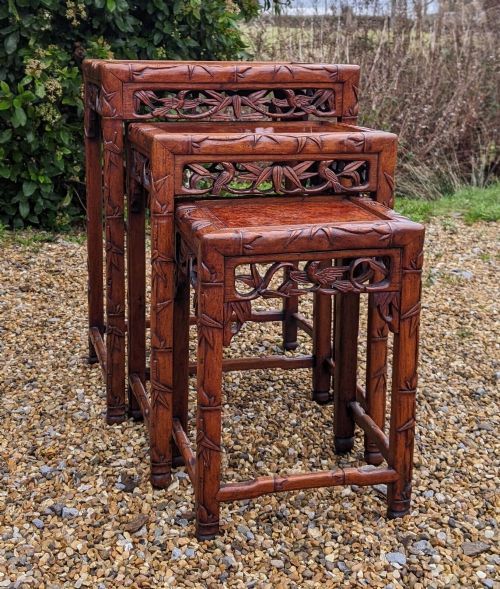
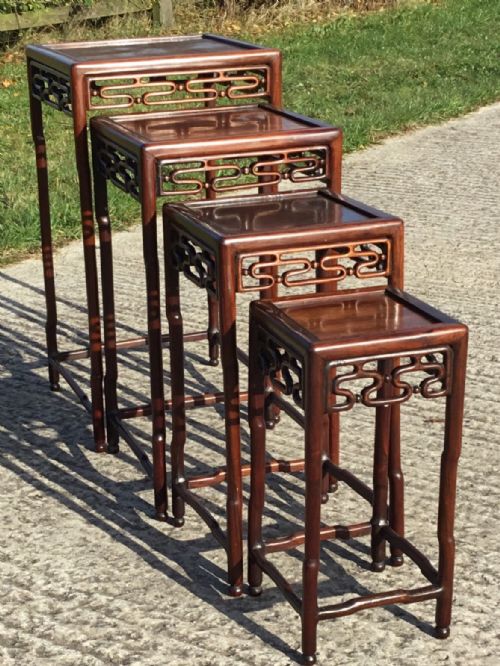
Traditional chinese nesting tables comprise sets of graduating surfaces designed to slide one beneath another when not in use, serving as occasional or coffee tables. These pieces frequently appear in configurations of three or four separate tables, shaped primarily from dense Asian timbers.
The selections available span the nineteenth century, the Victorian era, and the early decades of the twentieth century. Common stylistic descriptors include Chinese export, late Qing dynasty, and traditional Chinese forms, reflecting both domestic use and international trade.
How they were made
Craftsmen utilised heavy timbers such as rosewood, hongmu, and huanghuali wood to construct these sets, relying on the natural strength and rich grain of the wood. These dense hardwoods allowed for slender yet robust framing that could support repeated sliding and daily use.
Joinery techniques without metal fixings held the frames together, maintaining clean lines across each graduated table in the nest.
Traditional Chinese Nesting Tables Retail Price Guide 2026
Typical asking prices for traditional chinese nesting tables among the pieces listed under this phrase on Sellingantiques today, from the lower quarter to the upper quarter. They describe what is for sale here now, not the wider market.
Some nineteenth-century makers built these tables so tightly that the smallest one acts as a secret biscuit press.
What varies in quality
Quality rests principally on the choice of timber and the natural character of the grain visible across the tabletops. Sets fashioned from prized woods like huanghuali or heavily figured rosewood display superior visual depth compared to simpler hardwood variants.
The refinement of the proportions and the precision with which the smaller tables slide into the largest frame also separate standard production from finer workshop output.
The Traditional Chinese Nesting Tables Glossary
- Hongmu
- A translation meaning red wood, used to describe dense tropical hardwoods prized by traditional makers for their deep colour and weight. It provides exceptional durability.
- Graduated
- Describing a set of tables where each successive piece is slightly smaller than the last, allowing them to fit neatly together in a stack. This arrangement saves space when the tables are not deployed.
- Quartetto
- An alternative term for a set of four matching occasional tables designed to nest together. The word derives from musical terminology.
- Qing dynasty
- The final imperial dynasty of China, spanning from sixteen forty-four to nineteen twelve, whose aesthetic heavily influences these traditional forms.
Traditional Chinese Nesting Tables: Frequently Asked Questions
What are traditional chinese nesting tables?
Traditional chinese nesting tables are sets of graduating occasional tables designed to slide neatly underneath one another to save space.
They typically come in sets of three or four, constructed from dense hardwoods like rosewood or huanghuali.
How were nesting tables used?
These tables served as flexible surfaces for tea, writing, or display, easily separated when guests visited.
Once finished, they stacked back into a single compact footprint against a wall or in a corner.
How do you date these tables?
Dating relies on timber selection, construction methods, and stylistic cues linked to the nineteenth and early twentieth centuries.
Earlier nineteenth-century examples often exhibit superior hongmu or huanghuali timbers with traditional joinery.
How do you live with them?
They offer practical surfaces that can be deployed individually around a room and stored compactly when cleared.
Keep them away from direct heat sources to protect the dense hardwood surfaces and traditional finishes.