


Traditional Chess Board
A traditional chess board is a playing surface that brings tactile precision to every match, offering a solid surface for strategy.
Traditional Chess Board
A traditional chess board represents a tactical surface designed for play, appearing across multiple eras from the nineteenth century to the twentieth. These boards manifest in several distinct formats, including folding boards, travelling sets, leather library editions, and comprehensive games compendiums.
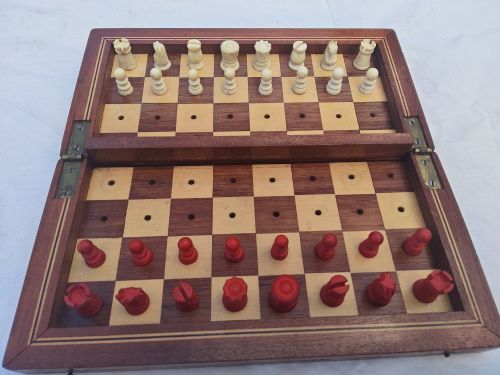
The versions most commonly met on this page span the Victorian and Edwardian periods, utilising timbers such as mahogany, rosewood, and sycamore. Makers constructed these items for domestic leisure, often combining chess with backgammon or drafting sets within a single folding case.
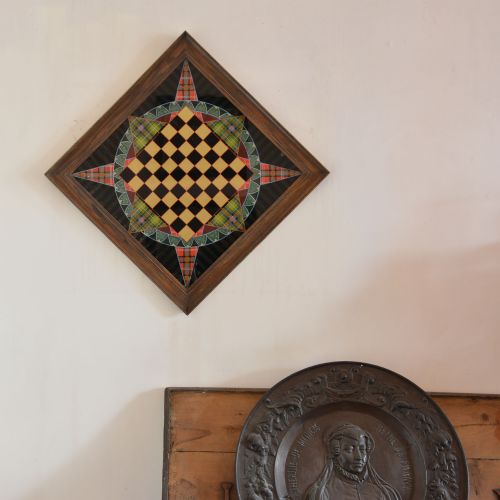
Makers also produced specific regional variants, such as Scottish reverse glass painted boards and Ottoman Revival designs. English traditional pieces dominate the selection, showing the domestic production methods typical of the period.
How they were made
Craftsmen built these boards using dense hardwoods like mahogany and rosewood for the dark squares and borders, paired with lighter timbers such as boxwood and sycamore. Carpenters frequently employed folding mechanisms with brass hinges to allow the board to double as a storage box for pieces.
Surface ornamentation involved varied techniques, including inlaid veneers, gilt tooling on leather library boards, and reverse glass painting executed on Scottish examples. Bone frequently formed the material for accompanying chess sets, shaped into traditional patterns like the Whittington design.
Joinery techniques focused on stability and durability during travel, ensuring the wooden squares remained flush despite shifts in temperature. Leather editions utilised gilt borders pressed directly into the hide to define the playing grid.
A Scottish artisan once decided that a flat wooden board simply lacked drama, introducing reverse glass painting to the game.
What varies in quality
The standard of a traditional chess board rests upon the precision of the timber inlay and the selection of figured veneers. Finer examples display meticulous matching of rosewood and mahogany grains, whereas simpler items utilise plain stained timbers.
The integrity of the playing surface dictates the overall grade, with superior boards maintaining perfectly flat folding leaves without warping. The execution of decorative elements, from reverse glass painting to bone carving on accompanying sets, marks the division between standard production and master work.
A British Chess Company
The Traditional Chess Board Glossary
- Compendium
- A multi-game box containing equipment for chess, backgammon, and other pastimes within a single folding case. These items consolidate several leisure activities into one portable wooden container.
- Staunton
- A standardised style of chess piece introduced in the mid-nineteenth century, featuring distinct, recognizable shapes for each role. This design became the tournament standard for play worldwide.
- Veneer
- A thin slice of decorative timber applied over a secondary wood base to provide a figured surface. This technique allows makers to utilise expensive rosewood or mahogany efficiently.
- Inlay
- The technique of embedding contrasting strips of wood or bone into the surface to form the grid pattern. Artisans execute this by cutting precise channels into the base timber.
- Library board
- A portable or table-format board covered in leather with gilt tooling, designed for quiet study. These items often fold to fit neatly on a bookshelf.
Traditional Chess Board: Frequently Asked Questions
What periods do these boards cover?
The pieces span the nineteenth century, including Victorian, Edwardian, and later 1930 examples. Makers produced these boards across various decades using traditional regional methods.
Collectors encounter specific eras identified through stylistic clues, such as gilt leather work from the 1900s or robust rosewood constructions from the 1890s.
How were travelling boards used?
Travelling boards functioned as portable gaming units designed for journeys, often featuring folding cases that stored the pieces inside. Passengers utilised them on trains or carriages to pass the time during transit.
Many of these portable designs doubled as backgammon boards or included slots to keep pieces secure while in motion.
What woods appear most often?
Mahogany, rosewood, boxwood, and sycamore form the primary materials for these playing surfaces. Craftsmen selected these timbers for their contrasting tones and durability during intense matches.
Secondary woods and leather also appear on specific library editions and folding compendium cases.
Are pieces included with the boards?
Some listings include complete chess sets or draughts pieces housed inside the folding compartments. Others offer the board as a standalone playing surface without accompanying playing pieces.
Compositions vary depending on whether the item forms part of a larger games compendium or a dedicated travelling set.