

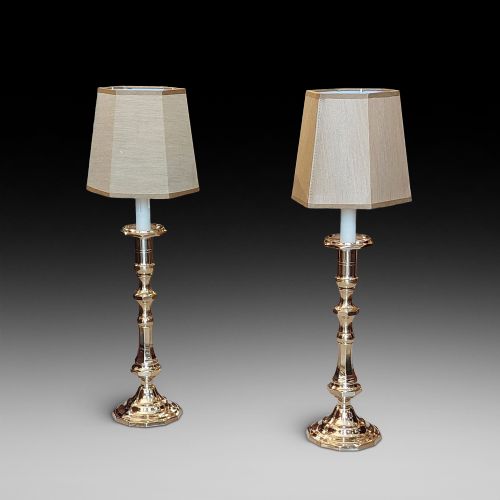


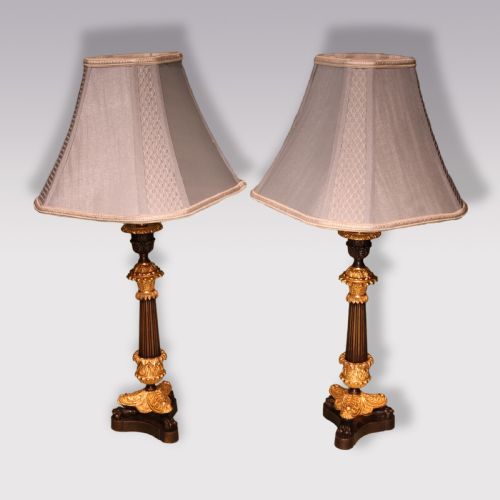


Traditional Brass Buffet Lamp
These traditional brass buffet lamp pieces bring classical column forms and warm metallic light to a room, offering the proportion and presence serious interiors demand.

Traditional Brass Buffet Lamp
When you search for a traditional brass buffet lamp, you encounter lighting built around historical revival styles, particularly the Corinthian column and classical candlestick forms. These pieces draw on Victorian, Georgian, and Louis XVI design vocabulary, translating architectural motifs into domestic illumination.
The versions most commonly met on this page span the nineteenth century through the early decades of the twentieth century, including pieces dated to nineteen-ten, nineteen-twenty, and nineteen-thirty. They appear singly or in pairs, often adapting earlier metalwork or ceramic vessels into tall table lamps.
Makers and workshops utilise styles ranging from French Neoclassical and French Empire to Chinoiserie and Anglo-Indian. This diversity means a traditional brass buffet lamp can anchor either a formal period dining room or a curated eclectic interior.
Materials and construction methods
Construction relies heavily on cast and turned brass, solid brass, bronze, and ormolu, sometimes complemented by electroplating, copper, enamel, and fabric shades in silk or other textiles. Metalwork techniques involve precision casting, chasing, and mounting, creating substantial weight and crisp architectural fluting on column shafts.
Many examples incorporate decorative elements from distinct artistic traditions, pairing metal bases with cloisonné vases or hand-painted details. The integration of electrical wiring into these older candlestick and vase bodies represents later adaptation of pieces originally intended for candles or oil.
Traditional Brass Buffet Lamp Retail Price Guide 2026
Typical asking prices for traditional brass buffet lamp among the pieces listed under this phrase on Sellingantiques today, from the lower quarter to the upper quarter. They describe what is for sale here now, not the wider market.
At least one nineteenth-century lamp proudly wears a coat of painted decoration that refuses to take itself too seriously.
Distinguishing quality across the range
Quality in a traditional brass buffet lamp is determined by the crispness of the casting and the depth of the metal finish, whether natural brass, gilded ormolu, or patinated bronze. Higher quality pieces display sharply defined acanthus leaves on column capitals and precise joining of heavy components rather than lightweight pressed sheet metal.
The inclusion of specific decorative arts techniques, such as detailed cloisonné enamel or documented French styling after classical models, elevates a piece. Superior examples maintain structural integrity and genuine period patination that mass-produced reproductions fail to replicate.
The Traditional Brass Buffet Lamp Glossary
- Ormolu
- Gilded bronze, usually mercury-gilded, used extensively in French decorative arts to provide a rich, warm metallic highlight. It requires careful cleaning to preserve the historic surface layer.
- Corinthian Column
- An architectural order featuring an ornate capital decorated with acanthus leaves, frequently adapted for the shafts of heavy metal table lamps. This form remains a staple of nineteenth-century classical revival lighting.
- Cloisonné
- An ancient technique for decorating metalwork objects with coloured glass paste placed within enclosed wire compartments. These decorated vessels are occasionally converted into distinctive table lamps.
- Chinoiserie
- European artistic style reflecting Chinese motifs and decorative techniques, popular across various furniture and lighting periods. It introduces asymmetrical patterns and exotic imagery to traditional forms.
Traditional Brass Buffet Lamp: Frequently Asked Questions
What is a traditional brass buffet lamp?
A traditional brass buffet lamp is a tall, slender table lamp, often styled after classical columns or candlesticks, designed to fit narrow sideboards and serving tables while providing ambient illumination.
These pieces typically date from the Victorian era into the early twentieth century, utilising solid brass, bronze, and ormolu to achieve a formal decorative presence.
How do I style these lamps at home?
These lamps suit formal dining rooms, libraries, and hallways where their vertical proportions and warm metallic surfaces can complement dark wood furniture and period textiles.
Pairing them with appropriate silk or fabric shades helps balance the visual weight of the heavy metal bases without overwhelming the surrounding space.
Are these lamps converted from older items?
Many examples began life as candlesticks, oil lamps, or decorative vases before being wired for electricity during subsequent decades of use.
This adaptive history is common among nineteenth-century lighting, where original metalwork bodies receive modern internal components to allow safe domestic operation.
How can I tell the period of a brass lamp?
Dating relies on examining the casting techniques, the style of the capital and base, and the specific composition of the metal alloys used in construction.
Victorian and Edwardian pieces often exhibit hand-finishing marks and heavier gauge brass compared to later mid-century commercial reproductions.