






Traditional Balkan Kilim
Traditional balkan kilim rugs bring geometric warmth and regional storytelling to floors, offering flatweave durability combined with folk artistry.
Traditional Balkan Kilim
These pieces are flatwoven rugs originating from the Balkan region, encompassing styles known as Balkan Folk, Balkan Traditional, and Ottoman Balkan. When exploring traditional balkan kilim listings, the dominant forms met are rugs and area rugs dating from the late nineteenth century through the early decades of the twentieth century. Examples include specific regional weaving styles such as Sarkoy and Pirot kilims.
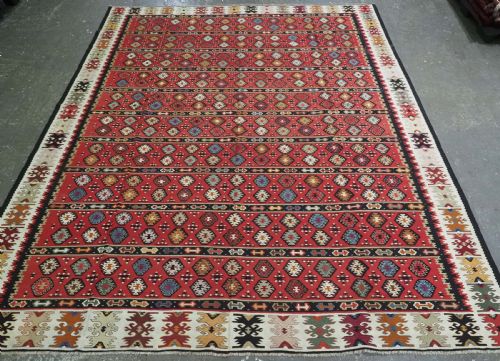
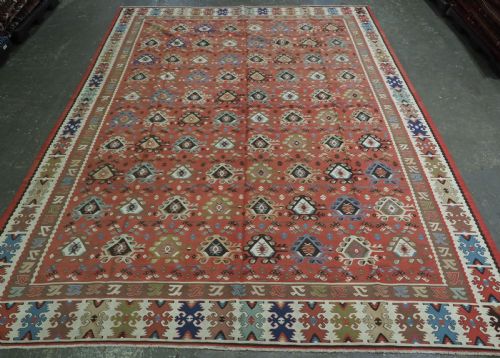
The aesthetic of these textiles relies on repeat medallions, flowering trees, lattice patterns, and fine banded arrangements. Rugs range from modest room sizes to large formats, often displaying classic design layouts passed down through generations of weavers. The palette spans warm soft colours, pastel tones, and deep reds that anchor a room with distinct historical character.
Originating across Thrace and surrounding Balkan territories, these floor coverings reflect a bridge of cultural influences between Ottoman traditions and local folk art. Pieces emerge from periods recorded across the eighteen-sixties, eighteen-nineties, and the nineteen-twenties to nineteen-thirties. Buyers encounter a cohesive visual language built upon repeating motifs and symmetrical compositions.
What varies in quality in traditional balkan kilim rugs
The distinction between tiers of traditional balkan kilim pieces rests on the precision of the flatweave structure and the complexity of the design layout. Finer examples display meticulous control over the slit-weave technique, resulting in sharp geometric transitions and balanced symmetry. Simpler compositions or standard repeat patterns represent more utilitarian domestic production rather than intricate masterwork.
Colour retention and the subtlety of the wool dye palette define the upper range of these textiles. Pieces exhibiting harmonious warm soft colours or scarce lattice arrangements achieve greater visual depth than those with straightforward, repetitive colour blocking. The visual impact of a well-preserved flowering tree or classic medallion design elevates the standing of an individual rug.
Some weavers hid tiny geometric surprises inside flowering tree branches, daring anyone walking past to spot the stray knot.
The Traditional Balkan Kilim Glossary
- Kilim
- A flatwoven rug or carpet produced without a knotted pile by tightly interlocking coloured wefts over warp threads. This technique creates a lightweight textile with identical patterns visible on both sides.
- Sarkoy
- A specific regional designation for flatweaves originating from the Thracian town of Sarkoy, known for distinctive floral and geometric compositions. These rugs frequently incorporate soft pastel palettes and large repeat motifs.
- Pirot
- A renowned rug-weaving centre located in the Balkans, famous for finely executed flatweaves featuring intricate geometric symmetry. Pirot pieces often share stylistic traits with Sarkoy textiles due to regional trade and cultural overlap.
- Slit-weave
- A fundamental flatweaving method where weft threads of different colours reverse direction around adjacent warp threads, leaving a small vertical slit. Weavers use this gap to form sharp diagonal lines and geometric patterns.
- Warp
- The stationary vertical threads stretched taut on a loom that form the structural foundation of the textile. Weft yarns are passed horizontally over and under these foundational threads.
Traditional Balkan Kilim: Frequently Asked Questions
Where were traditional balkan kilim rugs made?
These flatweaves originated across the Balkan region, including areas associated with Pirot, Sarkoy, and Thrace. Local weavers combined Ottoman design influences with distinct regional folk art traditions.
Production spanned towns and rural communities where wool textile crafts flourished through the nineteenth and early twentieth centuries.
How do I style a traditional balkan kilim?
Place these flatweaves on wooden floors or neutral tiles where their geometric patterns and soft colours can serve as a visual anchor. Their flat profile makes them practical for placement beneath dining tables or in high-traffic hallways.
Pair them with simple furnishings to let the flowering tree or repeat medallion designs remain the focal point of the room.
Are these rugs made from wool?
The listings show that wool serves as the primary material for constructing these flatweaves. It was utilised for both the structural foundation and the coloured pattern wefts.
This material choice provided the durability required for domestic floor coverings while accepting natural dyes readily.
What designs appear on these kilims?
Common motifs include flowering trees, lattice patterns, banded arrangements, and large repeat medallions. Many pieces follow classic Balkan folk layouts handed down through generations of makers.
Designs range from simple all-over repeats to complex compositions requiring precise flatweaving technique.
How do I date a traditional balkan kilim?
Dating relies on stylistic analysis, material characteristics, and documented periods ranging from the eighteen-sixties to the nineteen-thirties. Pieces from the nineteenth century often exhibit distinct regional dye palettes and hand-spun wool textures.
Twentieth-century examples transition into refined pastel tones and standardised repeat medallion formats.