
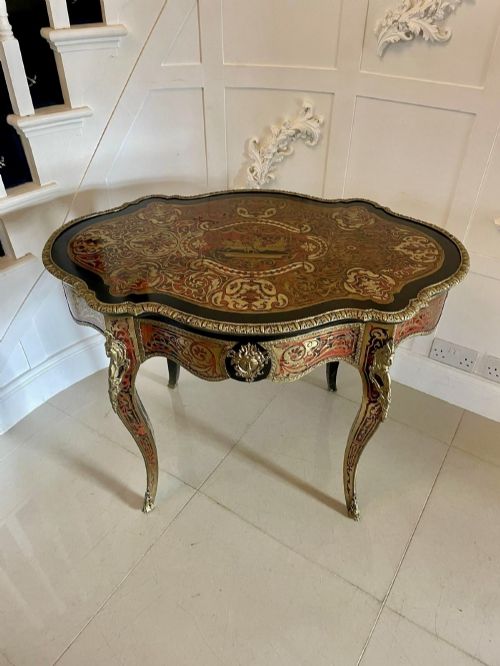
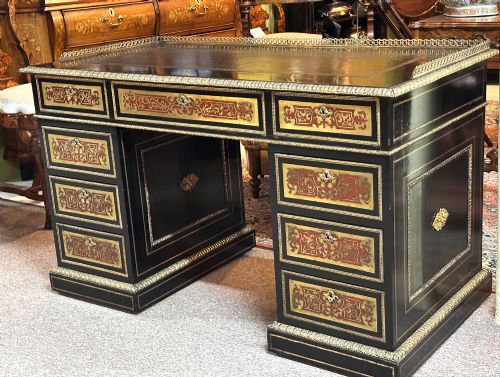
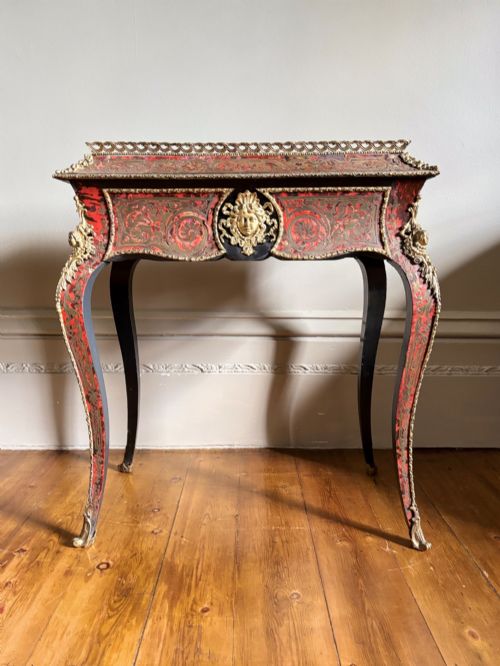
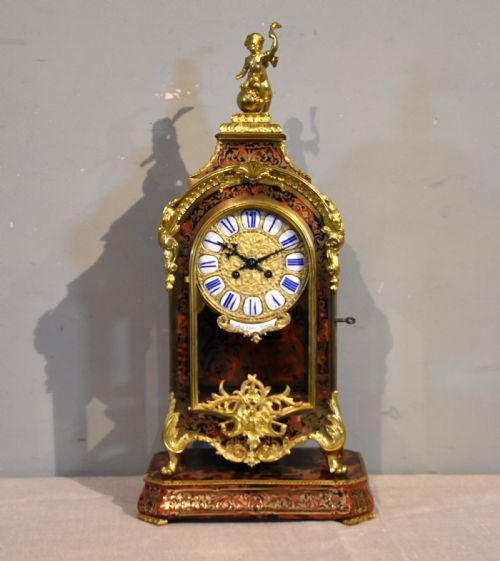
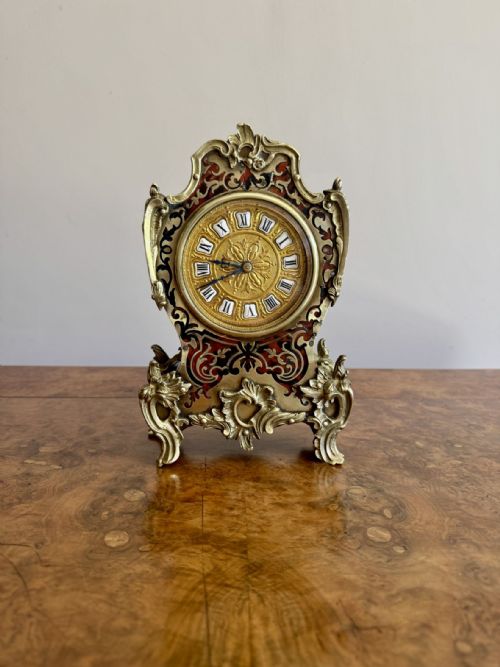


Tortoiseshell Marquetry Table
These tortoiseshell marquetry table pieces offer intricate brass inlay and rich ebonised wood, bringing grand French revival style into the home.
Tortoiseshell Marquetry Table
When you search for a tortoiseshell marquetry table, you are looking at nineteenth-century French furniture often designated as Boulle work. The pieces appearing here span centre tables, writing desks, side tables, card tables, and jardiniere stands.
Most examples date from the Victorian era and adopt Louis XIV, Louis XV, or Napoleon III revival styles. They combine tortoiseshell with cut brass inlay set into dark ebonised wood frames.
Centre tables and writing desks form the bulk of the larger furniture forms, frequently finished with shaped tops and gilt bronze mounts. Smaller card tables and jardiniere stands share the same decorative vocabulary.
What varies in quality
Quality rests in the crispness of the brass cutting and the depth of the tortoiseshell ground. Finer pieces display exceptionally tight registration between the metal and shell elements without excessive filler in the joints.
Tortoiseshell marquetry tables quietly prove that cabinet makers could make sea turtles and brass sheets look like absolute royalty.
Maison Millet·Edwards & Roberts·Samuel Marti
The Tortoiseshell Marquetry Table Glossary
- Boulle work
- A method of marquetry using brass and tortoiseshell developed in France and popularised during the seventeenth and nineteenth centuries. This technique creates elaborate floral and geometric patterns across tables and clocks.
- Ormolu
- Gilded bronze mounts applied to furniture edges and corners for decorative enrichment. These metallic elements protect vulnerable areas and enhance the French revival aesthetic.
- Ebonised wood
- Timber treated to resemble dark ebony wood, commonly used as a contrasting background for inlaid brass and shell. This dark ground makes the tortoiseshell marquetry stand out visually.
- Bureau plat
- A flat-topped freestanding writing desk fitted with drawers and elaborate surface inlay. These desks often feature cabriole legs and gilt bronze mounts.
Tortoiseshell Marquetry Table: Frequently Asked Questions
What is a Boulle table?
A Boulle table is a nineteenth-century French piece decorated with tortoiseshell and brass marquetry. These tables reflect Louis revival styles and feature rich metallic inlays.
They serve as centre tables, writing desks, or card tables within formal interior schemes.
How are these tables cleaned?
Maintenance requires gentle dusting with a soft dry cloth to protect the delicate brass and shell inlay. Moisture and harsh cleaning agents can damage the traditional adhesives holding the marquetry.
Keeping the pieces away from direct sunlight preserves the rich tones of the tortoiseshell.
Are these pieces French?
The majority of these tables originate from nineteenth-century France or follow French revival designs popular during the Victorian period. Parisian workshops produced many of the finest examples seen today.
English cabinet makers also adopted the Boulle technique during the same decades.
What wood is used underneath?
The structural carcase is typically constructed from timber that is then ebonised to create a dark background. Oak or pine often forms the internal secondary framing beneath the decorative veneers.
Visible surfaces receive the black finish to contrast with the golden brass and amber shell.