
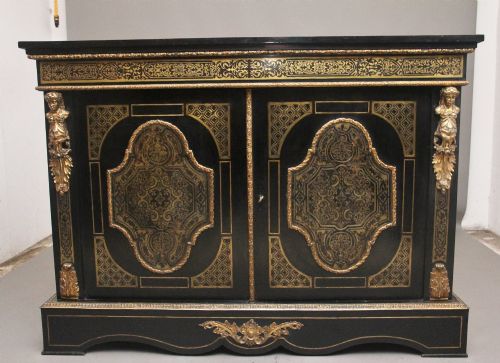
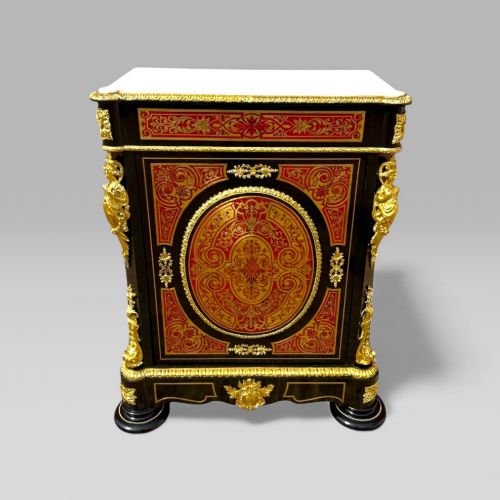


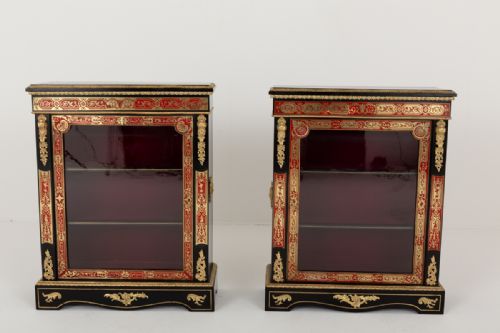


Tortoiseshell Brass Inlaid Cabinet
A tortoiseshell brass inlaid cabinet brings unmistakable nineteenth-century French revival grandeur into a room through elaborate marquetry and gilt mounts.
Tortoiseshell Brass Inlaid Cabinet
A tortoiseshell brass inlaid cabinet sits among nineteenth-century forms such as pier cabinets, credenzas, side cabinets, display cabinets, and writing desks. These pieces originate from French Napoleon III, Victorian, and Louis XVI styles, showcasing the distinctive revival aesthetics of the period.
Buyers will most frequently encounter ebonised wood or rosewood side cabinets and pier cabinets featuring traditional boullework. The selection spans compact writing desks like the bonheur du jour up to larger credenzas, bookcases, and breakfront side cabinets.
The form functions primarily as a statement display piece or a refined writing surface. Their architectural presence integrates smoothly into period interiors while providing enclosed shelving or surface display.
Materials and construction methods
The technique relies on precise cutting of thin sheets of brass and tortoiseshell, historically pressed together and sawn into interlocking patterns. Ebonised wood or rosewood forms the foundational carcase, providing a dark contrasting background that accentuates the metallic inlay.
Gilt bronze and ormolu mounts punctuate the corners, friezes, and feet, adding sculptural definition to the rectilinear and serpentine cabinet carcases. Glass panels frequently appear in doors for display cabinets and bibliotheques, while marble tops finish select pier cabinets.
The documented pieces span French Napoleon III, Victorian, Louis XVI style, and Victorian Boulle Revival periods dating from 1850 through 1880.
Assessing quality and execution
The finesse of the brass and tortoiseshell cutting dictates the visual sharpness of the scrollwork and geometric motifs. Superior examples maintain tight junctions between the inlaid elements without excessive filler or widening gaps.
The crispness of the cast ormolu and gilt bronze mounts reveals the workshop standard, alongside the depth of the ebonised finish or the grain selection in rosewood carcases. Structural integrity in the doors and hinges ensures the functional longevity of these display and storage pieces.
The Tortoiseshell Brass Inlaid Cabinet Glossary
- Ormolu
- Gilded bronze applied as decorative mounts, feet, and edging on nineteenth-century furniture. The technique involves coating cast bronze with a mercury and gold amalgam before heating.
- Ebonised
- Wood treated with a dark stain or finish to imitate ebony. This dark surface creates a high-contrast background for brass and tortoiseshell inlay.
- Pier Cabinet
- A narrow cabinet designed specifically to stand against the wall space between windows. These pieces often feature glass doors for displaying collections.
- Bonheur du jour
- A small, light nineteenth-century writing desk featuring a set of drawers and compartments on the top surface. The form suits informal correspondence rather than heavy administrative work.
Tortoiseshell Brass Inlaid Cabinet: Frequently Asked Questions
How do I care for a boulle cabinet?
Keep the cabinet away from direct sunlight and fluctuating heat sources to prevent the tortoiseshell and wood from drying out or warping. Dust gently with a dry, soft cloth and avoid chemical polishes that can degrade the historic finish.
Maintain a stable indoor humidity level to protect the delicate brass and tortoiseshell inlay from lifting along the edges. Professional conservation should address any loose mounts or marquetry immediately.
What is the difference between a credenza and a pier cabinet?
A credenza is typically a low, wide side cabinet often fitted with multiple doors used for display and storage. They command considerable wall space and serve as focal points in dining rooms or grand salons.
A pier cabinet is narrower and taller, specifically proportioned to fit the wall space between windows. These frequently incorporate glazed doors and marble tops suited for smaller decorative objects.
How can I tell Napoleon III style from Victorian pieces?
Napoleon III pieces often display heavier French influence with elaborate ormolu mounts, serpentine forms, and sophisticated boulle marquetry. These items frequently originate from French workshops or closely follow Parisian designs.
Victorian examples produced in Britain adopt similar French revival motifs but often reflect local cabinetmaking traditions and proportions. Both styles utilise ebonised wood and brass inlay, making the specific decorative detailing and construction techniques the primary indicators of origin.
Where should I place a tortoiseshell brass inlaid cabinet?
Position the cabinet against an interior wall away from direct sunlight to protect the sensitive tortoiseshell and ebonised wood surfaces. A location with controlled ambient light allows the brass inlay and ormolu mounts to catch the room lighting effectively.
Ensure the piece sits clear of high-traffic walkways where doors or projecting mounts might experience accidental impact. A room with stable temperature and humidity offers the ideal environment for long-term preservation.