
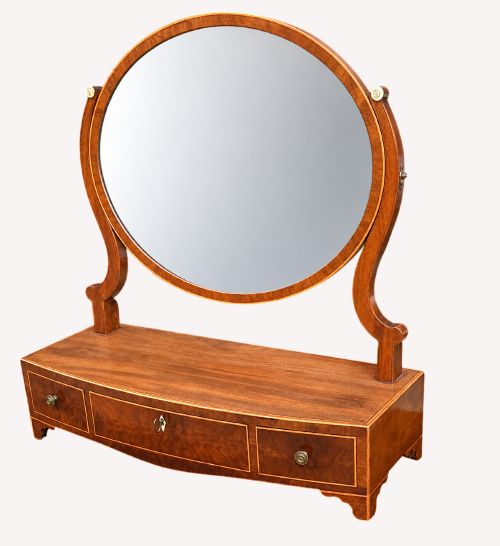
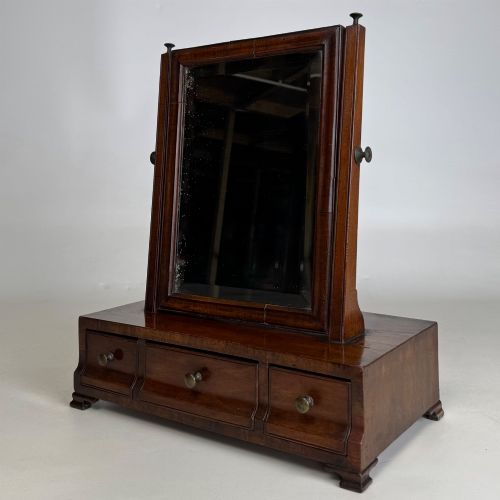
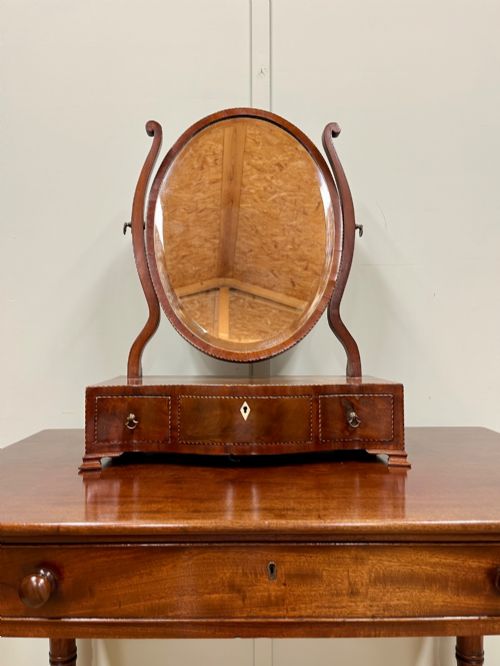
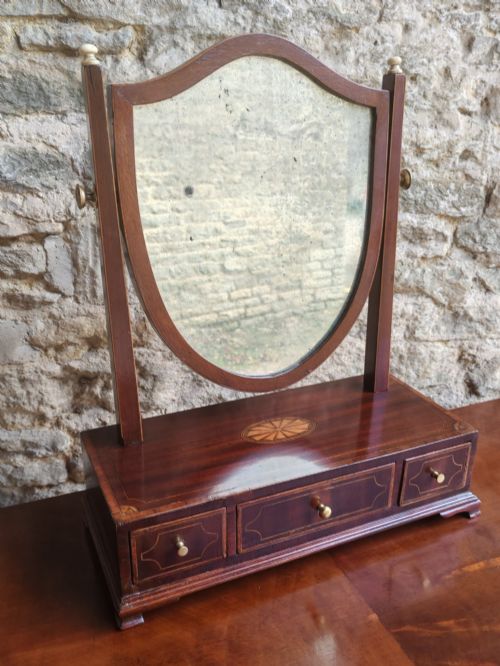


Toilet Mirror Box Base
These toilet mirror box base pieces combine a swing glass with a functional storage compartment, offering period charm for your dressing table.
Toilet Mirror Box Base
A toilet mirror box base sits upon a table or chest, providing a pivoting mirror mounted above a small fitted compartment or drawers. When you search for a toilet mirror box base, you encounter examples ranging from the early Georgian period through the Victorian era.
The base typically houses small drawers for trinkets or documents, supporting upright arms that hold the glass. The form evolved through Queen Anne, George II, George III, and Regency styles, shifting from walnut veneers to figured mahogany and occasionally lacquered finishes.
Most pieces date from the eighteenth and nineteenth centuries, spanning eras noted for refined cabinet making. You will find rectangular plates, shield shapes, and serpentine outlines among the variations recorded here.
Materials and construction methods
Cabinet makers utilised dense timbers such as mahogany and walnut, frequently applying boxwood inlay or gilded wood accents to enrich the surfaces. Glass plates were silvered by hand and held within adjustable wooden frames supported by brass pivots.
Box bases were constructed with dovetailed joints to withstand daily use, housing small drawers lined with paper or soft wood. More elaborate examples incorporated serpentine fronts and miniature bureau interiors behind the mirror frame.
One exceptional piece pairs a swing mirror with a miniature bureau base, proving that eighteenth century correspondence could happen on a very small scale indeed.
Distinguishing quality and craftsmanship
Quality rests in the choice of timber figure, such as richly grained mahogany or figured walnut veneer, alongside the crispness of the boxwood inlay. Superior examples display careful proportion between the box base and the swing glass, with harmonious lines rather than heavy proportions.
The interior joinery and drawer construction reveal the maker's hand, where tight dovetails and matching secondary woods indicate higher grade production. Original glass plates, brass hardware, and intact lacquer work distinguish the finest surviving pieces from later restorations.
John Franklin London
The Toilet Mirror Box Base Glossary
- Box base
- The enclosed lower section of a dressing mirror that contains drawers or a small compartment.
- Swing glass
- The pivoting mirror plate mounted between upright arms above the base.
- Serpentine
- A curved shape featuring a convex centre flanked by concave sides.
- Harewood
- Sycamore wood that has been stained to a greyish brown tone, popular in high end Georgian cabinet making.
- Dovetail
- A joint formed by interlocking wedge shaped fingers, used to join drawer corners securely.
Toilet Mirror Box Base: Frequently Asked Questions
What is a toilet mirror box base?
It is a tabletop dressing mirror attached to a small wooden cabinet or box base containing drawers.
These pieces were designed for bedrooms and dressing rooms to assist with grooming and personal care.
How were these mirrors used historically?
They sat upon larger chests of drawers or dressing tables to provide a clear reflection for shaving or styling hair.
The enclosed box base held small valuables, cosmetics, and letters out of sight.
How do I date a Georgian mirror?
Dating relies on observing the timber choice, such as walnut for early pieces or mahogany for later Georgian work, alongside construction details.
Cabinet styles shifted from plain rectangular boxes to serpentine outlines and shield shaped glass frames over the course of the eighteenth century.
Are the mirror plates original?
Many surviving pieces retain their original glass, which often exhibits minor foxing and age spots due to the early silvering process.
Replacements do occur, so inspecting the fit within the wooden frame provides clues to its age.
How do I care for antique wood?
Keep the wood away from direct sunlight and fluctuating heat sources to prevent the veneers from drying and cracking.
Regular dusting with a dry cloth and occasional application of appropriate wax helps maintain the surface finish.