
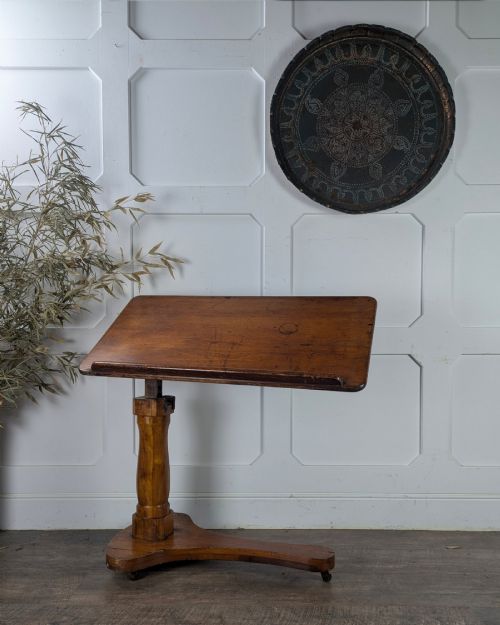
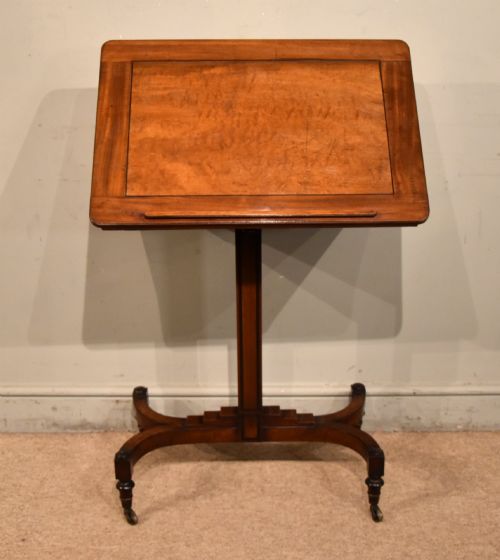
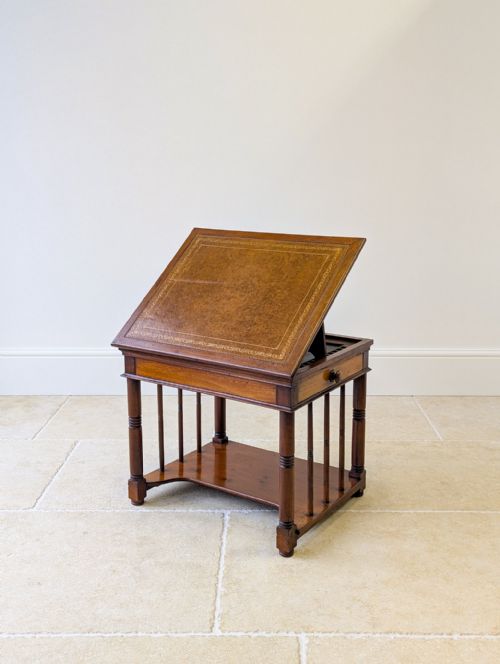
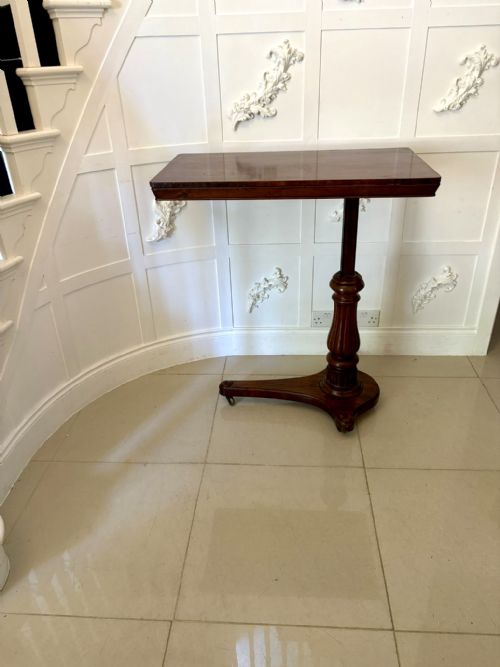
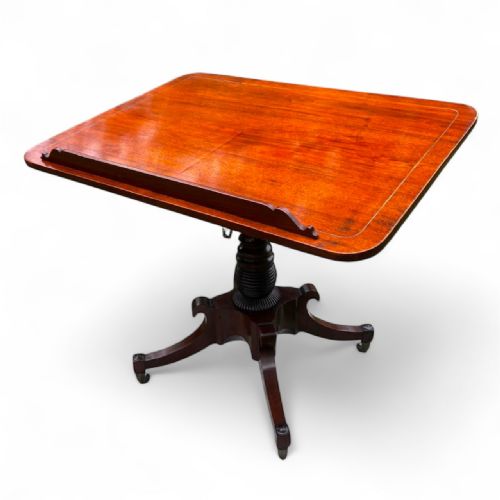


Tilt Top Reading Table
These tilt top reading table examples offer adjustable surfaces designed for books, music, and writing across Georgian, Regency, and Victorian periods.
Tilt Top Reading Table
A tilt top reading table provides a surface that inclines for reading, music, or writing, often featuring adjustable heights or folding tops. Buyers seeking a tilt top reading table encounter forms ranging from library chairsides to music stands and double-sided desks.
The materials recorded across these pieces centre on mahogany alongside brass, pine, iron, leather, and cast iron. Surviving examples span Georgian, Regency, Victorian, and Edwardian eras, including specialised pieces like artist's or architect's desks and mobility aids.
How they were made
Makers utilised solid timbers such as mahogany and pine, shaping surfaces for daily utility in libraries, music rooms, and studies. Brass inlay and hardware provided structural adjustment and decorative detail on select examples.
Cast iron and iron components appeared in later Victorian bed tables and mobility aids, offering robust mechanisms for height and angle adjustments. Leather inserts featured on desks and reading tables to provide durable writing surfaces.
Object types include occasional tables, lecterns, reading stands, desks, and writing tables.
What varies in quality
Quality rests in the precision of the adjustable mechanisms and the integrity of the timber framing. Superior pieces integrate brass inlay and sophisticated pivoting actions smoothly into the overall design.
The choice of primary wood and secondary materials dictates the standard of the piece, with finely figured mahogany and robust cast iron supports distinguishing higher grades from utility items.
The Tilt Top Reading Table Glossary
- Tilt top
- A tabletop mechanism that pivots from a horizontal position to an inclined angle for reading or storage. This allows the surface to function as both a conventional table and a lectern.
- Lectern
- A stand with a slanted top used to hold a book or manuscript at a reading height. They appear frequently in educational, religious, and domestic settings.
- George III period
- The era spanning the reign of King George III from 1760 to 1820, known for refined cabinetmaking and classical proportions. Pieces from this period often display elegant proportions and restrained ornamentation.
- Double sided
- A furniture configuration accessible from two opposing sides, typically featuring drawers or surfaces facing both directions. These pieces often stood free in the centre of a room rather than against a wall.
Tilt Top Reading Table: Frequently Asked Questions
What is a tilt top reading table?
A tilt top reading table is a piece of furniture designed with an adjustable surface that can be angled for reading, writing, or holding sheet music. These tables served scholars, musicians, and readers in libraries and parlours.
Surviving examples utilise materials such as mahogany, pine, and brass, spanning several centuries of domestic design from the Georgian period through to the Edwardian era.
How were these tables used?
Users adjusted the height and angle of the surface to support books, folios, or music sheets while seated in chairs or at desks. Some configurations included double-sided access or candle stands for evening work.
Specialised variants functioned as artist's desks, architect's tables, or bedside mobility aids, reflecting the diverse domestic and professional requirements of past centuries.
How do I identify the period?
Period identification relies on observing timber selection, construction methods, and hardware styles associated with eras like the Regency or Victorian periods. Georgian and George III pieces typically exhibit classical lines, while later Victorian and Edwardian items incorporate cast iron mechanisms.
Matching the design characteristics with recorded historical styles helps narrow down the decade of manufacture for each individual piece.
Are all tilt top tables adjustable?
Many examples feature mechanisms to alter the angle of the top, while others incorporate adjustable height columns or pivoting joints. The presence of brass ratchets, hinges, or screws usually indicates functional adjustability.
Reviewing the specific hardware on each piece reveals how the original maker intended the table to be manipulated and positioned during use.