
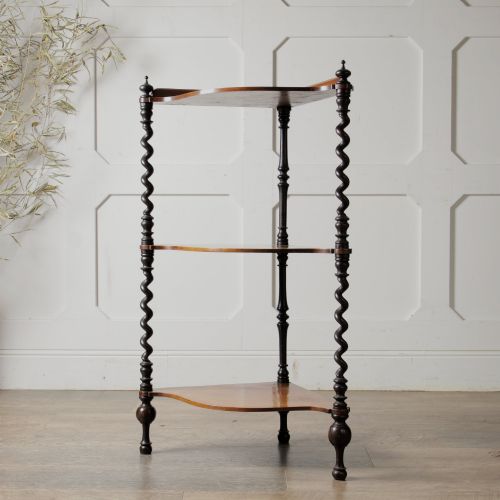
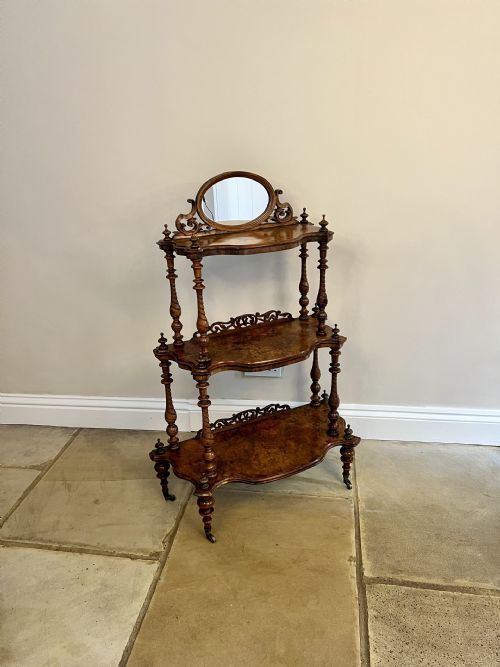
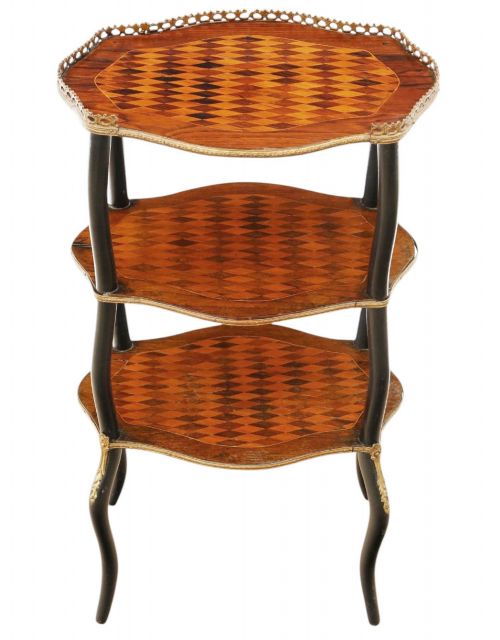
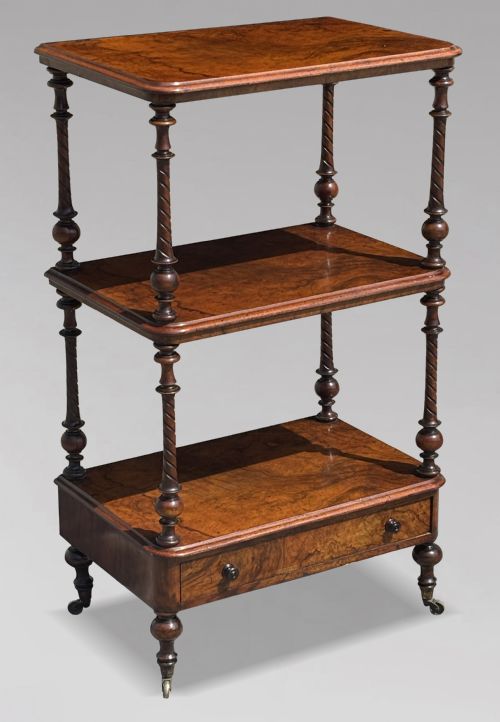




Three Tier Corner Shelf
A three tier corner shelf makes clever use of unused room, holding books and ornaments across stacked wooden surfaces.
Three Tier Corner Shelf
Beyond standard timber variants, the selection includes pieces described as whatnots or etageres, utilising bamboo, burr walnut and ceramic elements. They serve primarily to display small decorative objects or hold books without taking up floor space in narrow rooms.
How they were made
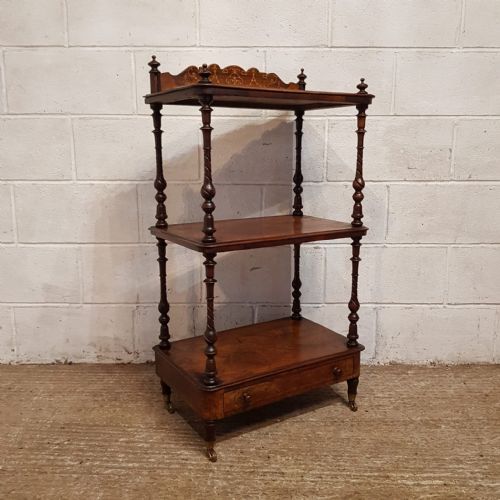
Cabinetmakers constructed these shelves using solid hardwoods like mahogany and walnut, frequently applying veneers of burr walnut or rosewood to the display surfaces. Turnery produced the supporting columns and barley twist uprights, while joinery methods secured each tier to the vertical frame.
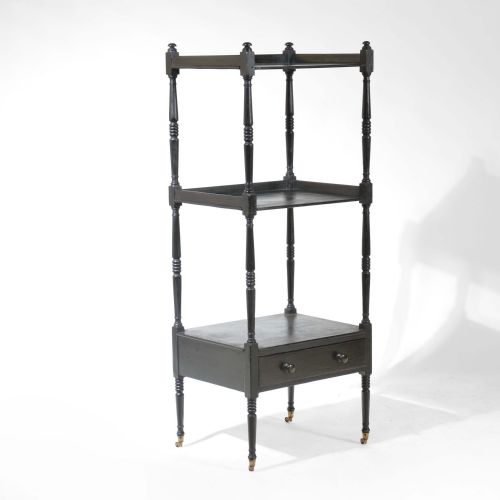
Decoration often involved inlay, parquetry or ebonising to contrast the grain of the wood. Some examples incorporated bamboo or slatted iron riveted structures, showing varied material uses across the nineteenth century.
The listings show materials ranging from traditional mahogany and walnut to ceramic, bamboo and slatted iron.
What varies in quality
Quality rests upon the choice of timber and the precision of the veneer work, particularly on burr walnut and rosewood surfaces. Finely figured grain patterns and careful matching across the tiers separate standard items from finer productions.
The sophistication of the turnery on the upright supports and the crispness of any inlay or carved detail indicate the skill of the original workshop. Robust construction at the joints ensures stability across all three levels.
The Three Tier Corner Shelf Glossary
- Whatnot
- A piece of furniture with shelves for displaying ornaments, books or small objects. They are often freestanding or designed to fit into corners.
- Etagere
- A piece of furniture consisting of a set of open shelves for displaying small articles. The term is frequently used interchangeably with whatnot.
- Barley twist
- A type of turned wooden column resembling the spirals of a barley sugar twist. This decorative turning appears frequently on nineteenth-century uprights.
- Burr walnut
- Wood taken from a walnut tree growth containing swirling grain patterns. It provides a highly decorative surface veneer on finer cabinets and shelves.
- Parquetry
- Geometric mosaic woodwork used for decorative floors or furniture panels. It employs contrasting timber pieces to create patterned surfaces on shelves.
Three Tier Corner Shelf: Frequently Asked Questions
Where should I place a corner shelf?
These units fit directly into ninety-degree room angles to utilise dead space effectively. They sit comfortably in living rooms, hallways or studies.
Because they rise in tiers, they lift decorative objects off the ground and draw the eye upward without obstructing pathways.
Can these shelves hold heavy books?
Most examples are designed for displaying ceramics, small ornaments or light volumes rather than heavy reference sets. The tier construction relies on slender turned supports.
Checking the rigidity of the uprights and shelf joints helps determine what weight a specific piece can safely carry.
How do I identify a Victorian piece?
Victorian examples frequently utilise mahogany, walnut or rosewood, often featuring rich grain figures or dark ebonised finishes. Turnery styles range from simple columns to elaborate barley twists.
Details such as inlaid woodwork or carved trim often point towards mid to late nineteenth-century manufacture.
What is the difference between a whatnot and an etagere?
Both terms describe open-shelved furniture intended for display, though etagere often leans toward French-influenced designs. In practical terms, makers used both labels for similar stacked shelving units.
Construction methods and tier counts remain largely consistent across items given either designation.