
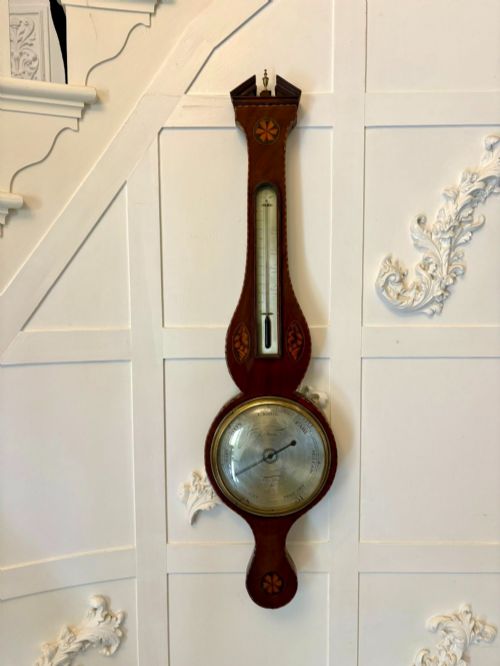
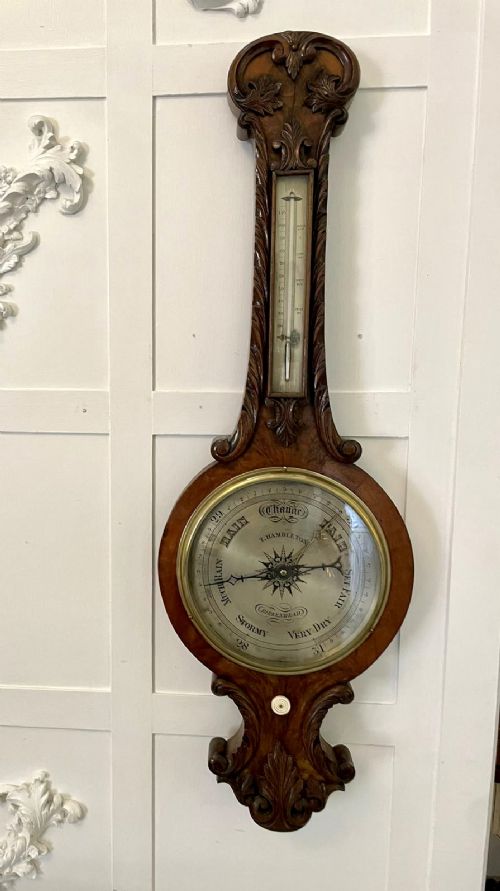
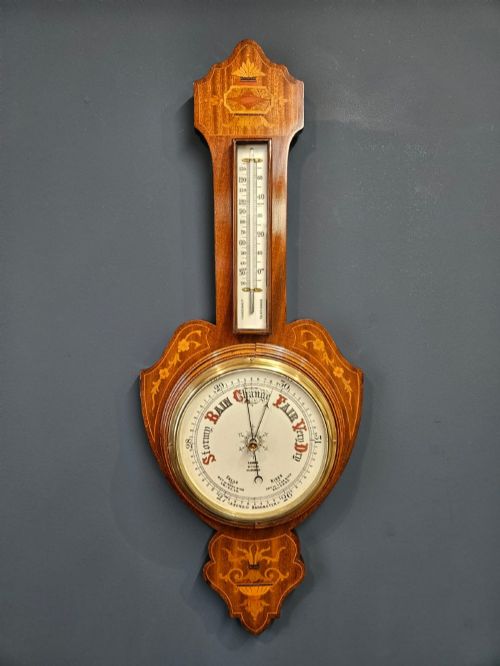
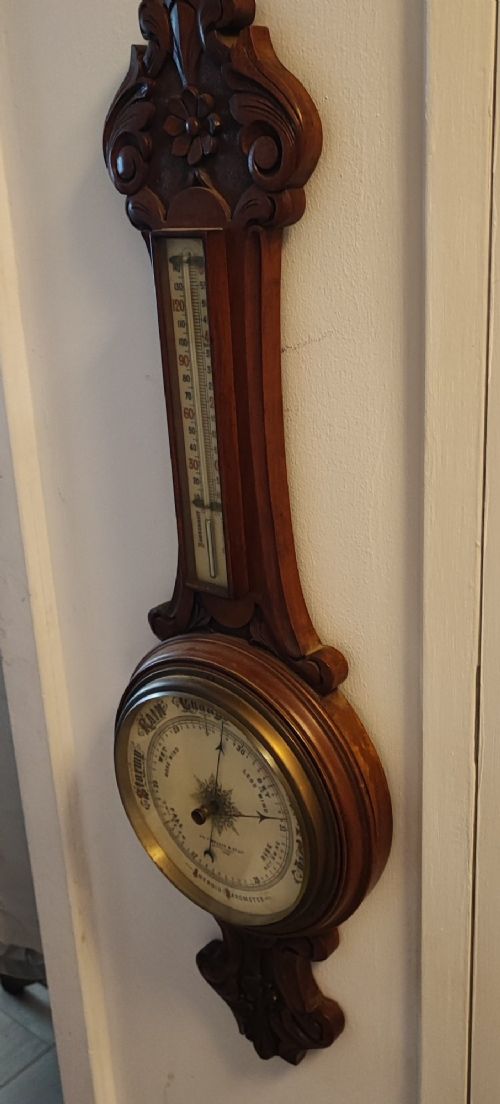


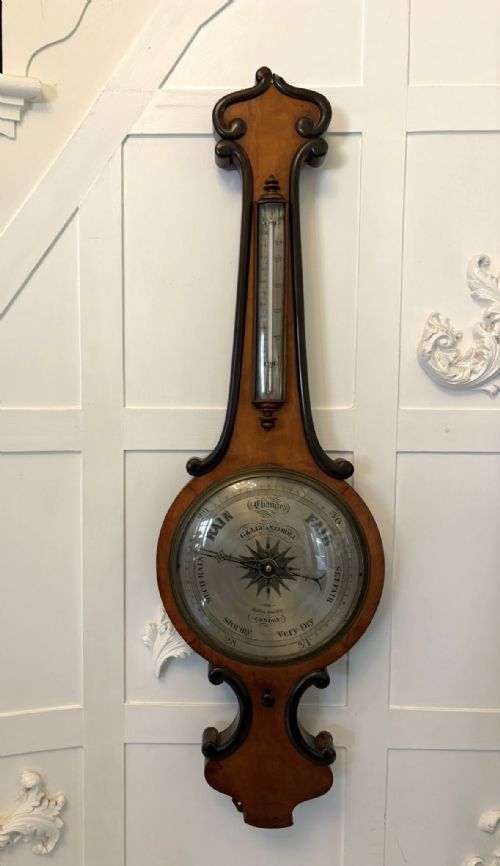


Thermometer Banjo Barometer
A thermometer banjo barometer combines weather-reading instruments inside a distinctive wooden wall-hanging frame, bringing both functional history and domestic elegance to a room.
Thermometer Banjo Barometer
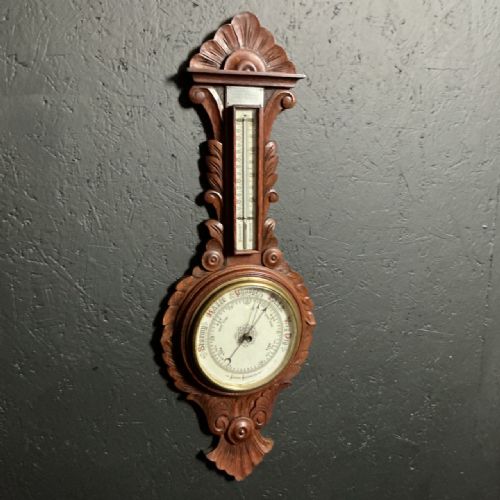
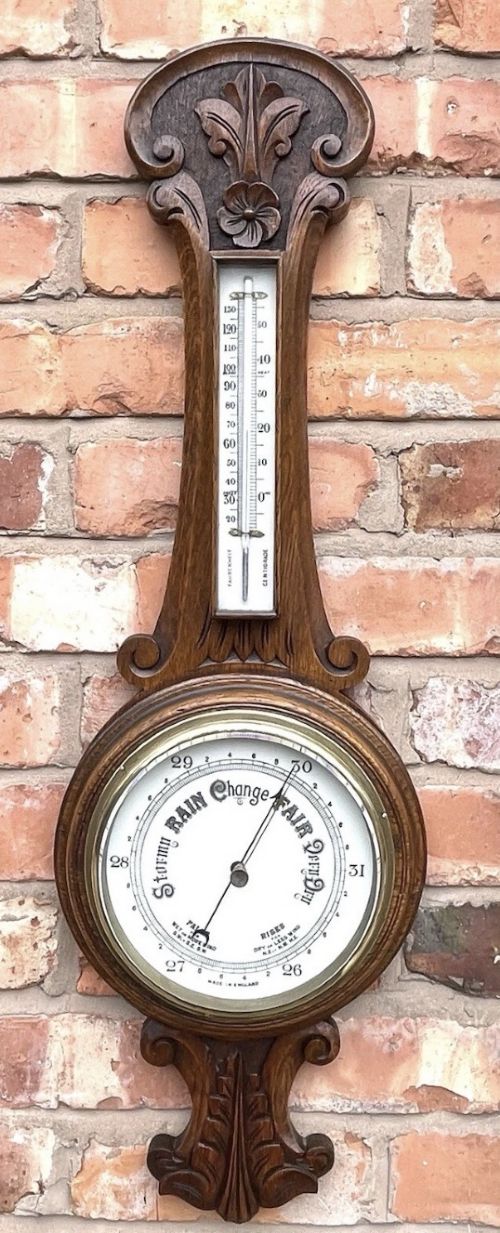
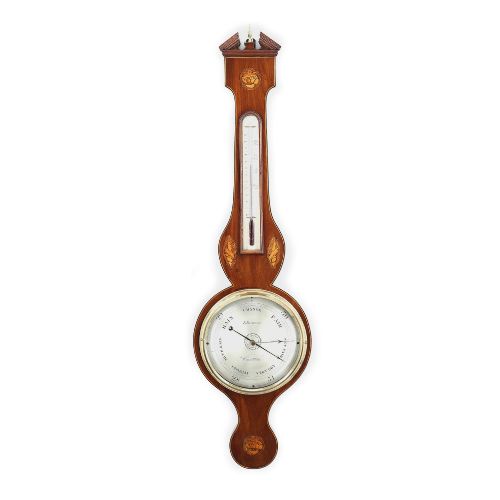
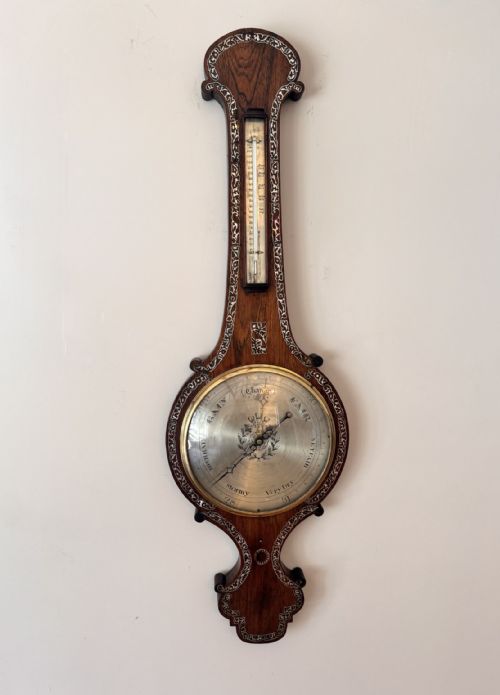
A thermometer banjo barometer takes its name from its characteristic curved silhouette, widening from a slender neck into a bulbous base that houses the main weather dial. These pieces span several distinct eras, with examples originating in the Georgian period and extending through the Victorian and Edwardian epochs.
The versions most frequently encountered on this page belong to the Victorian era and the Edwardian period, often constructed from rich timbers like mahogany or oak. Makers also utilised walnut, rosewood, and satinwood, frequently shaping the wooden housings with carved details or contrasting shell inlays.
Many variants integrate an open thermometer scale alongside the primary circular barometer dial, while some incorporate clock movements within the wooden body. Wall barometers and wall clocks share this format, hanging vertically to display atmospheric changes alongside ambient temperature.
Materials and Construction
Cabinetmakers constructed these instruments using solid and veneered hardwoods, selecting mahogany, oak, walnut, and rosewood for their grain and stability. Artisans applied delicate stringing and shell marquetry to embellish the wooden surfaces, sometimes incorporating mother-of-pearl accents into the design.
The internal mechanics rely on sensitive glass components, housing either traditional mercury columns or aneroid mechanisms to register atmospheric pressure. Brass bezels enclose the dials, while protective glass plates shield the paper or silvered brass indicator faces from dust and damage.
Several Victorian models feature an onion top case, giving the weather station the cheerful silhouette of a domed gourd.
Craftsmanship and Detail
The distinction between standard examples and finer pieces rests upon the precision of the cabinetwork and the intricacy of the wood veneers. Superior items display crisp hand-carved ornamentation, carefully matched burr walnut or figured mahogany grains, and precise marquetry rather than simple painted decoration.
B Besozzi of Weymouth·G & L Guanziroli London·Prada of High Wycombe·Molton of Norwich·Luisetti of London·W Watson & Sons·Giana Shrewsbury·Jenkins Of Old Swindon·Maple & Co·James H Kelly of Glasgow·WE Pain of Cambridge·Vecchio & Co of Shaftsbury
The Thermometer Banjo Barometer Glossary
- Banjo barometer
- A wall-hanging weather glass housed in a wooden case shaped like a banjo, featuring a narrow neck and a circular base. This layout accommodates both a thermometer and a large dial for measuring atmospheric pressure.
- Aneroid barometer
- A barometer that measures air pressure without liquid, using a flexible sealed metal capsule that expands or contracts with changing weather. This mechanism allows the instrument to operate reliably in various physical orientations.
- Mercury barometer
- A traditional weather glass that registers atmospheric pressure through the rise and fall of liquid mercury inside a sealed glass tube. These units require careful handling and transport due to the movable liquid column.
- Wheel barometer
- Another term for a banjo barometer, describing the mechanical linkage where pressure changes turn an indicator needle around a circular dial. The design often includes a visible hygrometer or spirit thermometer above the main scale.
- Marquetry
- The art of applying small pieces of veneer to a wooden structure to form decorative patterns or pictures. Artisans utilise contrasting timbers to create floral motifs or geometric borders on the barometer case.
Thermometer Banjo Barometer: Frequently Asked Questions
How do I read a thermometer banjo barometer?
The upper scale displays the ambient temperature in Fahrenheit or Celsius, while the large lower dial registers atmospheric pressure to indicate approaching weather changes. The pointer moves towards stormy or fair icons inscribed on the dial face.
Many instruments include a secondary manual pointer that you can set over the main needle to track whether pressure is rising or falling since your last observation.
Where should I hang a wall barometer?
Mount the instrument securely on an interior wall away from direct sunlight, central heating radiators, and damp exterior doors. Stable room temperatures ensure the internal mechanism responds accurately to true barometric pressure rather than localized heat.
Choose a wall height that places the main dial at eye level so you can easily read the weather indicators and check the thermometer throughout the day.
How do I tell a Georgian barometer from a Victorian one?
Georgian examples generally feature plainer mahogany cases with restrained string inlay and architectural pediments, focusing on clean lines and proportion. Their thermometer scales often feature distinct hand-engraved brass plates.
Victorian and Edwardian versions tend to display heavier carved oak or burr walnut frames, onion tops, and more elaborate scrollwork. They frequently utilise aneroid movements alongside traditional mercury tubes.
Are these barometers still accurate for weather forecasting?
These instruments continue to reflect genuine atmospheric pressure changes and can indicate local weather trends effectively when properly calibrated. Aneroid models adjust easily via a screw on the back, while mercury tubes require careful vertical positioning.
While modern digital sensors offer instant local forecasts, antique barometers provide a reliable mechanical gauge of coming pressure drops and improvements.