
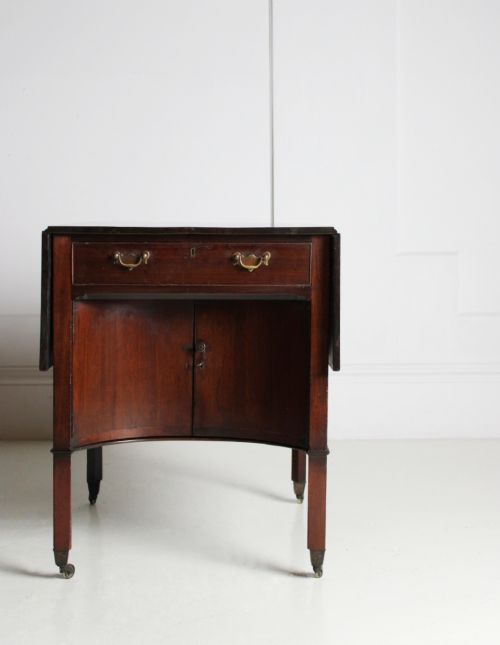
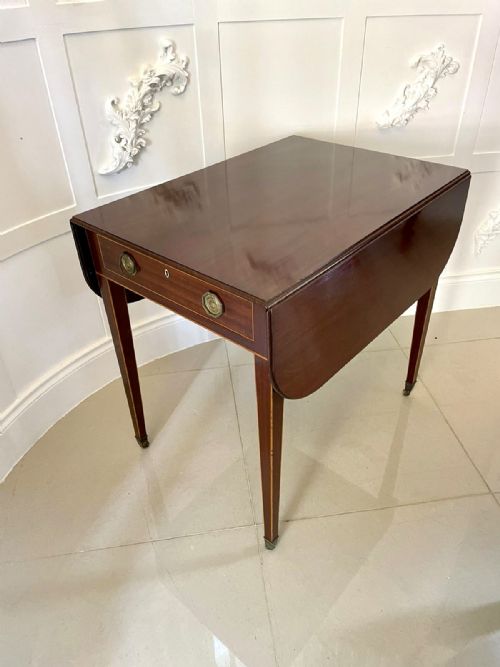
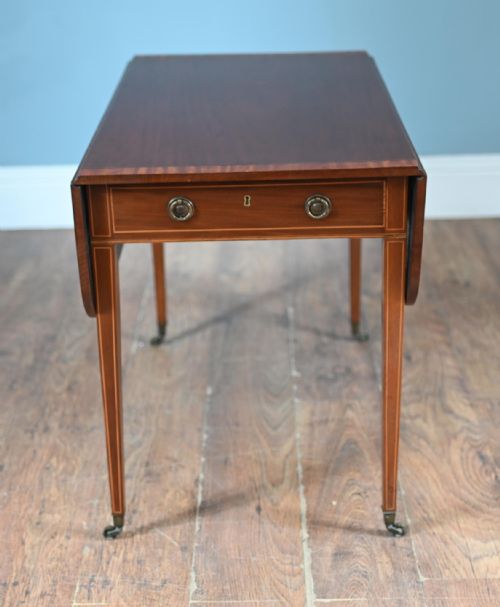
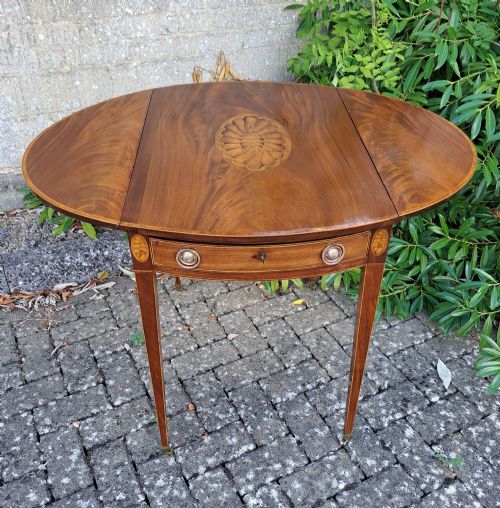


Tapered Leg Drop Leaf
These tapered leg drop leaf tables offer versatile folding surfaces supported by slender uprights, bringing Georgian and Regency craftsmanship into modern living spaces.
Tapered Leg Drop Leaf
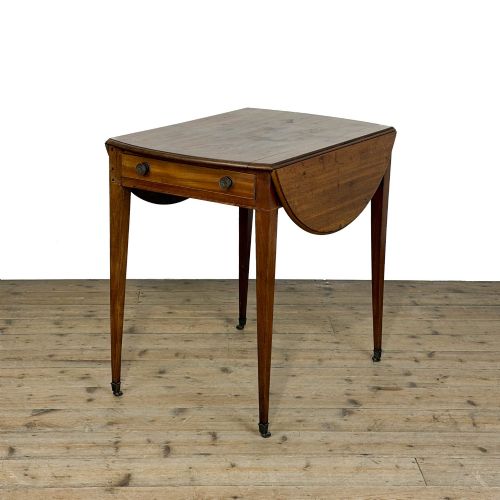
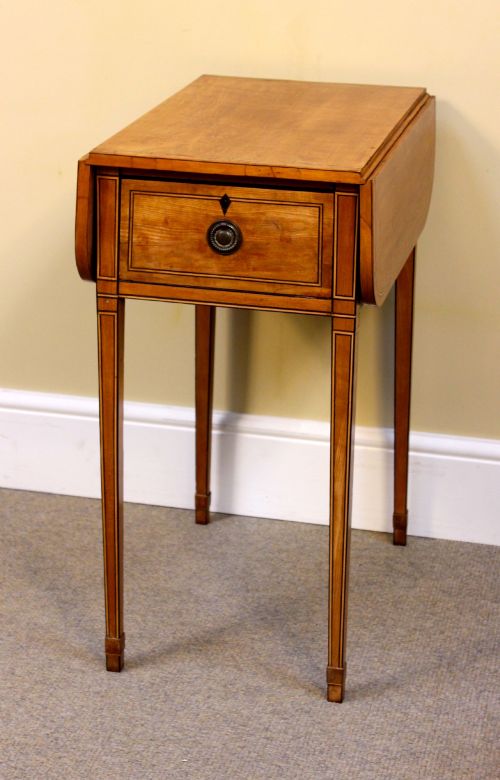
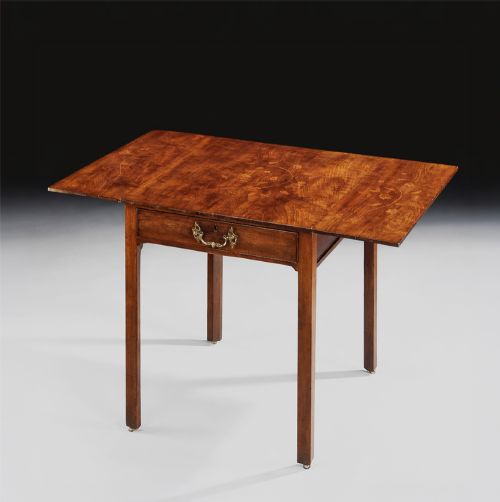
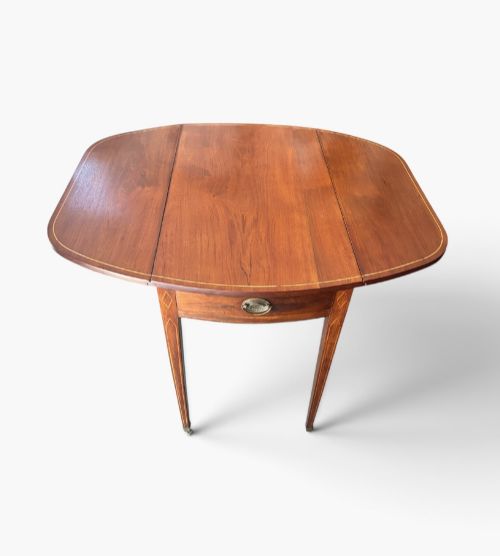
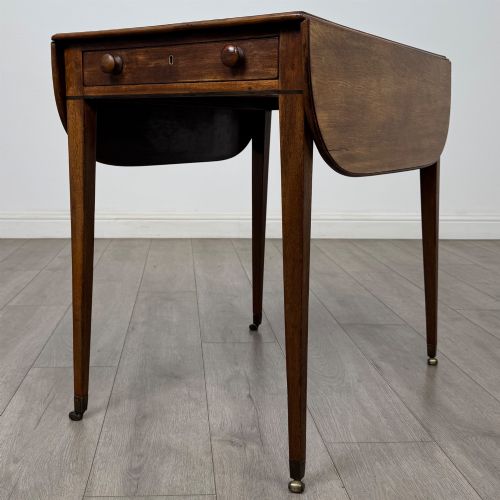
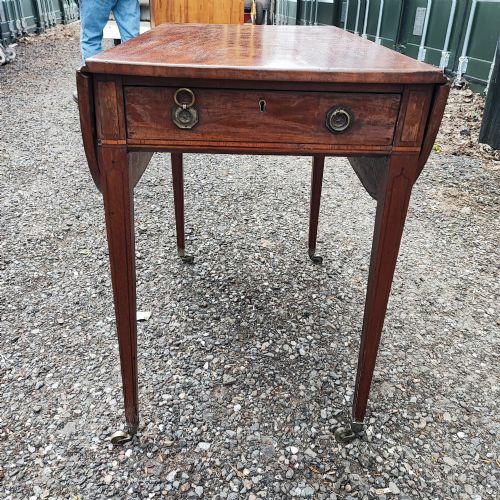
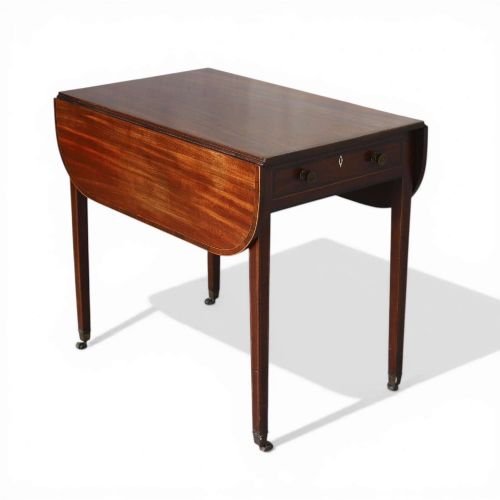
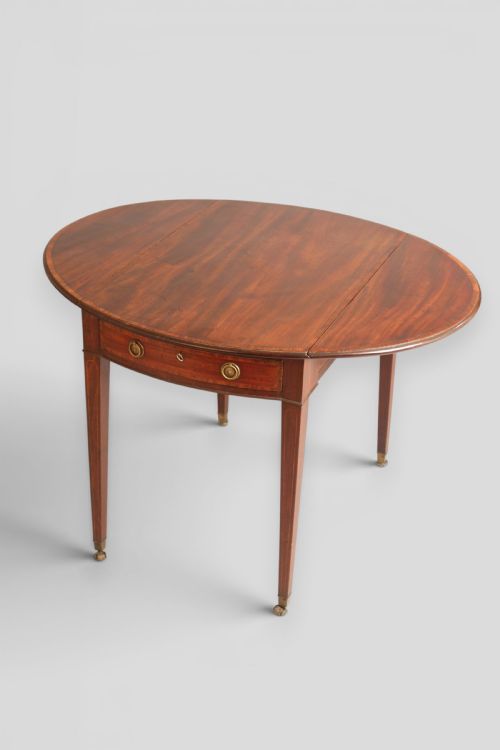
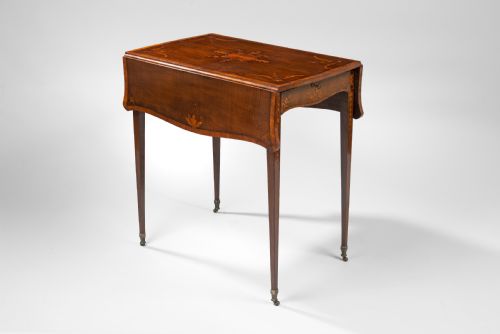
A tapered leg drop leaf table provides a compact surface with hinged flaps that lift to expand the top when needed. You will most commonly encounter mahogany Pembroke tables from the eighteenth and nineteenth centuries on this page.
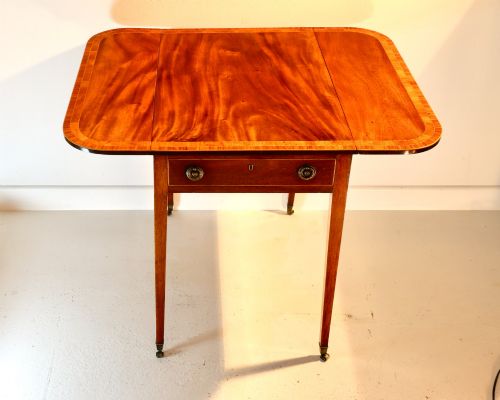
The selection includes oval and rectangular variants built as occasional, side, or small dining tables. Georgian and Regency examples frequently incorporate cross-banding or stringing along the edges.
Pieces span periods from the late eighteenth century through the Victorian era, reflecting stylistic influences associated with Sheraton and Hepplewhite designs.
Materials and construction
Cabinetmakers constructed these tables primarily in solid mahogany and accented them with lighter timbers such as satinwood, harewood, and boxwood. Inlays and cross-banding defined the borders of the tops and leaves.
Makers utilised brass fittings for castors and hinges, while secondary woods formed the structural framing underneath the flaps. Marquetry work added decorative detail to the better finished surfaces.
Listings feature mahogany, satinwood, and rosewood timbers across Georgian, Regency, and Victorian periods.
Factors of quality
The refinement of the woodwork dictates the standard of the piece, visible in the precision of the boxwood or satinwood inlay and the crispness of the table edges. Finer examples display carefully chosen timber grains with matching cross-banding.
Structural integrity depends on the original hinges and the stability of the drop-leaf action. Tables retaining their matching brass castors and unwarped leaves command greater regard among collectors.
Williamson
The Tapered Leg Drop Leaf Glossary
- Drop-leaf table
- A table with a fixed central section and hinged flaps that fold down on either side. These leaves extend the surface area when supported.
- Cross-banding
- A border of veneer laid with the grain running perpendicular to the main surface. It frames the central panel of the tabletop.
- Boxwood inlay
- Narrow strips of pale boxwood set into recesses within darker wood surfaces to create geometric or linear decoration. This technique highlights the borders of drawers and tabletops.
- Sheraton style
- A neoclassical furniture design style popular in the late eighteenth century. It is characterised by straight tapered legs, delicate proportions, and contrasting veneer inlays.
Tapered Leg Drop Leaf: Frequently Asked Questions
What is a pembroke table?
A pembroke table is a small, versatile table featuring two hinged drop leaves on opposite sides. It generally includes a single drawer and straight tapered legs.
Cabinetmakers designed these pieces to sit against a wall or in the centre of a room, ready to expand when extra surface area was required for writing or dining.
How do you date a drop leaf table?
Dating relies on identifying the timber species, construction methods, and stylistic details such as inlay patterns or leg shapes. Georgian and Regency pieces often show hand-cut joinery and specific veneer choices.
Examining the underside, drawer construction, and brass hardware provides further clues to the manufacturing period, ranging from the eighteenth century into the Victorian era.
Where were these tables used?
These tables served various functions in domestic interiors, acting as breakfast tables, writing desks, or side tables in sitting rooms and parlours. Their compact footprint suited smaller spaces.
Because the leaves folded down, owners could easily move them out of the way or reposition them against a wall when not in use.
How do you care for mahogany furniture?
Protect antique mahogany surfaces by keeping them away from direct sunlight and maintaining stable room humidity. Dust regularly with a soft cloth.
Avoid chemical polishes and use wax sparingly to preserve the natural patina developed over the centuries by the timber.