





Tapered Leg Centre Table
A tapered leg centre table brings surface space and refined proportions to a room, anchored by slender supports that taper cleanly to the floor.
Tapered Leg Centre Table
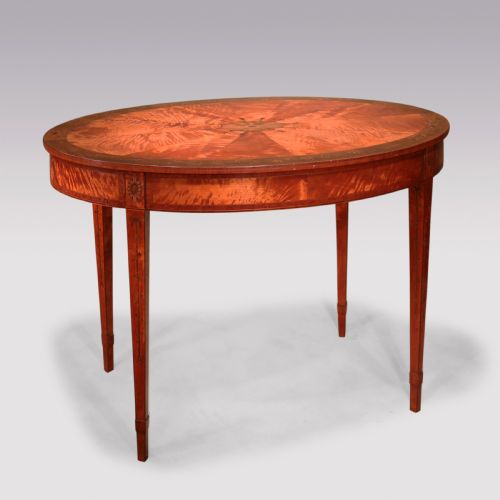
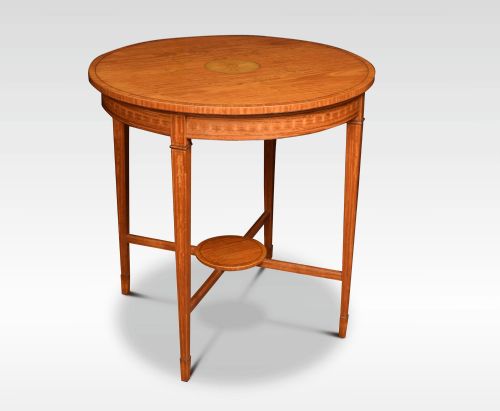
A tapered leg centre table is a versatile piece designed to stand freely within a room rather than against a wall. The selection ranges widely in form and origin, spanning occasional tables, desks, and coffee tables.
You are most likely to encounter Edwardian examples and pieces from the nineteenth century. These items frequently display classical revival influences such as Sheraton Revival and French Louis XVI style.
Materials vary from rich timbers to painted surfaces, accommodating both formal reception rooms and more relaxed interiors. Each piece offers a distinct interpretation of the slender leg silhouette.
Materials and construction
Cabinet makers utilised fine timbers including satinwood, rosewood, mahogany, kingwood, and burr walnut for their visible surfaces. These woods were often enhanced with boxwood inlay to create delicate contrasting borders.
Alternative constructions involved painted pine, providing a lighter aesthetic seen in Swedish and continental pieces. Selected tables also incorporate marble tops, combining solid stone surfaces with wooden bases.
One versatile nineteenth-century survivor doubles as a pier table, a sofa table, and a dressing table.
Assessing quality
Quality rests in the crispness of the timber selection and the precision of the inlay work. Finer examples display carefully matched grain patterns and harmonious proportions across the entire frame.
The execution of the tapered leg itself dictates the overall elegance of the object. Subtle shifts in profile and clean lines separate standard utility pieces from items commissioned with greater care.
The Tapered Leg Centre Table Glossary
- Centre table
- A freestanding table finished on all sides so it can occupy the middle of a room. These pieces provide surface access from any angle.
- Satinwood
- A lustrous, hard timber native to Ceylon and India, prized for its golden yellow sheen. It became central to late eighteenth-century and revival furniture making.
- Boxwood inlay
- The practice of inserting narrow strips of pale boxwood into contrasting darker wood surfaces. This technique forms geometric borders and delicate decorative motifs.
- Kingwood
- A dense, richly figured timber from the rosewood family featuring dark violet and brown stripes. It was heavily utilised in high-status French furniture.
- Sheraton Revival
- A late nineteenth-century design movement inspired by the neoclassical furniture of George Sheraton. It favours light timbers, slender supports, and classical ornamentation.
Tapered Leg Centre Table: Frequently Asked Questions
Where should I place a centre table?
These tables are designed to sit away from walls, often anchoring the middle of a drawing room or library. They function well as surfaces for lamps, books, or decorative objects.
Because they are finished on all sides, they can be viewed from any angle within an open room layout.
How do I care for satinwood and rosewood?
Keep these timbers away from direct sunlight and heat sources to prevent the wood from drying out. Regular dusting with a soft, dry cloth maintains the natural lustre.
Avoid liquid polishes containing silicone, choosing instead traditional wax applied sparingly when the surface needs nourishment.
What is the difference between an occasional table and a centre table?
A centre table typically stands larger and more substantial, designed as a primary focal point in a room. Occasional tables are smaller and lighter, moved easily to suit immediate needs.
Both categories frequently share the tapered leg form seen across nineteenth-century and Edwardian examples.
How can I identify a Sheraton revival piece?
Sheraton revival items date predominantly from the late nineteenth and early twentieth centuries, mimicking the lighter neoclassical styles of the 1700s. Look for satinwood veneers and painted details.
They often feature delicate tapered legs and restrained classical stringing rather than heavy Victorian carving.