
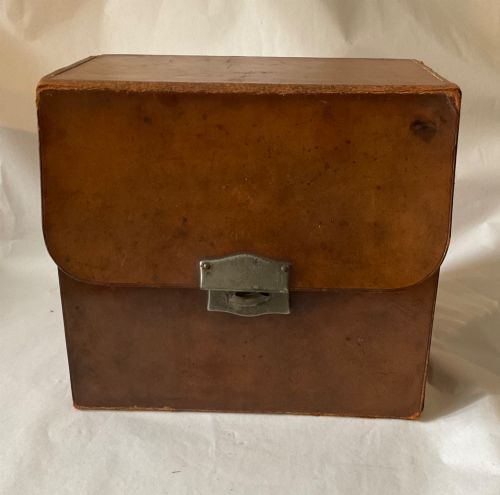
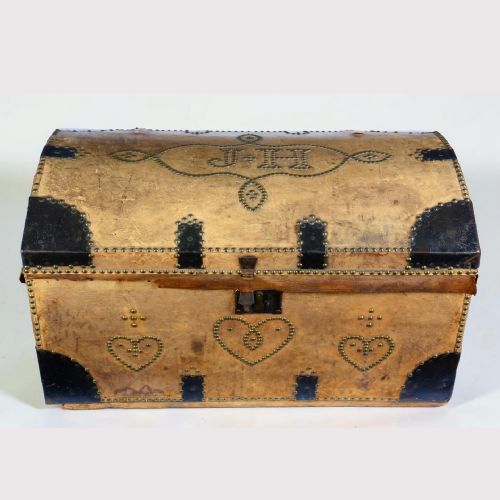


Tan Leather Travel Chest
A tan leather travel chest is a sturdy piece of luggage built for transit, offering rugged character and rich history for the modern home.
Tan Leather Travel Chest
A tan leather travel chest is a practical storage object designed for journeys, spanning periods from the eighteenth century to the twentieth century. These pieces appear in forms such as trunks, coffers, suitcases, and fitted picnic cases.
The versions most commonly met on this page date from the Victorian and Edwardian eras, alongside early twentieth-century examples. Makers constructed these items using wood, iron, brass, and canvas alongside the primary leather hide.
Origin locations recorded for these pieces include English, French, Spanish, and African workshops. Such items functioned as officer's luggage, steamer trunks, and monogrammed hat boxes before finding a role in contemporary interior display.
How they were made
Makers constructed these travel chests using a wooden carcass or framework bound in leather and hide. Metal elements such as iron and brass provided structural reinforcement and protective corner guards.
Detailing often included decorative brass studwork, canvas reinforcement, and specialised internal fittings for apothecary items or picnic service. Exterior surfaces received treatment with travel labels, stamps, and signatures from makers.
Several chests wear foreign travel labels and monograms like old holiday stickers, chronicling decades of forgotten globetrotting.
What varies in quality
The standard of a travel chest depends upon the integrity of its wooden framework and the condition of the exterior hide. Pieces featuring intact brass hardware, functional locks, and original internal fittings represent higher execution.
Evident provenance, such as maker stamps, retailer labels, and historic travel documentation, distinguishes exceptional examples from standard utilitarian luggage.
Arthur Wannop·Drew & Sons·John Pound·Louis Vuitton
The Tan Leather Travel Chest Glossary
- Hide
- The heavy, natural skin of large animals used to cover travel chests and trunks. This material provided durability during transport.
- Brass studwork
- Small metallic pins driven into the leather surface in decorative patterns. This technique secured edges while adding visual ornamentation.
- Steamer trunk
- A lower-profile travel case designed to fit beneath a ship cabin berth. These pieces date predominantly to the early twentieth century.
- Apothecary case
- A specialised compartmented box used for carrying medicines and medical equipment. These items featured fitted internal sections for glass bottles.
- Portmanteau
- A large leather travelling case that opens into two equal compartments. This form served travellers during the Victorian and Edwardian periods.
Tan Leather Travel Chest: Frequently Asked Questions
What periods do these travel chests cover?
The selection includes pieces spanning from the mid-eighteenth century through the Georgian and Victorian eras up to the 1930s.
Victorian and Edwardian examples appear frequently alongside early twentieth-century steamer trunks.
How were these chests used originally?
These items served travellers as luggage on ships, trains, and carriages for personal belongings, uniforms, or provisions.
Some functioned as specialised picnic cases, officer travel chests, or apothecary storage units.
What materials make up these trunks?
Construction relies primarily on a combination of leather or hide over a wooden core.
Brass, iron, and canvas frequently supplement the exterior for reinforcement and weather resistance.
How do I identify a maker?
Makers often marked their work through stamped signatures, exterior labels, or brass hardware engravings.
Prominent names like Louis Vuitton or Drew & Sons stamped their details directly onto the leather or fittings.
Can I use a travel chest for home storage?
These sturdy chests provide functional storage space for blankets, books, and household items in modern interiors.
Their decorative exterior hide and travel history make them suitable for room display.