
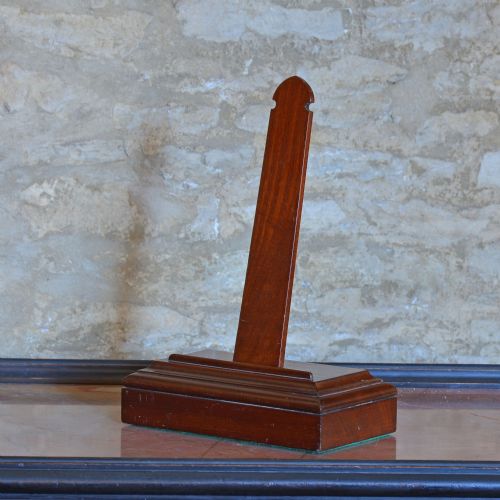
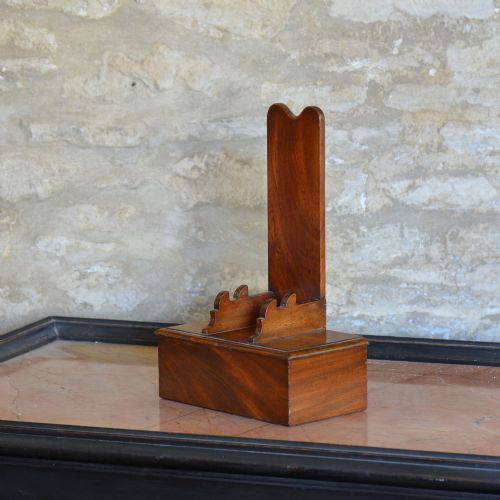


Tabletop Plate Holder
When you need a tabletop plate holder, you are looking for a practical stand to display ceramics or trays neatly on a surface.
Tabletop Plate Holder
Buyers will encounter wooden designs, specifically in mahogany, which offer a warm timber grain for traditional interiors. These stands range from simple weighted bases to architectural frames designed to prop up decorative tableware.
The selection reflects both Georgian origins and later nineteenth-century utility, focusing heavily on mahogany construction. Each piece serves to elevate decorative items rather than conceal them.
Materials and construction methods
Makers relied on solid mahogany to build stable frames capable of supporting the weight of heavy ceramics or wooden trays. This timber was often polished to a smooth finish, highlighting the natural grain of the wood.
Weighted elements were sometimes incorporated into the base to prevent the stand from tipping under the load of a large plate. Joinery in these pieces prioritised durability and discretion to keep the focus entirely on the displayed item.
Current listings feature mahogany as the primary material for tabletop plate holder items, spanning Georgian and nineteenth-century periods.
Assessing quality in stands
Quality rests in the density and condition of the mahogany timber, alongside the tightness of the structural joints. Superior examples maintain their balance without leaning, showing careful attention to the angle of the back support.
Finer pieces display subtle shaping and smooth surfaces without distracting blemishes, while simpler versions rely purely on utility. The degree of craftsmanship in the pivot or support strut separates standard items from better workshop output.
Hardy Brothers·Barker Ellis
The Tabletop Plate Holder Glossary
- Mahogany
- A dense reddish-brown tropical hardwood prized for furniture and display stands. It takes a high polish and resists warping.
- Georgian
- Pertaining to the period from 1714 to 1830 in Britain, characterised by classical proportions and fine timber use.
- Weighted base
- A concealed heavier insert within the bottom of a stand designed to lower the centre of gravity and prevent toppling.
- Display stand
- A supportive framework intended to hold decorative plates, pictures, or trays upright for viewing.
Tabletop Plate Holder: Frequently Asked Questions
What is a tabletop plate holder used for?
These stands are designed to display decorative ceramic plates, trays, or framed pictures upright on a table or sideboard.
They allow owners to showcase items that might otherwise lie flat and remain unnoticed on a surface.
Are these stands suitable for heavy plates?
Mahogany stands with weighted bases offer substantial stability for heavier ceramic pieces and trays.
Buyers should examine the depth of the ledge and the strength of the back strut before placing very heavy items on display.
How do I date a mahogany plate stand?
Dating relies on observing the timber colour, the joinery methods, and the style of the wood turning.
Earlier Georgian pieces tend to show simpler, heavier forms, while nineteenth-century versions incorporate varied shaping.
Can these holders be folded away?
Certain designs feature hinged struts that allow the back support to fold flat against the main frame.
This construction makes storage straightforward when the stand is not actively holding a plate.