

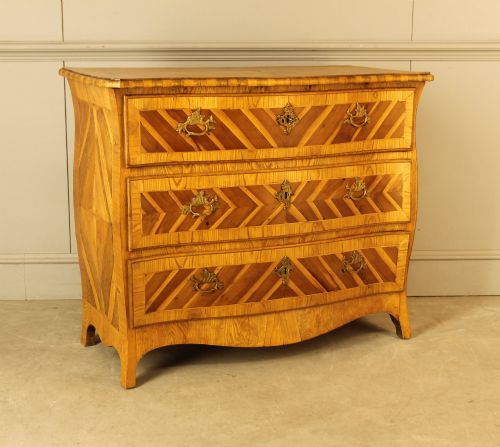
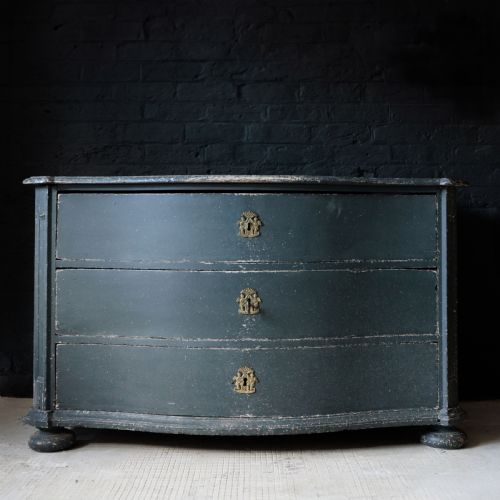


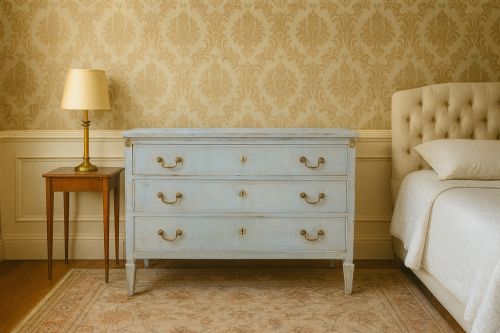


Swedish Three Drawer Chest
A swedish three drawer chest brings calm proportion and pale, reflective painted pine or rich birch into a room.
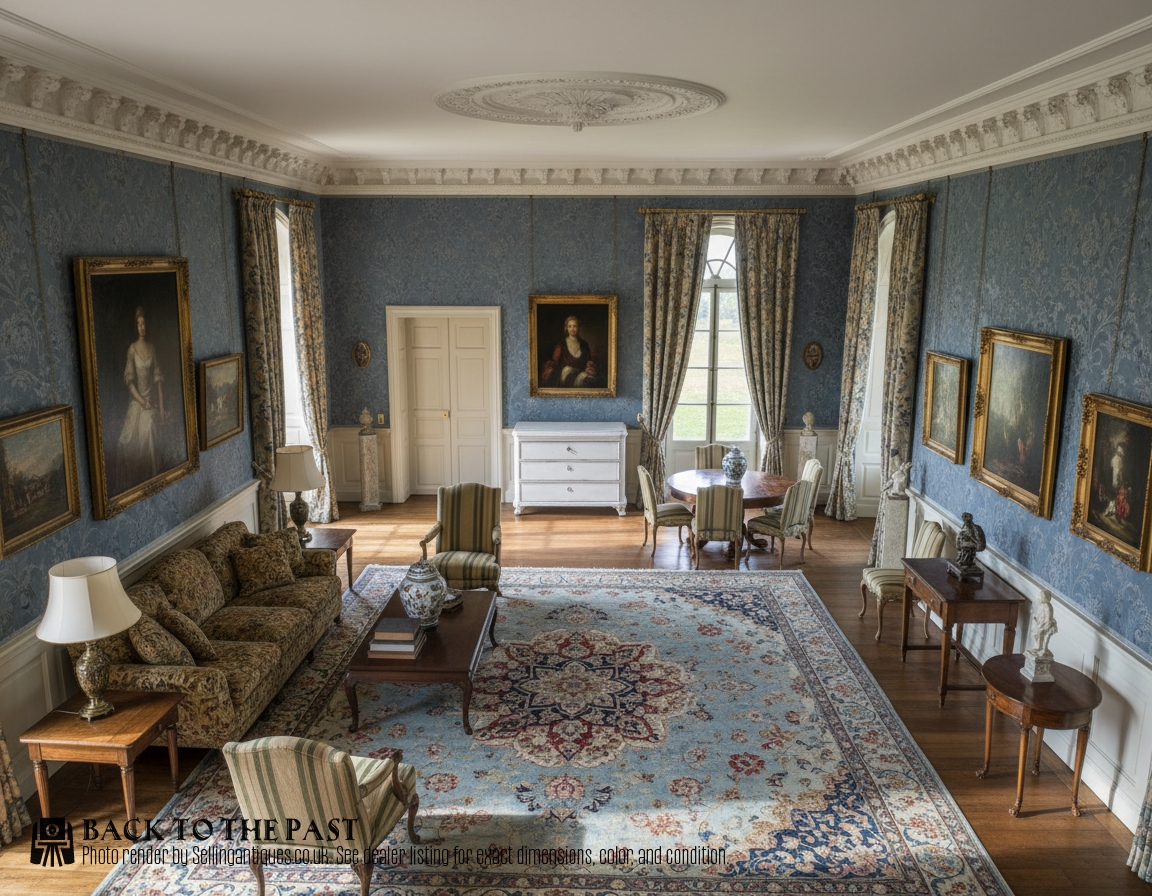
Swedish Three Drawer Chest
A swedish three drawer chest appears primarily across the eighteenth and nineteenth centuries, taking forms from the curving lines of Rococo and the restraint of Gustavian neoclassical design. These pieces serve as functional storage while establishing a distinct architectural presence through their characteristic shallow drawers and balanced proportions.
Most examples encountered here belong to the nineteenth century, often finished in painted pine or warm Scandinavian birch. Makers worked within established regional vocabularies, producing both serpentine commodes and simpler rectilinear bodies suited to domestic interiors.
How they were made
Cabinetmakers constructed these chests using native softwoods and hardwoods like pine and birch, frequently applying layered oil or distemper paint over the timber. Surfaces often received subtle distressing or pale monochrome finishes designed to catch northern daylight.
Joinery relied on traditional hand-cut techniques for the carcase and drawer construction, sometimes paired with applied brass hardware or hand-carved decorative motifs. Finer pieces incorporated book-matched veneers of satin birch or fruitwood arranged across the drawer fronts.
Listings span the eighteenth and nineteenth centuries, featuring both painted pine and figured birch timbers across Gustavian and Rococo styles.
What varies in quality
Quality rests in the handling of proportion, the integrity of the timber framing, and the retention of early or original painted surfaces. Pieces with sophisticated serpentine or bombe shaping demand higher levels of joinery skill than straight-fronted carcases.
The distinction between ordinary utility items and exceptional pieces lies in the subtlety of the surface preparation and the crispness of any applied carving. Untouched painted patination elevates a chest above later refinished equivalents.
The Swedish Three Drawer Chest Glossary
- Commode
- A low chest of drawers or cabinet developed in France and widely adopted in eighteenth-century Sweden. It typically stands on taller legs than an English chest and functions as a principal decorative piece.
- Gustavian
- The Swedish neoclassical style spanning the late eighteenth century, named after King Gustav III. It is characterised by straight lines, restrained fluting, and pale, calm colour palettes.
- Bombe
- A swelling, convex furniture profile that curves outward in multiple directions. This form requires advanced woodworking skill to execute successfully.
- Serpentine
- A front profile composed of a central convex curve flanked by two concave curves. It adds rhythmic movement to the face of a chest.
Swedish Three Drawer Chest: Frequently Asked Questions
How do I date a swedish three drawer chest?
Dating relies on examining the construction methods, timber choice, and stylistic vocabulary evident in the carcase and hardware. Eighteenth-century pieces frequently display hand-split secondary woods and early Rococo or neoclassical curves.
Nineteenth-century examples often shift toward simpler rectilinear proportions or employ the blonde figuring of birch. Surface treatments also provide clues, as original paint layers show distinct craquelure and wear patterns over time.
Where should I place a painted commode?
These chests suit bedrooms, hallways, or living spaces where their pale tones can reflect natural light. Their modest depth allows them to sit comfortably in narrower circulation areas without blocking passage.
Pair them with minimal surroundings to let the painted finish and timber grain stand out. Avoid positioning them in areas of high humidity or direct sunlight to protect the fragile historic paint surfaces.
What is the difference between Gustavian and Rococo styles?
Gustavian design follows neoclassical principles with straight fluted legs, restrained urn motifs, and symmetrical balance. It reflects a cooler, more austere aesthetic inspired by French and Italian antiquity.
Swedish Rococo, by contrast, embraces asymmetry, sweeping curves, and exuberant carved ornamentation such as scrolls and shells. Commodes from the earlier Rococo period are generally more rounded and sculptural than their neoclassical successors.
How do I care for historic painted furniture?
Maintain a stable indoor climate with moderate humidity to prevent the underlying timber from expanding or contracting. This protects the historic paint layer from flaking or lifting off the wood.
Dust gently with a dry, soft cloth and avoid modern chemical polishes or abrasive cleaners. Wax should only be applied if the specific surface finish permits, as many early distemper paints require dry maintenance.