

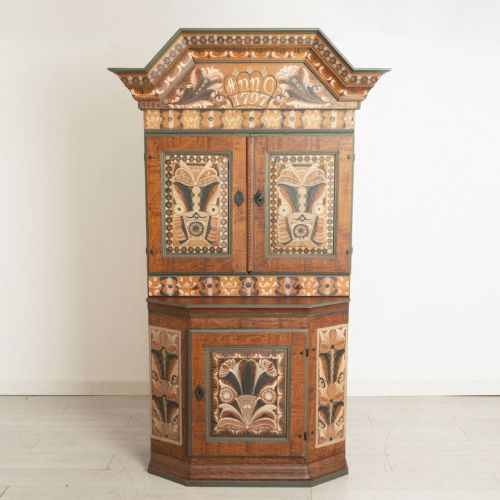


Swedish Folk Art Cupboard
A Swedish folk art cupboard brings tactile warmth and historic colour to a room through painted pine surfaces.
Swedish Folk Art Cupboard
A swedish folk art cupboard unites practical storage with traditional decorative painting from the eighteenth and nineteenth centuries. These pieces encompass various forms including wall cupboards, kitchen cabinets, corner cupboards, dressers, and hall wardrobes.
The versions most commonly met on this page date from the nineteenth century and originate from Scandinavian country workshops. They range from compact wall-hung boxes to large freestanding cupboards on stands and armoires.
Makers utilised native softwoods to construct robust storage that served everyday domestic life. Over generations, these utilitarian items acquired layers of decorative scheme that define their appeal today.
How they were made
Construction relies primarily on solid pine, shaped and joined using traditional carpentry methods suitable for provincial workshops. Iron and brass fittings such as hinges, latches, and escutcheons secure the doors and drawers.
Surfaces are finished with mineral paint, traditional oil mediums, or creative techniques like ragwork to produce mottled and textured effects. These decorative finishes protect the soft wood beneath while expressing regional aesthetic preferences.
Swedish Folk Art Cupboard Retail Price Guide 2026
Typical asking prices for swedish folk art cupboard among the pieces listed under this phrase on Sellingantiques today, from the lower quarter to the upper quarter. They describe what is for sale here now, not the wider market.
Objects range widely in scale, from compact wall cabinets to tall Gustavian kitchen cabinets and two-door hall wardrobes.
What varies in quality
Quality rests in the survival of the original painted surface and the sophistication of the decorative work. Pieces featuring untouched regional ragwork or hand-painted motifs stand apart from later repainted examples.
Proportion and form also determine the character of each piece, from simple rustic utility cupboards to refined Gustavian kitchen cabinets. The integrity of the structural pine and the preservation of original iron or brass hardware complete the distinction.
The Swedish Folk Art Cupboard Glossary
- Ragwork
- A decorative painting technique where rags or cloths are used to manipulate wet paint on a surface, creating textured patterns and mottled colour effects. This method was widely employed in Scandinavian country furniture to imitate more expensive finishes or provide visual depth.
- Gustavian
- The Swedish neoclassical style spanning the late eighteenth and early nineteenth centuries, characterised by lighter proportions and restrained classical ornamentation. In these cupboards, it appears as a more formal counterpoint to rustic country styles.
- Mineral paint
- A durable, natural paint formulation that bonds chemically with porous substrates like pine, leaving a matte finish. It forms a traditional coating found on historic Scandinavian cabinetry.
- Armoire
- A large freestanding cupboard or wardrobe used for storing garments and household textiles. Northern European examples often feature double doors and generous interior depth.
- Wall cupboard
- A compact storage cabinet designed to be hung directly onto a wall rather than resting on the floor. These pieces typically feature single doors and served to hold small household provisions.
Swedish Folk Art Cupboard: Frequently Asked Questions
What rooms suit a Swedish folk art cupboard?
These cupboards adapt well to kitchens, hallways, and living spaces where their painted finishes add warmth and practical storage. Their varied proportions allow wall cabinets to fit compact areas while larger armoires anchor bigger rooms.
Placing them in modern or traditional interiors creates a striking focal point that breaks up plain walls. They provide generous enclosed shelving for everyday household items.
How do I care for the painted pine surfaces?
Maintenance requires gentle dusting with a dry or slightly damp cloth, avoiding harsh chemical cleaners that might strip historic paint. Keeping the wood away from direct heat sources prevents the pine from warping and protects the mineral or oil paint.
Allowing the piece to acclimate to stable indoor humidity preserves both the timber and the decorative finish. Wax can be applied sparingly if the surface composition permits.
How can I tell a wall cupboard from a larger cabinet?
Wall cupboards are built with mounting points or hanging brackets on the back and feature shallower depths suited for suspension. Larger cabinets and armoires are designed to rest directly on the floor or upon dedicated stands.
Scale and internal shelving capacity also differentiate the two forms, with wall versions holding smaller provisions. Floor-standing pieces offer substantial height and floor footprint.
What is the difference between ragwork and standard paint?
Ragwork involves manipulating wet paint with cloth to create distinctive mottled, cloudy, or textured patterns across the pine surface. Standard painted finishes rely on flat, uniform coats or simple brushwork.
This decorative technique adds movement and complexity to Scandinavian country furniture. It reflects the inventive methods provincial makers used to embellish simple softwoods.