


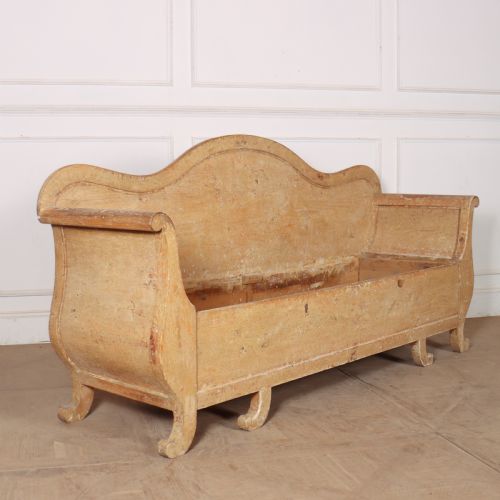


Swedish Country Pine Bench
A Swedish country pine bench brings robust Scandinavian utility and enduring rustic character straight into a modern hallway or kitchen.
Swedish Country Pine Bench
When you search for a Swedish country pine bench, you encounter sturdy seating fashioned from softwood and pine. These pieces originate predominantly from the nineteenth century, alongside earlier eighteenth-century examples.
The most common form on this page is the painted pine bench, often configured as a settle bench with storage or a dedicated workbench. Alongside these, you find related dining preparation tables and regional variations like Austrian country pieces.
Makers shaped these utilitarian objects for rural Scandinavian domestic life, resulting in robust proportions and practical forms. Gustavian-inspired designs also appear, bringing refined neoclassical lines to traditional country pine.
How they were made
Carpenters built these benches using pine and softwood planks, joining the timbers with traditional woodworking techniques suited to heavy daily use. Iron fixings and hardware frequently reinforce the structural joints of workbenches and storage settles.
Surfaces received layers of paint, often applied as an original finish that now shows charming weathering and patina. This painted wood protects the underlying softwood while defining the distinct regional aesthetic of Scandinavian country furniture.
Swedish Country Pine Bench Retail Price Guide 2026
Typical asking prices for swedish country pine bench among the pieces listed under this phrase on Sellingantiques today, from the lower quarter to the upper quarter. They describe what is for sale here now, not the wider market.
Listings span the eighteenth and nineteenth centuries, featuring softwood, iron, and painted pine across Scandinavian and Austrian country styles.
What varies in quality
Quality in these benches rests upon the integrity of the original construction and the preservation of early painted surfaces. Pieces retaining their uncompromised nineteenth-century or eighteenth-century paint stand apart from later repainted examples.
Proportion and form also dictate distinction, as simpler utilitarian workbenches contrast with sophisticated Gustavian-inspired pieces or storage settles with integrated compartments. The balance between sturdy softwood structure and honest patination defines the upper tier of the range.
The Swedish Country Pine Bench Glossary
- Pine
- A softwood commonly utilised throughout Scandinavian cabinetmaking for its availability and workability. It forms the primary structural material for nearly all benches on this page.
- Settle bench
- A traditional wooden seat featuring a high back and enclosed sides designed to block draughts in rural homes. Many versions include lift-up lids revealing storage compartments beneath.
- Gustavian
- The Swedish neoclassical style spanning the late eighteenth and early nineteenth centuries. It brings lighter, symmetrical proportions and pared-back classical ornamentation to country furniture.
- Softwood
- Timber derived from conifers, including pine, which carpenters favoured for domestic vernacular furniture. It responds well to paint and provides a durable surface for everyday use.
Swedish Country Pine Bench: Frequently Asked Questions
What is a Swedish country pine bench?
A Swedish country pine bench is a utilitarian wooden seat or work surface originating from Scandinavian farmhouses and rural homes.
These pieces typically date from the eighteenth and nineteenth centuries and are constructed from local softwood and pine.
How were these benches used?
Rural households utilised these sturdy benches for daily seating around dining areas, workspace preparation, and domestic chores.
Versions featuring high backs and enclosed bases also served to block cold draughts and store household goods.
How do I live with a painted pine bench?
These benches integrate smoothly into modern kitchens, boot rooms, and hallways as practical seating and surface space.
Their robust pine construction handles daily use well, while the painted wood finish adds warmth and rustic character to an interior.
How do I tell periods apart?
Eighteenth-century pieces typically exhibit heavier vernacular framing and earlier paint layers, whereas nineteenth-century examples often incorporate Gustavian neoclassical influences.
Workbenches and storage settles also display specific functional adaptations that distinguish them from standard dining benches.