


Sussex Landscape Art
These sussex landscape art pieces capture the downland, coast and villages of the county in oil, watercolour and gouache.
Sussex Landscape Art
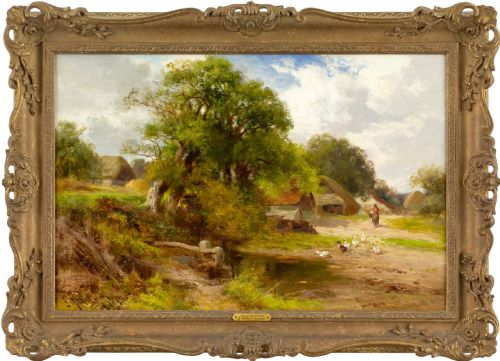
Sussex landscape art spans depictions of recognisable local landmarks, rivers and rural scenes across the county. The examples met most often on this page are watercolours and oil paintings dating from the Victorian and Edwardian periods.
The selection ranges from early naïve topographical views to mid-century watercolours and marine oils. Subject matter covers specific locations such as Arundel, Rye, Chichester and the South Downs.
Framed works in wood and gilt frames predominate, offering traditional wall art created by British artists working in the nineteenth and twentieth centuries.
Materials and technique
Painters recorded the Sussex countryside using oil on canvas, wood panels, and watercolours on paper. Gouache also appears in works capturing coastal and castle scenes.
Many of these paintings retain their original framing materials, including gilt wood frames that complement the traditional subjects.
Sheep grazing near Pevensey Bay share space on this page with bustling harvest fields and distant castle walls.
Quality and execution
The distinction between standard works and finer pieces lies in the strength of composition and the artist's handling of light across downland and marine settings. Stronger works convey atmosphere and topography with distinct tonal control.
Condition of the paper, canvas and original frame contributes to the overall integrity of the piece. Works that retain their period character without excessive restoration hold greater visual coherence.
John Horace Hooper·Charles Gregory·Stanley Orchart·Arthur Winter Shaw·Henry Charles Fox·Harry Pennell·Henry John Kinnaird·Annie L. Lee·William Luker Snr·Yeend King·J. Mitan·Walter J. Hall·Reginald Mills·Herbert Charles Nye·Margaret Fisher Prout
The Sussex Landscape Art Glossary
- Topographical painting
- A work depicting a specific real place with an emphasis on accurate local detail. These early views document towns and landmarks as they appeared historically.
- Gouache
- An opaque water-based medium that provides denser colour and heavier coverage than traditional watercolour. It allows artists to build rich highlights in landscape views.
- Oil on canvas
- Pigment bound in drying oil applied to a woven fabric support stretched over a wooden frame. This technique was favoured for durability and depth of colour.
- Watercolour
- A paint where the colour pigments are suspended in a water-soluble vehicle, usually applied to paper. It creates luminous washes suited to capturing shifting atmospheric skies.
Sussex Landscape Art: Frequently Asked Questions
What periods do these paintings cover?
The works span from the Regency era through the Victorian and Edwardian periods into the mid-twentieth century. Most examples date from the late nineteenth and early twentieth centuries.
Artists during these periods frequently travelled through the county to record its downland, rivers and historic market towns.
Are the frames original to the art?
Many pieces retain their period wooden or gilt frames, which reflect the framing styles of the nineteenth and early twentieth centuries.
These frames often show age-appropriate wear that matches the period of the painting they enclose.
How should I hang and care for watercolour paintings?
Watercolours on paper require protection from direct sunlight to prevent fading of the pigments over time. Glazing helps shield the paper surface from environmental dust and moisture.
Keeping them on interior walls away from direct heat sources ensures the paper and framing remain stable.