
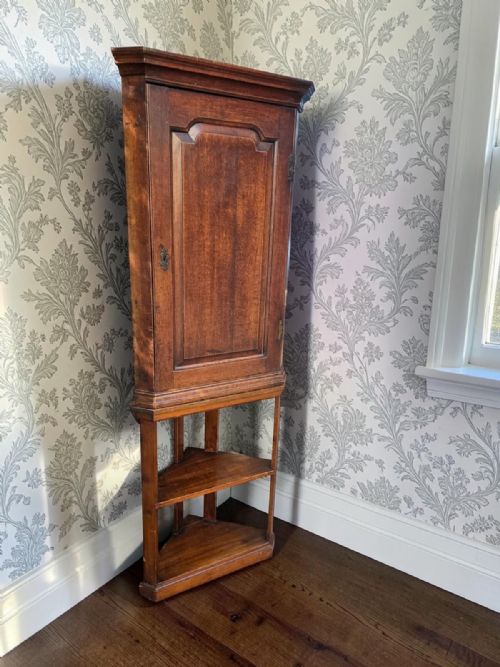

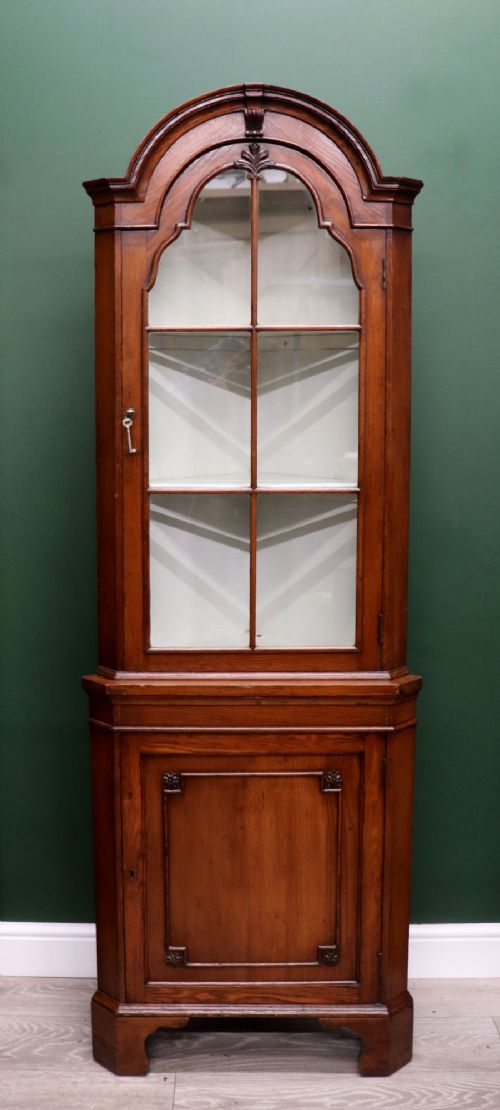


Standing Oak Corner Unit
These standing oak corner units turn awkward angles into handsome display space, built from solid timbers to make the most of every forgotten room corner.
Standing Oak Corner Unit
A standing oak corner unit solves the problem of empty wall junctions by fitting flush into a ninety-degree angle, rising straight from the floor rather than hanging on a wall. The pieces recorded here range across several distinct periods, from 18th century country workshops up to early 20th century revivals, offering both single-door cupboards and towering two-part designs.
Georgian examples and later Victorian or Edwardian interpretations form the backbone of what turns up on the floor. You will encounter straightforward panelled doors, bow fronts that soften the geometric angle into the room, and occasional floor-standing arrangements that pair oak with secondary timbers like mahogany or pine.
The form stretches from tall Welsh country cupboards down to more compact floor cabinets, sometimes incorporating glazed upper sections or open etagere shelving. Regional variations appear too, particularly in robust Welsh pieces that show the heavier timber framing typical of western workshops.
Materials and construction methods
Makers relied primarily on solid oak for the primary structural members and visible facades, often combining it with pine or mahogany for internal shelving and secondary framing. Panel construction allowed the timber to expand and contract naturally through seasonal changes without splitting the main frame.
Iron and brass hardware, from sturdy hinges to keyhole escutcheons, secured the heavy doors and added functional detail to the facade. Surface finishes varied from polished natural grain to simulated treatments on secondary woods like pine, reflecting local workshop practices and the fashion of the period.
Listings span Georgian, Victorian, and Edwardian eras, pairing solid oak with occasional mahogany, pine, and brass hardware.
What separates the better examples
Quality rests heavily on the selection of timber and the tightness of the corner joints, where poorly seasoned wood reveals itself through warped doors or gaping mitres. Superior pieces exhibit well-figured oak grain and thoughtful proportions that balance the heavy geometric wedge against the walls of a room.
The handling of interior details and hardware tells another story, distinguishing utilitarian country pieces from more ambitious cabinet work. Original brass fittings, crisp mouldings on the panel work, and clean interior shelving elevate a cabinet far beyond a basic storage box.
The Standing Oak Corner Unit Glossary
- Bow front
- A convex curved cabinet front that softens the sharp angles of a room corner. This curved profile requires skilled joinery to shape the timber accurately.
- Etagere
- A set of open shelves for displaying small objects or books. These pieces often feature stacked tiers supported by slender uprights.
- Panelled
- A method of construction where a central thin board floats within a grooved frame. This technique prevents the wood from cracking as humidity changes.
- Two part
- A large cabinet constructed in separate upper and lower sections stacked vertically. This modular approach made transporting and installing tall furniture much easier.
- Simulated oak
- A painted or grained surface finish applied to a less expensive timber like pine to imitate the appearance of oak. This finish was common in regional cabinet making.
Standing Oak Corner Unit: Frequently Asked Questions
Where should I place a standing oak corner unit?
These cabinets suit dining rooms, hallways, or living spaces where an unused right-angled corner calls for grounding furniture. Their triangular footprint lets them slip into tight spaces that standard rectangular bookcases or sideboards cannot manage.
Ensure the walls meet at a true square angle before purchasing, as older properties often feature irregular corners that require minor adjustments to sit flush.
How do I date a standing oak corner unit?
Examine the construction of the door panels, the type of hinges, and the secondary woods used inside the cabinet. 18th-century pieces often display heavier hand-planed timbers and pegged mortise-and-tenon joints, while Victorian and Edwardian examples lean towards machine-cut elements and different internal shelving supports.
Style clues such as bow fronts or Welsh country proportions also point toward specific regional eras and workshop traditions recorded across the periods.
Can these units hold heavy items inside?
Solid oak construction and sturdy internal framing make these cabinets well suited for storing heavy items like dinnerware, books, or bottled collections. The thick timber floor-standing base distributes weight evenly without relying on wall anchors.
Check the condition of the internal shelf supports and backboards to confirm they remain secure before loading heavier crockery onto the upper tiers.
How do I care for antique oak furniture?
Maintain the finish by dusting regularly with a dry cloth and applying traditional beeswax sparingly to nourish the dry timber. Avoid placing the unit near direct heat sources or in fluctuating damp environments that cause the wood to split.
Keep the brass hardware clean and check the door alignment periodically to ensure the heavy oak panels continue to swing smoothly on their hinges.