



Staffordshire Pottery Lions
Staffordshire pottery lions are earthenware mantel figures modelled on the antique marble prototypes, built to command a Victorian hearth with glassy eyes and painted teeth.
Staffordshire Pottery Lions
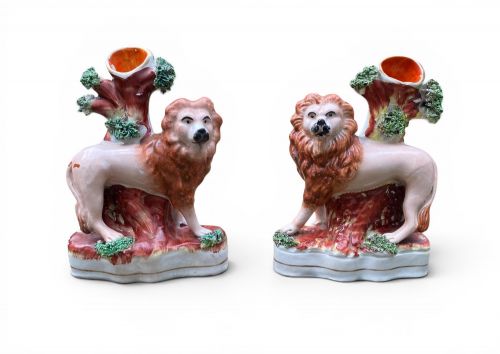
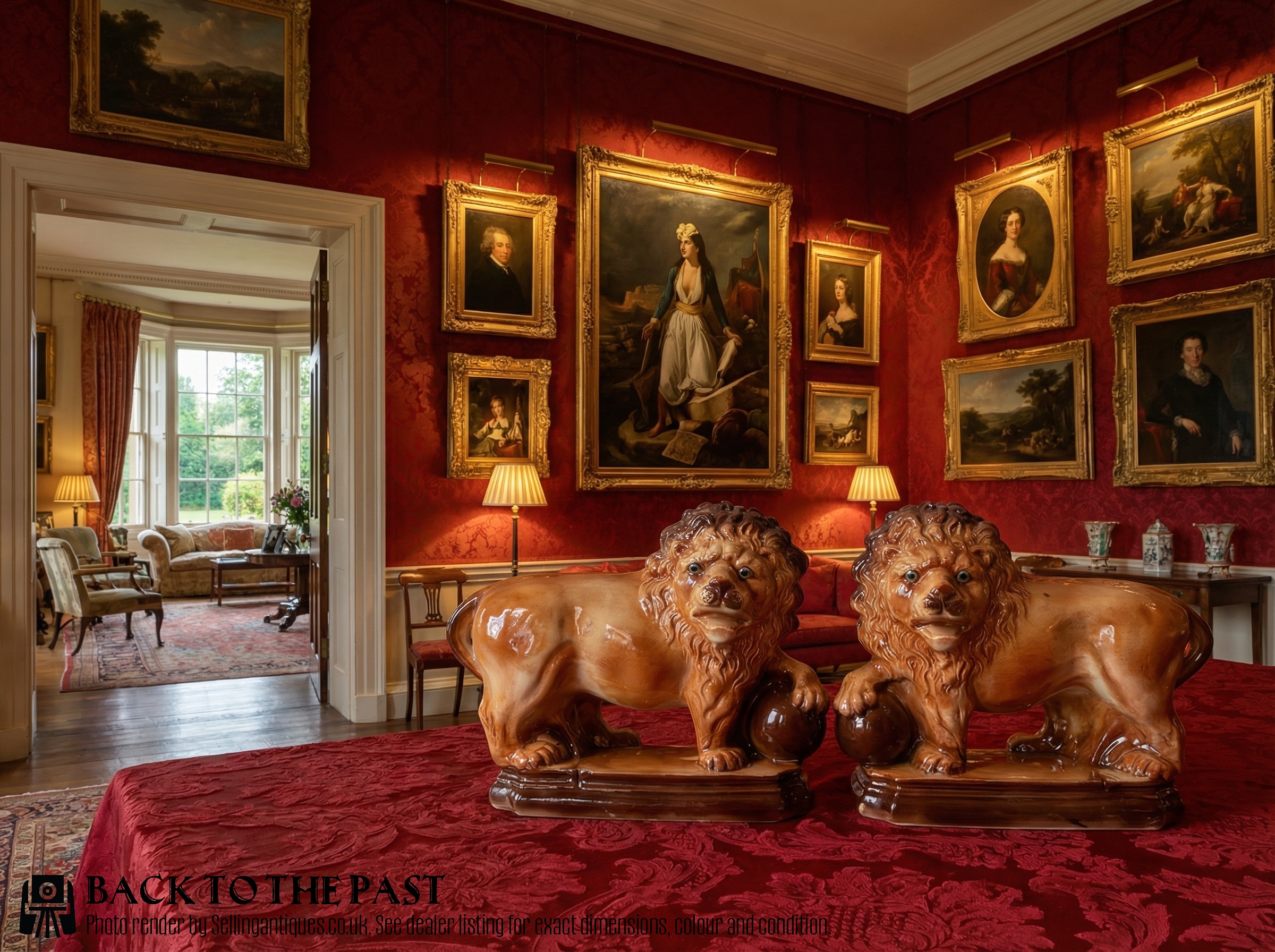
Staffordshire pottery lions appear primarily as decorative figurines, spill vases, and recumbent pairs intended for nineteenth-century domestic displays. These ceramic figures often draw directly on classical models such as the Medici lions, rendered in earthenware and creamware.
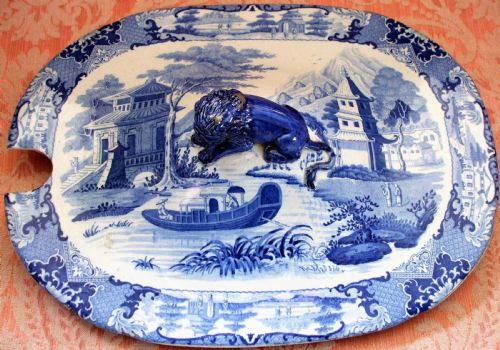
Makers produced these animals in various forms, including seated pairs, bookends, and specialised jelly moulds or vessels bearing lion mask handles. The inventory spans the nineteenth century, capturing changing Victorian tastes through figures, spill vases, and occasional historical scenes like the death of the lion queen.
Materials and production methods
Factories utilised moulding techniques to form pairs of lions and associated wares, finishing surfaces with characteristic glaze formulations. The resulting ceramic pieces combine moulded earthenware bodies with painted or printed surface details.
Listings feature earthenware, pearlware, and creamware bodies finished with lead, treacle, or blue and white transfer glaze.
Distinctions in quality
Quality rests upon the crispness of the moulding and the depth of the ceramic glaze, distinguishing sharper early nineteenth-century work from later mass production. Painted facial expressions and the application of gilding further separate standard decorative figures from superior modelled pairs.
Robert Hamilton·Lancaster and Sons of Hanley·Rogers·Thomas Parr
The Staffordshire Pottery Lions Glossary
- Medici lion
- A classical marble sculpture replica adapted by Staffordshire potters as a seated figure, typically produced in facing pairs. These models draw directly on the antique prototypes found in Florence.
- Treacle glaze
- A dark, translucent brown lead glaze that imparts a glossy, syrup-like finish to nineteenth-century earthenware. This rich surface treatment is frequently seen on nineteenth-century ceramic figures.
- Spill vase
- A hollow ceramic cylinder attached to a figure, designed to hold wooden spills for lighting fires. These practical additions sit directly behind or beside the modelled animal.
- Pearlware
- A refined earthenware developed in the late eighteenth century featuring a subtle bluish glaze cast over a pale body. Potters used this material for early figures before the widespread adoption of heavy Victorian enamels.
- Creamware
- A fine, cream-coloured earthenware perfected by English potters, valued for its warm tone and smooth lead glaze. It serves as an early base material for jelly moulds and decorative vessels.
Staffordshire Pottery Lions: Frequently Asked Questions
Are these lions always found in pairs?
Many of these ceramic figures survive as mirror-image pairs intended to sit at either end of a mantelpiece. Potters frequently moulded them facing left and right to balance domestic fireplace arrangements.
Single figures also appear, functioning independently as spill vases, jelly moulds, or bookends. The survival of a matched pair depends largely on their original use and subsequent history.
How do I identify a spill vase lion?
A spill vase version incorporates an upright cylindrical holder attached to the back or side of the animal's body. This open-topped tube served a practical purpose for holding wooden tapers used to light candles and fires.
Standard decorative figures lack this opening, presenting a solid modelled form meant solely for visual display. The addition of the vase changes the overall silhouette from a solid sculpture to a functional hearth accessory.
What distinguishes pearlware from later earthenware?
Pearlware exhibits a characteristic pale body under a thin glaze that pools with a faint bluish tint in crevices. This refined material predominates in the earlier segments of the nineteenth century.
Later Victorian pieces utilise heavier earthenware bodies paired with opaque glazes or dark treacle surfaces. Examining the base fabric and glaze pooling helps clarify the chronological placement of an individual piece.
How were treacle glazed lions finished?
Potters applied a dark, manganese-rich lead glaze over the moulded earthenware body before firing to achieve a deep, glossy brown colour. This technique created a reflective surface that accentuated the musculature and facial details of the lion.
Such treatment was popular across nineteenth-century workshops producing domestic shelf ornaments. The resulting finish provides a uniform, treacle-like sheen across the entire ceramic surface.