
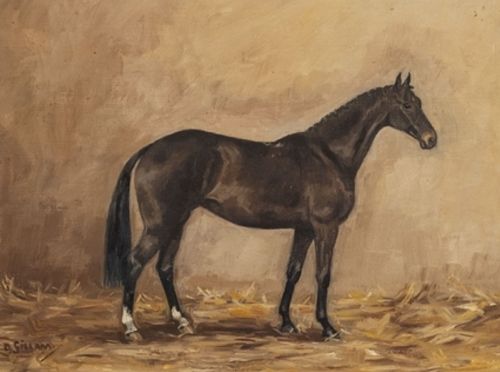

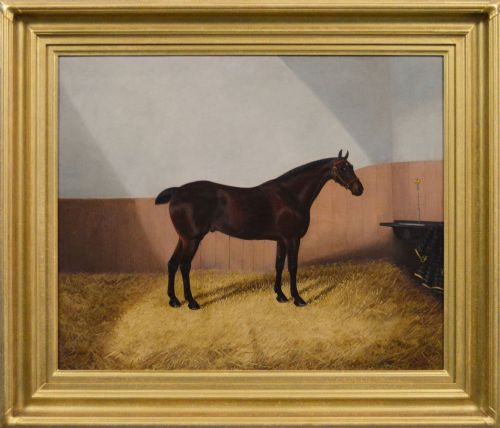
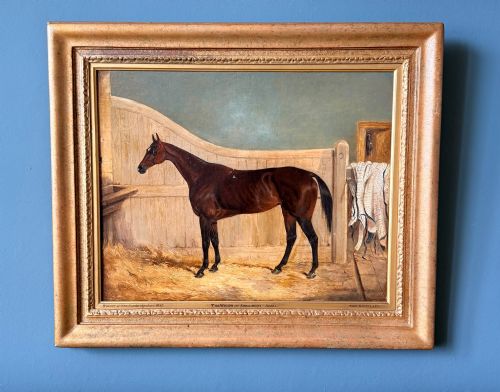


Stable Scene Oil Portrait
These stable scene oil portrait works capture equine and livestock subjects in their stalls, offering direct visual links to historical equestrian culture.
Stable Scene Oil Portrait
A stable scene oil portrait brings together equine subjects and their domestic quarters, rendered on canvas through traditional painting methods. Buyers seeking a stable scene oil portrait will encounter depictions of named hunters, stud horses, and working animals housed within interior stable settings.
The selections span the nineteenth century into the early twentieth century, encompassing Victorian sporting art, Victorian fine art, and English folk art styles. Pieces range from detailed studies of bay horses and strawberry grey roans to naive representations of cattle.
The primary forms found here are oil paintings executed on canvas, frequently retained within their period frames of gilt wood and giltwood plaster. These works document specific animals, often recording celebrated hunters and regional hunt stables alongside accompanying terriers.
Materials and construction methods
Artists painted these works using oil paint applied to stretched canvas surfaces, mounted on or supported by wooden stretching frames. The physical fabric of the paintings relies on traditional media that retain pigment depth and surface texture over generations.
Surrounding the canvases are heavy frames constructed from wood and finished with layers of gilt, plaster, and giltwood. These ornamental surrounds reflect the period framing techniques designed to complement nineteenth and early twentieth-century domestic interiors.
Listings span the nineteenth century and the Edwardian era, featuring oil paintings on canvas alongside gilt wood frames.
Distinctions in quality
Quality in these portraits rests upon the anatomical precision of the animal and the descriptive handling of the stable environment. Finer examples demonstrate careful attention to bone structure, musculature, and the play of light within a confined interior.
The handling of the frame also marks a division between standard pieces and high-end works, with elaborate giltwood and plaster mouldings indicating greater investment by the original commissioner. Conversely, simpler naive works rely on direct, unpretentious line rather than academic accuracy.
Albert Clark·Thomas Walker Bretland·George E Sharpe·Samuel Spode·Edwin Frederic Holt·Alfred Moginie Bryant
The Stable Scene Oil Portrait Glossary
- Bay
- A horse colour characterised by a reddish-brown body with a black mane, tail, and lower legs. This coat colour appears frequently in equestrian paintings.
- Roan
- A coat pattern of mixed white and coloured hairs, such as strawberry roan which blends white and chestnut hairs. It is a distinct marking noted in hunter portraits.
- Giltwood
- Wood that has been covered with a thin layer of gold leaf or gilt paint. Many nineteenth-century painting frames utilise this decorative finish.
- Naive art
- Art produced by an artist without formal academic training, often characterised by a flat perspective and direct expression. Such works form part of the folk art tradition.
- Equestrian
- Pertaining to horses, horse riding, and horse breeding. This category defines much of the sporting art produced during the Victorian period.
Stable Scene Oil Portrait: Frequently Asked Questions
What is a stable scene oil portrait?
A stable scene oil portrait is a painted canvas depicting a horse or livestock animal inside a stable interior, produced primarily during the nineteenth and early twentieth centuries.
These works often record specific named hunters, prize-winning animals, or horses associated with particular regional hunt stables.
How were these paintings used?
Owners commissioned these portraits to document prized hunters, stud animals, and sporting horses that held significant value within agricultural and sporting communities.
They were displayed in country houses, estate offices, and hunting lodges as expressions of equestrian status and sporting pride.
How do I date a stable scene painting?
Dating relies on stylistic evidence, costume details of handlers, frame construction, and inscriptions naming specific horses or historical winners.
Catalogues and signatures on the canvas, alongside period designations such as Victorian or Edwardian, provide further chronological markers.
How do I live with these paintings?
Displaying these works requires avoiding direct sunlight and excessive humidity to protect both the oil canvas and the delicate giltwood frame.
They pair well with traditional interiors, wood-panelled rooms, and spaces dedicated to sporting or equestrian decor.