
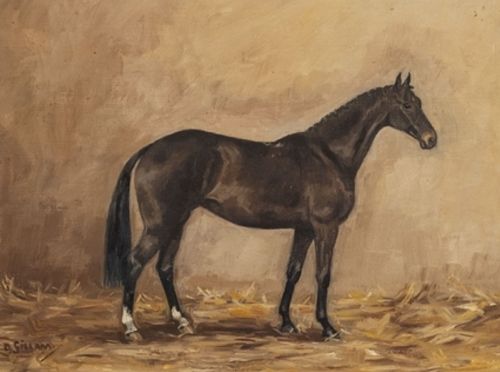
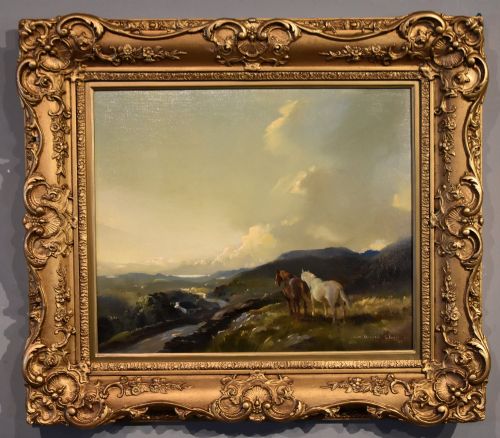


Signed Horse Oil Painting
A signed horse oil painting brings rural life and equestrian tradition onto the wall with depth and character.
Signed Horse Oil Painting
A signed horse oil painting captures equine subjects and rural scenes across the eighteenth, nineteenth, and twentieth centuries. These works range from detailed portraits of individual bay hunters to energetic depictions of fox hunting and farm labour.
The pieces appearing here include depictions of shire horses, racing scenes, and coaching landscapes executed by named artists and regional painters. Buyers encounter works rendered on canvas, wood panel, and board from periods spanning Georgian elegance to mid-century modernism.
The scope encompasses British sporting art, French impressionism, and naïve rustic compositions. Each signed canvas offers a distinct window into historical relationships between humans, horses, and the British countryside.
Materials and Construction
Artists built these works using oil paint applied to canvas, wood panels, or timber boards prepared with gesso grounds. The medium allowed painters to build rich textures and deep tones that capture the musculature of horses and the shifting light of outdoor landscapes.
Many of the period frames utilise giltwood moulding to complement the depth of the painted surface. Panels of pine or oak provided sturdy supports for earlier nineteenth and eighteenth-century compositions before canvas on stretchers became standard.
Several canvases include diligent farmyard dogs sharing the frame with working horses.
Distinctions in Execution
Quality rests upon the anatomical precision of the horse and the handling of light within the surrounding landscape. Skilled painters capture tension in the animal's posture and balance the composition between foreground figures and distant scenery.
The clarity of the signature and the preservation of the original paint surface influence the standing of a piece. Works retaining their initial wooden panels or period giltwood frames maintain greater contextual integrity.
Vernon DeBeauvoir Ward·W Williams·Philip Henry Rideout·Herbert Royle·Walter Herbert Wheeler·B J Burrows·Edmund Bristow·Basil Nightingale·Wilson Hepple
The Signed Horse Oil Painting Glossary
- Oil on Canvas
- A traditional painting technique where pigment mixed with drying oil is applied to a stretched cloth support. This method permits subtle blending and rich impasto effects.
- Giltwood
- Timber carved and coated with a thin layer of gold leaf or metal powder. It frequently frames nineteenth-century equestrian art to provide a reflective border.
- Pine Panel
- A solid wooden board used as a rigid support for paintings before canvas predominated. It offers a smooth, stable surface for detailed brushwork.
- British Sporting Art
- A genre focusing on horses, hounds, shooting, and rural sports. It flourished across the eighteenth and nineteenth centuries to document country pursuits.
- Gesso
- A paint mixture consisting of a binder mixed with chalk, gypsum, or pigment. It prepares wooden panels and canvas surfaces to receive oil paint.
Signed Horse Oil Painting: Frequently Asked Questions
How do I date an equestrian painting?
Dating relies on costume details, harness styles, and the construction methods of the canvas support or wooden panel. Frame types and artist signatures also provide key chronological markers.
Comparison with documented works by the same hand helps narrow the decade of creation.
Where should I hang a horse oil painting?
These works suit traditional reception rooms, libraries, or studies where their rich earth tones complement timber furniture and book-lined walls. Adequate wall space allows larger canvases, such as shire horse scenes, to command the room.
Avoid placing oil paintings in direct sunlight or above active heat sources to protect the canvas and paint layers.
What is British sporting art?
British sporting art encompasses paintings that record horses, hunting, racing, and rural pastimes, particularly from the Georgian and Victorian eras. Artists in this tradition combined precise anatomical knowledge with atmospheric landscape painting.
These works served both as records of prized animals and as celebrations of country life.