
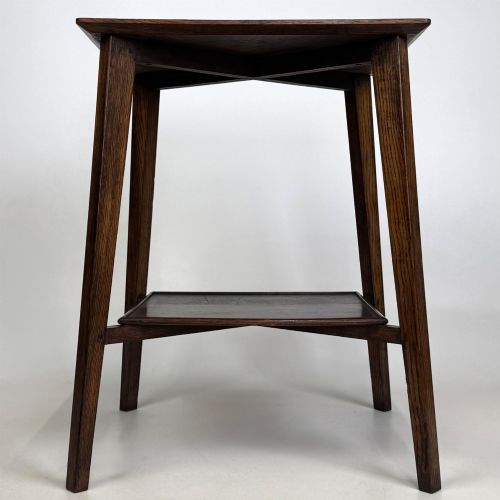
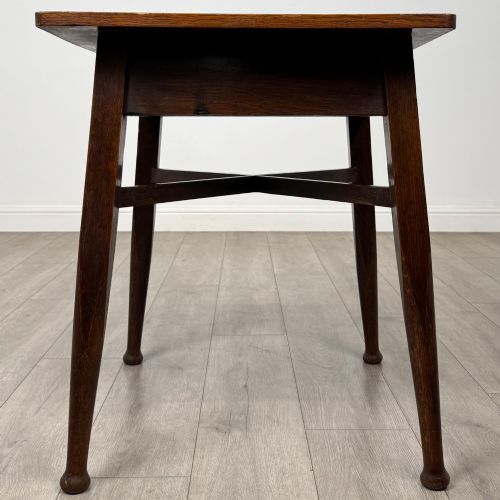
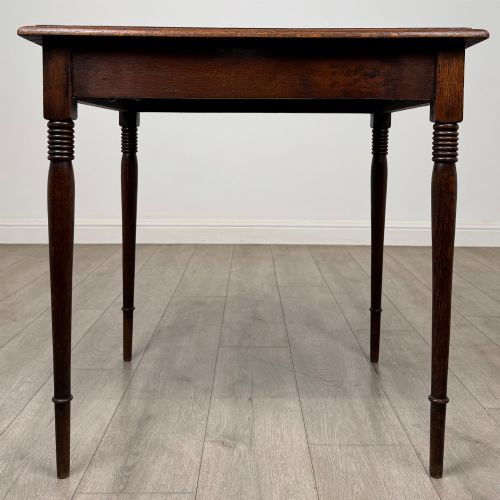

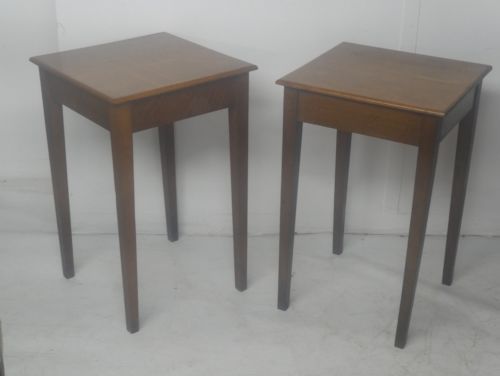


Square Oak End Table
These square oak end table examples bring honest utility and distinct period character to a room, offering sturdy surfaces built to last.

Square Oak End Table
A square oak end table brings compact wooden utility to a seating area, appearing across Edwardian, Art Deco, and Arts and Crafts designs. Buyers searching for a square oak end table will most frequently encounter Edwardian side tables and early twentieth-century occasional pieces.
The selections span functional side tables, occasional tables, lamp tables, and nesting sets. Origins range from Scottish country workshops to defined Arts and Crafts and Jacobean Revival movements.
Dated examples stretch from the late nineteenth century through the 1930s. The forms remain consistently proportioned for placement beside chairs and sofas.
Materials and construction methods
Solid oak provides the primary structural timber across these listings, occasionally paired with ceramic tile inserts or wood veneer surfaces. Craftsmanship relies on traditional joinery methods suited to domestic furniture.
Maker execution includes handmade carved details and distinctive turned supports such as barley twist legs. Construction varies from rustic country framing to refined period studio work.
Current listings feature oak as the primary timber, complemented by ceramic tile and wood veneer surfaces across Edwardian and Art Deco styles.
Judging execution and design
Quality separates in the crispness of hand-carved detailing and the selection of timber grain. Pieces attributed to specific designers or distinct regional workshops command greater attention from discerning collectors.
Subtle differences in leg turning, such as well-proportioned barley twist supports, distinguish superior examples from standard production pieces. The integration of materials like ceramic tiles alters the overall decorative success of a table.
Baillie Scott
The Square Oak End Table Glossary
- Edwardian
- A stylistic period spanning the reign of King Edward VII, noted for lighter furniture forms than the preceding Victorian era. It frequently reinterprets earlier historic styles with restrained elegance.
- Arts and Crafts
- A design movement prioritising traditional craftsmanship and simple forms over mass production. It values visible construction methods and honest use of natural materials.
- Art Deco
- A twentieth-century design style characterised by sleek geometric shapes and stylised decoration. It emerges in furniture forms from the nineteen-twenties and thirties.
- Barley Twist
- A type of furniture leg turned in a helical screw pattern resembling a twisted rope. This decorative turning appears frequently on early twentieth-century wooden tables.
- Occasional Table
- A light, movable table designed for specific, intermittent use rather than central domestic placement. These versatile surfaces suit sitting rooms and halls.
Square Oak End Table: Frequently Asked Questions
What periods do these tables come from?
The available pieces span the late nineteenth century, the Edwardian era, and through the nineteen-twenties and thirties. They reflect distinct aesthetic shifts from traditional revivals to modernist departures.
Most items cluster around the Edwardian period and the interwar decades, showing how domestic furniture tastes evolved over forty years.
Where should I place a small wooden table?
These compact surfaces fit easily beside armchairs, sofas, or in narrow hallways where floor space is limited. Their square tops provide a stable spot for lamps, books, or drinks.
They work effectively as standalone accent pieces or paired as lamp tables depending on the room layout.
How do I identify an Arts and Crafts piece?
Look for visible construction joints, honest material selection, and an absence of excessive surface ornamentation. These items emphasise structural integrity and handmade character.
Design influences often draw inspiration from regional traditions and simplified historical motifs.
What is a nest of tables?
A nest comprises a set of graduated tables designed to slide neatly beneath one another when not in use. This clever arrangement saves floor space in smaller rooms.
They provide flexible surface area for entertaining while occupying the footprint of a single small table.