


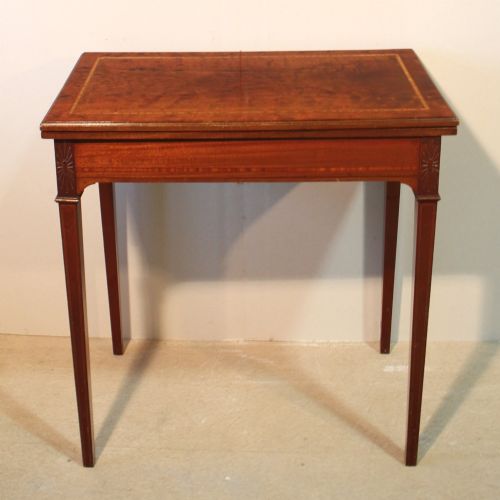


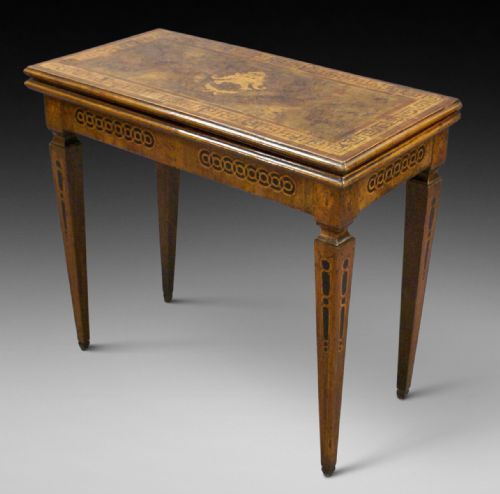
Square Leg Card Table
Square leg card table pieces combine ingenious folding mechanisms with rich timber surfaces, offering versatile furniture that transforms from a compact console into a playing surface.
Square Leg Card Table
A square leg card table is a foldable piece designed for games and social gatherings, appearing primarily in mahogany alongside oak and walnut. These tables span several eras, stretching from eighteenth-century Georgian designs through the nineteenth century into Edwardian revivals.
The version most commonly met on this page is the Edwardian mahogany variation, often featuring delicate inlay work and a fold-over top. Alongside standard card tables, the listings include related forms such as envelope tables, tea tables, and flip-top side tables with straight, square supports.
Materials and construction methods
Makers constructed these tables predominantly from solid mahogany and wood veneer, frequently embellishing the surfaces with boxwood and satinwood inlay. Brass components appear in the mechanisms and hinges that allow the folding tops to operate smoothly.
Joinery techniques enabled clever folding actions, including concertina actions and rotating envelope tops that reveal hidden interior wells. Secondary timbers such as oak and fruitwood support the internal framework beneath the polished primary veneers.
Several tables transform like wooden puzzles, unfolding compartments that make you wonder where the cards actually went.
Judging quality and craftsmanship
Quality rests in the precision of the folding mechanism and the crispness of the timber inlay. Superior examples maintain structural integrity in their square legs while offering seamless alignment when the top is unfolded.
The refinement of the secondary woods and the subtlety of the satinwood and boxwood stringing separate fine cabinetmaking from simpler production. Better pieces preserve their original polished finish and operate without stiffness in the hinges.
The Square Leg Card Table Glossary
- Concertina action
- An expanding frame mechanism that allows a card table to open on four legs rather than two, providing greater stability when fully extended. This clever engineering requires precise hinge placement.
- Envelope table
- A square card table with a top composed of four triangular flaps that swivel and fold open to reveal a baize-lined interior. This clever design gained popularity during the Edwardian period.
- Stringing
- Thin lines of contrasting wood inlay, such as boxwood or satinwood, set into channels in the primary timber. This technique defines the edges and geometric panels of the top.
- Flip-top
- A hinged table top that rotates and folds flat against the base to form a console or side table when not in use. It is the defining feature of the standard card table.
- Inlay
- A decorative technique where pieces of contrasting wood are fitted into the surface of a panel to create patterns. Satinwood and boxwood provide pale contrast against dark mahogany.
Square Leg Card Table: Frequently Asked Questions
How do I operate the folding top?
Most tables use a swivel, flip, or concertina action to reveal the playing surface inside. Lift the top section carefully and rotate or pull the rear frame to support the opened leaf.
Ensure the supporting leg or concertina frame is fully extended before placing any weight onto the expanded table surface.
What woods were used to make them?
Mahogany is the primary timber found across these listings, accompanied by oak, walnut, and fruitwood veneers. Decorative details often incorporate contrasting lighter woods like satinwood and boxwood.
Internal framing and secondary components may utilise sturdier utility timbers to support the folding hardware and heavy tops.
How do I distinguish Edwardian from Georgian examples?
Georgian tables often feature heavier proportions, rich dark mahogany, and restrained carving or simple cockbeaded edges. Edwardian pieces, particularly Sheraton revivals, lean toward lighter framing, extensive satinwood stringing, and sometimes novel envelope mechanisms.
Examine the sharpness of the inlay work and the thickness of the timber components to help determine the period.
Can these tables still be used for games?
Yes, many retain sturdy frames and level surfaces suitable for card games or general display use. The hinged leaves are designed to bear normal weight once properly supported by the extended frame or swing leg.
Care should be taken not to force stiff hinges on pieces that have rested in a closed position for long periods.