
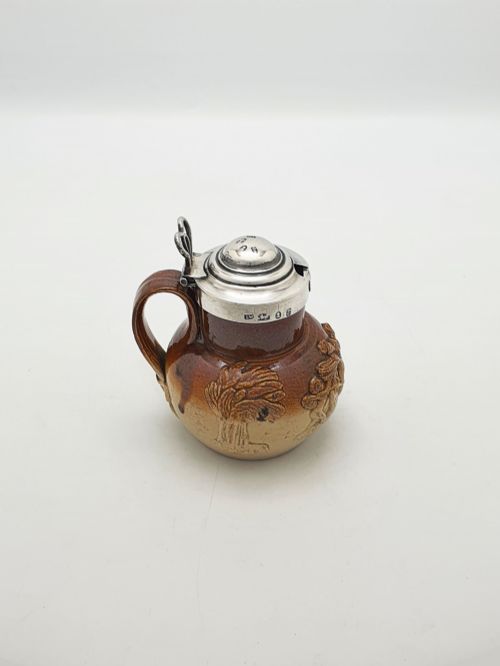
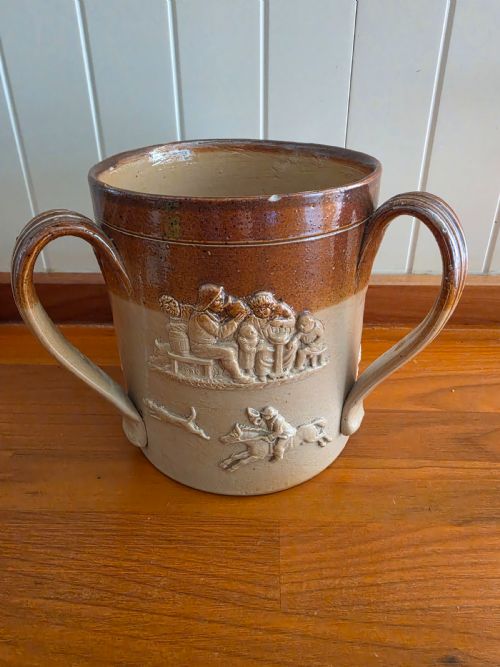


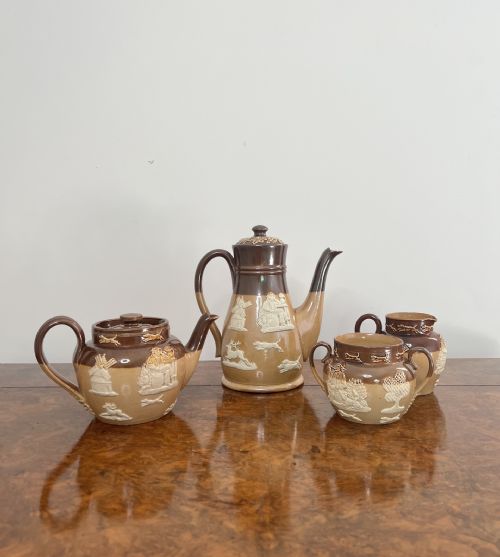


Sprigged Stoneware Pitcher
A sprigged stoneware pitcher brings heavy salt-glazed texture, applied moulded reliefs and earthy utilitarian heft straight to the Victorian or Georgian table.
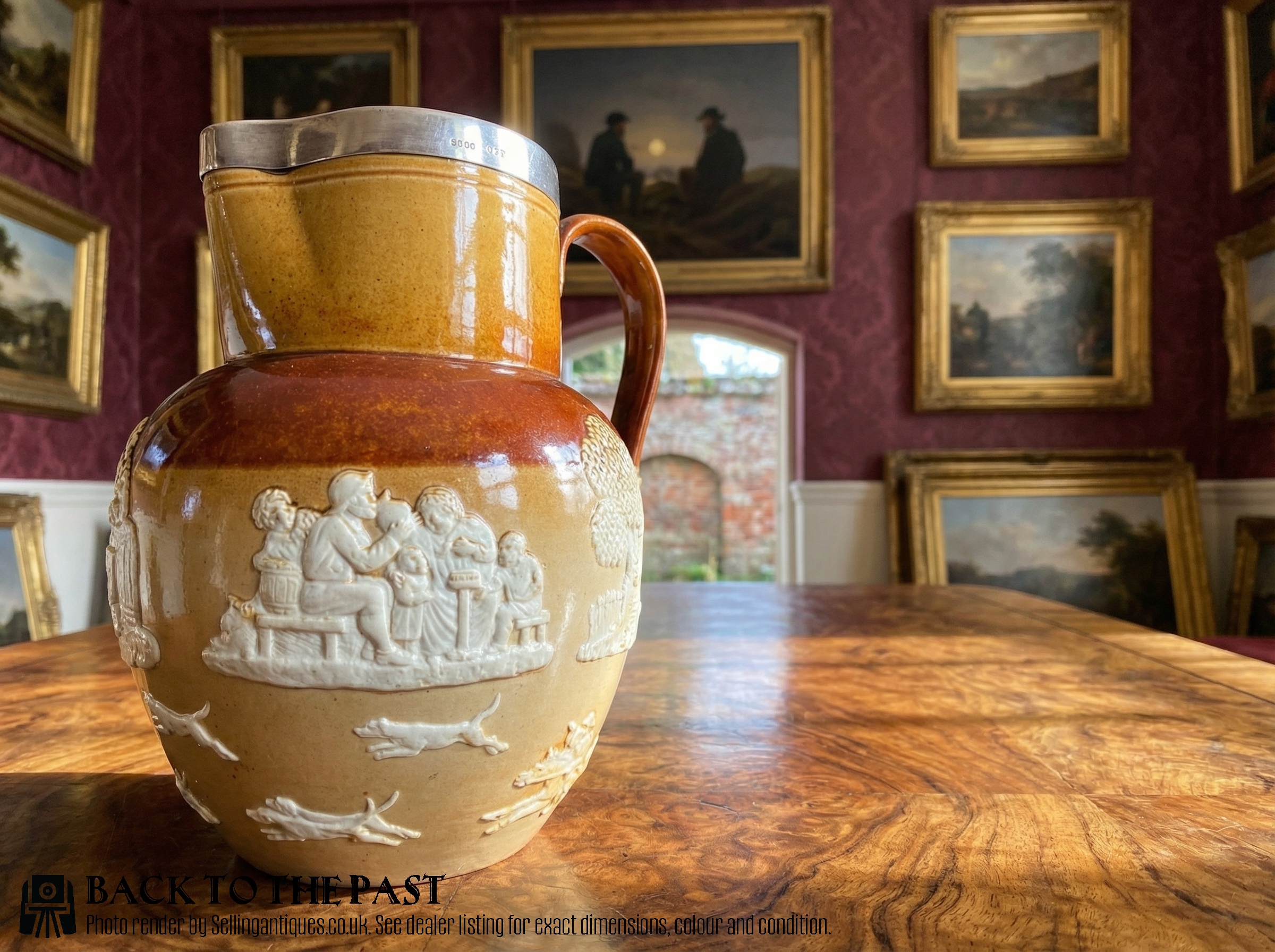
Sprigged Stoneware Pitcher
A sprigged stoneware pitcher is a robust ceramic vessel shaped for pouring, defined by its dense, vitrified body and distinct raised decorative motifs applied by hand before firing. These items range from compact harvest jugs and tavern vessels to large exhibition pieces, featuring in styles from English country pottery to Victorian folk art.
Most pieces seen here belong to the nineteenth century, including specific dates around eighteen hundred, eighteen eighty, and eighteen ninety. Collectors encounter robust three-handled tygs, graduated sets, and complete tea and coffee services alongside single pouring jugs.
Origins span notable English potteries and regional traditions, encompassing Doulton Lambeth, Mortlake, Bridgewater, Copeland Spode, and Staffordshire. Many incorporate functional additions such as sterling silver collars, hinged lids, and silver-plated mounts.
Materials and construction methods
Potters built these vessels using dense clay and stoneware bodies, often finished with salt glazes, lead glaze, or cream-coloured surfaces. The hard-fired ceramic provides a durable, impermeable structure suited to holding ale, water, or tea.
Decoration relies on sprigging, a technique where separately moulded clay reliefs are pressed onto the leather-hard body of the vessel prior to firing. Artisans then completed the form with applied handles and, where specified, fitted sterling silver or silver-plated rims and hinged lids.
Recorded styles include Victorian, Georgian, English Country Pottery, and Victorian Folk Art, taking the form of jugs, pitchers, tygs, and tea sets.
Assessing quality in stoneware pitchers
Quality rests in the crispness of the applied sprigged motifs and the balanced proportions of the thrown body. Sharp, well-defined relief work demonstrates greater skill from the modeller than soft or blurred ornamentation.
The integration of metalwork elevates certain pieces, where hallmarked sterling silver collars and substantial hinged lids fit seamlessly against the ceramic rim. Sets that remain together as graduated groups or complete tea services show a higher degree of original survival.
Doulton Lambeth·Mortlake·Bridgewater·Copeland Spode·Staffordshire
The Sprigged Stoneware Pitcher Glossary
- Sprigging
- The technique of moulding small clay ornaments separately and applying them to the surface of an unfired vessel with slip. This method creates raised decorative friezes of figures, foliage, or hunting scenes.
- Stoneware
- A hard, vitrified pottery fired at high temperatures until the clay body becomes non-porous and dense. It resists liquids completely without needing an interior glaze.
- Salt glaze
- A glassy, pitted texture formed by throwing common salt into the kiln during high-temperature firing. The sodium reacts with the silica in the clay to produce an orange-peel surface.
- Tyg
- A large drinking vessel featuring three or more handles designed for communal passing around a table. These sturdy pots date back centuries and frequently appear in regional earthenware and stoneware.
- Graduated set
- A group of matching vessels made in incremental sizes that nest together for storage. These sets demonstrate consistent workshop output and decorative design.
Sprigged Stoneware Pitcher: Frequently Asked Questions
What is a sprigged stoneware pitcher?
A sprigged stoneware pitcher is a durable ceramic pouring vessel decorated with raised clay motifs that were moulded separately and applied to the surface before firing. These pieces typically date from the nineteenth century and reflect utilitarian or tavern origins.
They combine dense, salt-glazed bodies with functional forms, sometimes finished with silver rims or hinged lids for serving ale and other beverages.
How do I date a stoneware jug?
Dating relies on stylistic markers, manufacturing techniques, and any accompanying hallmarks on silver mounts. Nineteenth-century examples often feature distinct salt glazes, sprigged hunting or harvest scenes, and maker marks associated with potteries like Doulton.
Objects with hallmarked sterling silver collars provide a precise year of manufacture based on the assay office date letters stamped into the metal.
Were these pitchers used for daily dining?
These vessels served practical roles in taverns and homes for holding and pouring ale, water, or hot liquids. Their robust stoneware construction made them resilient enough for heavy everyday use.
Larger exhibition pieces and those mounted with silver hardware likely held a more ornamental or prized status in domestic settings compared to standard tavern jugs.
How should I care for antique stoneware?
Antique stoneware requires gentle cleaning with warm water and a soft cloth to protect the ceramic body and any applied sprigged details. Harsh chemical cleaners or abrasive scouring pads must be avoided.
If the piece includes a sterling silver or silver-plated collar, appropriate metal polish applied carefully away from the ceramic will maintain the finish.