


Sonnerie Carriage Clock
A sonnerie carriage clock is a mechanical portable timekeeper that strikes the hours and quarters automatically, valued by collectors for its intricate complications and brass-and-glass housing.
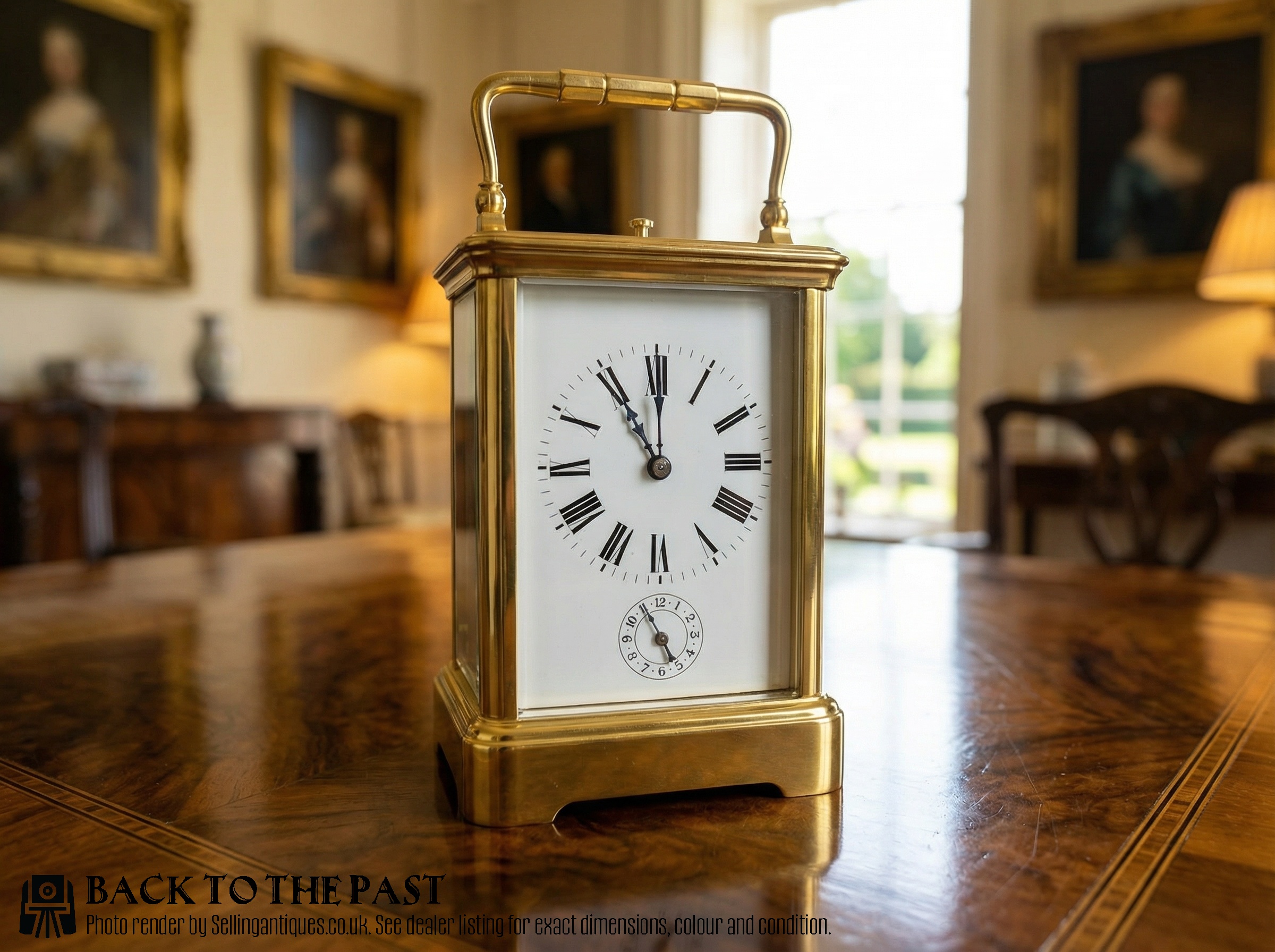
Sonnerie Carriage Clock
A sonnerie carriage clock represents a pinnacle of nineteenth-century horology, housed in a polished metal framework with bevelled glass panes that expose the movement within. These portable timepieces originated primarily in France and Britain during the Victorian era, spanning decades from the mid-nineteenth century through the late eighteen-nineties.
The versions most commonly met on this page are French examples featuring gorge cases, enamel dials, and complex striking trains. They often include additional complications such as alarm mechanisms, date work, moon phases, or repeaters that chime the hours and quarters on demand.
Materials and technique
The construction relies on heavy brass and gilded brass frameworks fitted with clear glass windows that protect the delicate gear trains. These metals are frequently polished or given original gilding to create a brilliant exterior finish that matches the precision of the inner mechanics.
Dials are typically constructed from white enamel with painted Roman or Arabic numerals, paired with finely blued steel hands. Internal movements incorporate brass plates, steel pivots, and occasionally engraved platforms or bells to manage the intricate sonnerie striking functions.
Some tiny travelling clocks come with their original boxes, proving that nineteenth-century owners worried about baggage handlers just as much as we do.
Factors that define quality
Quality in a sonnerie carriage clock is determined by the complexity of the movement and the crispness of its execution. Pieces featuring both grand and petite sonnerie striking, alongside additional complications like date work or moon phases, sit at the upper end of the range.
The integrity of the original case, the presence of matching keys and fitted travel boxes, and the reputation of the maker or retailer all elevate a piece. Finer examples display superior engraving on the brass framework and retain their original gilding and enamel dials without restoration.
J. F. Bautte Et Cie·Bourdin, Paris·Moser·J.W. Benson·Hunt & Roskell·Drocourt·Dent·Henri Jacot·Idrac Le Roy·Richard & Co·Asprey·Baumann Vienna·Margaine
The Sonnerie Carriage Clock Glossary
- Grand sonnerie
- A striking mechanism that automatically chimes both the hours and the passing quarters on every quarter-hour. This complex arrangement requires multiple barrels and gear trains within the clock.
- Petite sonnerie
- A striking mechanism that chimes the hours on the hour and only the quarters on the quarter-hours without repeating the previous hours. It offers a slightly simplified striking train compared to the grand sonnerie.
- Gorge case
- A distinctively shaped rectangular carriage clock case with stepped mouldings to the top and bottom frame. This style is frequently encountered on nineteenth-century French pieces.
- Repeating
- A mechanism activated by pushing a button on the case that causes the clock to restrike the last hour and quarter on demand. This function allowed owners to check the time in the dark.
- Mignonette
- A term used to describe a miniature carriage clock. These smaller versions demand exceptional miniaturisation of the sonnerie mechanics.
Sonnerie Carriage Clock: Frequently Asked Questions
What is a sonnerie carriage clock?
A sonnerie carriage clock is a portable mechanical timekeeper that automatically strikes the hours and quarters without manual intervention. They were designed for travellers and well-to-do households in the nineteenth century.
These clocks combine solid brass frameworks with glass panels and complex gear trains. Their ability to chime the time autonomously distinguishes them from standard time-only carriage clocks.
How do grand and petite sonnerie differ?
A grand sonnerie mechanism chimes the hours and the current quarters at every quarter-hour interval. This means at three-quarters past the hour, it sounds the three quarters followed by the preceding hour.
A petite sonnerie strikes only the quarters as they pass and sounds the full hour only when the hour is actually reached. Both systems represent advanced horological skill from the Victorian period.
How do I wind and set my clock?
Winding is performed using a matching key inserted into the winding arbors located on the back plate of the movement. Care must be taken not to over-wind the mainsprings.
Time setting should be done by moving the minute hand gently in a clockwise direction. Avoid turning hands backwards through striking sequences to protect the internal levers.
Where should I place a carriage clock?
Place the clock on a stable, level surface away from direct sunlight, excessive heat sources, and damp environments. A mantelpiece or a secure desk provides an ideal stable platform.
Because these are mechanical antiques, stability ensures the pendulum or escapement beats evenly. Levelling the clock correctly keeps the strike train synchronised with the timekeeping.
How can I tell the period?
Dating relies on stylistic clues in the case design, escapement type, and maker signatures recorded on the movement or dial. Mid-nineteenth-century examples often feature heavier platforms and distinct escapement forms.
Signatures from makers like Drocourt or Henri Jacot help narrow down the decade of production. Original retailer marks and fitted leather travel cases also point towards specific Victorian eras.